How to catch up on retirement savings at every age

Nerre Shuriah
JD, LLM, CM&AA, CBEC® | Senior Director of Wealth Content and Knowledge
When it comes to saving for retirement, it's easy to feel like you're behind. But even small steps today can help you build momentum over time. The sooner you start, the more time your retirement savings has to grow.

Whether you're starting from scratch in your 20s, catching up after a setback in your 30s or 40s or looking to maximize your savings in your 50s and 60s, your retirement goals are still within reach. These strategies can help you catch up on retirement savings at any age.
Key takeaways
- There are practical ways to build and catch up on retirement savings, regardless of your age.
- Contributing consistently, capturing employer matches and maximizing tax-advantaged accounts can strengthen your retirement readiness.
- As retirement approaches, take advantage of catch-up contributions and other opportunities to maximize your savings.
In your 20s
If you're just beginning your career, a good rule of thumb is to save 15% of your pretax income for retirement. But when you're juggling living expenses and student debt on an entry-level salary, it may not feel realistic. Still, starting early—even with small contributions—can have a significant impact on your financial future.
There are a few ways to start working toward your goals in your 20s while balancing a modest income and essential expenses—even if you currently have no retirement savings.
Save what you can
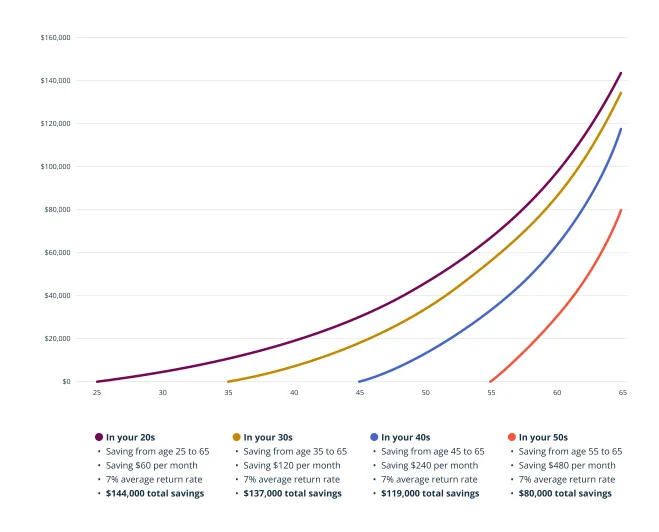
Thanks to the power of compound interest, even small contributions made during your 20s can have a sizable impact over time. For example, if you were to invest just $60 per month in an employer-sponsored 401(k) plan starting at age 25 and earn a 7% average annual rate of return—which is the historical average for long-term investments in the stock market after adjusting for inflation—you'd have roughly $144,000 at age 65. If your employer were to match 50% of your retirement contributions to the 401(k) for the duration of this period, your savings could grow to $215,621.
Focus on growth-oriented investments
In your 20s, you have a longer time to ride out market fluctuations—so it might make sense to be more aggressive with your investment strategy. Depending on your risk tolerance, you might consider allocating a larger share of your investments to assets like stocks. While they tend to fluctuate more, they often outperform other asset classes over the long term.
In your 30s
By your 30s, your income may be growing—along with your financial responsibilities. Major milestones like getting married, buying your first home and raising children can put pressure on your budget, and you may still be paying down your student loans.
While this can make it harder to prioritize saving for the future, it's still important to contribute what you can. The good news is you still have time on your side, and consistent saving can help you benefit from compounding and long-term growth.
These tactics can help you catch up on retirement savings in your 30s.
Set a retirement savings goal
While retirement may still seem far off, setting a target now can help guide your financial decisions and keep you motivated—especially if you're managing debt. A retirement savings calculator can help you estimate how much you'll need based on your expected retirement age and future income needs.
Create a simple retirement savings plan
Once you have a goal in mind, create a basic retirement savings plan to help keep you on track toward your recommended retirement savings by age. This includes deciding how much to save each month and choosing the right accounts for your needs. Your retirement plan can also guide other financial decisions—like how much home or car you can afford—by setting clear spending limits based on what you've committed to save.
Max out employer matching
If you're wondering how to boost retirement savings, start by taking full advantage of employer contributions if they're available. Employer matching is essentially free money that can significantly boost your retirement savings over time, making it a great way to maximize retirement savings at any age.
Automate your retirement savings
Automating your contributions can make it easier to maximize retirement savings. Some employer-sponsored plans may also allow you to set a percentage of your salary for retirement contributions. This will automatically increase your contributions whenever you receive a raise. Check with your plan administrator to confirm how your contributions are determined.
Find the right balance
If you carry a significant amount of debt, it can be tempting to put your retirement savings on hold. But deciding whether to save or pay off debt isn't an all-or-nothing proposition—it's a balancing act. The key is to look for ways to amplify your actions, such as taking advantage of employer matching. Even small, consistent contributions can help you build momentum over time.
In your 40s
Now that you're more established in your career, you might have a greater sense of financial stability—and a bit more disposable income. If you didn't save much in your 20s and 30s, it's time to kick your retirement contributions into high gear.
While your runway to retirement may be a bit shorter than it once was, you still have a few decades to grow your savings. Here are a few ways to catch up on retirement savings in your 40s.
Beware of lifestyle creep
In your prime earning years, lifestyle creep can quickly take hold. As your income increases, spending on nonessential items like high-end renovations and upgraded cars can rise just as quickly—often without you noticing.
One way to boost your retirement savings in your 40s is to identify and trim unnecessary expenses, then redirect that money into your retirement accounts. These changes don't have to impact your day-to-day lifestyle, but they can make a meaningful difference over time. For example, investing an extra $200 a month at a 7% average annual return could add nearly $100,000 to your retirement nest egg over the next 20 years.
Coordinate with your spouse
If you're saving for retirement with a spouse or partner, consider taking a household approach to retirement planning. If one of you has access to more generous workplace retirement benefits, it may make sense to prioritize contributions to that account. Likewise, if either of you expects to receive a pension, you may want to direct more of your savings to the other spouse's retirement account to help strengthen your household's retirement security.
Consider an IRA
If you're maxing out contributions to your 401(k) or primary retirement plan, it may be time to consider an individual retirement account, or IRA. IRAs are tax-advantaged accounts that can help you save even more for retirement.
Both Roth and traditional IRAs offer distinct tax benefits and a wide range of investment options, making them a powerful way to boost or catch up on retirement savings. Plus, unlike workplace retirement plans, most people with earned income may be eligible to contribute. In some cases, a nonworking spouse may also be able to save through a spousal IRA.
In your 50s
Your 50s are an important time to buckle down and ensure you're well prepared for retirement. While your salary may be at an all-time high, you could be facing new—and potentially unexpected—financial burdens. Here are some tips for catching up on retirement savings in your 50s.
Take advantage of catch-up contributions
The IRS allows individuals age 50 and older to make additional contributions to their 401(k), IRA and other retirement plans. Known as catch-up contributions, these exceed standard retirement plan contribution limits—making them a great way to maximize your retirement savings in your 50s and beyond. Our annual guide to retirement plan limits lists up-to-date information on catch-up contributions and contribution limits for most types of retirement accounts.
Explore additional tax-advantaged vehicles
If you're already maxing out contributions to your primary retirement plans, there are still several avenues you can explore to catch up on retirement savings in your 50s. These include:
- Employing a backdoor IRA strategy
- Purchasing indexed life insurance
- Maximizing your health savings account contributions
- Purchasing and contributing to a tax-deferred annuity
The best options for you will depend on a range of factors. Discussing these strategies with a financial advisor can help you decide which course of action will be the most effective at your life stage.
Prioritize your financial future
According to the Pew Research Center, 36% of Americans in their 50s are financially supporting a child while also caring for an elderly parent. For many, this can significantly impact their ability to save for retirement. If you're struggling with dueling financial obligations, consider speaking with an advisor. They can help you create a plan that helps you prioritize your future while meeting your current financial obligations.
In your 60s
With retirement on the horizon, many people struggle with how to catch up on retirement savings in their 60s. There are a few strategies that may help you maximize your savings during this time.
Take advantage of super-catch-up contributions
Between ages of 60 and 63, the SECURE 2.0 Act allows you to make enhanced catch-up contributions—up to an additional $10,000 annually to certain retirement plans. These higher limits build on the standard catch-up contributions available starting in your 50s, giving you an opportunity to boost your savings as you get closer to retirement.
Protect your savings
Your 60s are an important time to reassess your risk tolerance. Look for ways to defend your existing retirement savings against market volatility while still generating income for retirement. If you're planning for retirement with a spouse or partner, this can also be a good time to discuss your investment strategies together. Aligning your risk tolerance and overall approach to investing can help ensure you're working toward the same long-term goals. For some, this might mean shifting a portion of their portfolio into more conservative investments.
Coordinate your retirement timing
If you're married, be sure to coordinate your plans. Decisions like when each of you will retire, when to claim Social Security and whether one spouse will continue working can have a significant impact on your long-term financial picture. If one spouse has a pension or is eligible for Social Security benefits, carefully coordinating your claiming strategy may help maximize your household's retirement income.
Rethink your retirement plans
If necessary, consider working a few extra years to give your savings more time to grow. For example, you might step back from your full-time job but continue to earn extra income through consulting work. This can help boost your retirement savings while also reducing the number of years you'll need to rely on these funds.
Consider a Roth conversion
If you're in a lower tax bracket now than you expect to be in retirement, you may want to consider converting some of your retirement savings to a Roth IRA. Although you'll be hit with an immediate tax bill on the conversion amount, qualified withdrawals in retirement will be tax-free. Plus, the funds will continue to grow tax-free within the Roth account. Be sure to consult with a tax specialist to see if a Roth conversion is right for you.
The bottom line
No matter where you are in your savings journey, it's not too late to make meaningful progress toward your retirement goals. Small, consistent actions—paired with the right strategy—can help you build momentum over time.
If you're feeling behind on retirement savings, working with a financial advisor can provide added clarity and guidance. They can help you prioritize your next steps, identify opportunities to maximize your savings and create a plan to help you catch up—so you can move forward with a clearer path to retirement.
Quick tips to save more for retirement as you age
Only have a minute or two? Watch our video to get a quick summary of strategies and techniques to help you save more for retirement throughout your career.
Find the retirement plan that's right for you
Retirement looks different for everyone. That's why you need a savings plan that fits your unique needs. Whether you're retired, nearing retirement or just starting out, we'll help you develop a strategy that covers it all.