Family offices in private equity: From allocators to dealmakers
Ken Caffrey
Managing Director of Sponsor Finance
Chris Todaro
Managing Director, Head of Underwriting and Portfolio Management
Jake Ledbetter
Principal Researcher, Market Insights
Family offices are showing up differently in private equity, or PE, deals than they were even a few years ago. Long viewed primarily as investors in PE funds, many are now taking a more direct role in transactions.

This shift is reshaping the traditional PE model, creating new opportunities for sponsors and companies and altering the dynamics of middle market dealmaking.
Key takeaways
- Many family offices are evolving beyond fund investing into coinvestments and direct deals, gaining greater control and flexibility.
- Building a successful direct investing platform is talent-intensive, requiring family offices to build out sophisticated deal teams.
- Independent sponsors offer family offices a path to direct deals, but successful outcomes require strong relationships and incentive alignment.
Family offices proliferate and professionalize
The global family office landscape has expanded rapidly. According to Deloitte's 2024 report, Defining the Family Office Landscape, the number of family offices grew nearly 50% between 2019 and 2025, from roughly 6,100 to over 9,000—while assets under management doubled to approximately $6.9 trillion. Along with this growth has come professionalization.
Family offices are evolving from informal wealth managers into institutional-grade investment platforms, building experienced investment teams, proprietary deal-sourcing networks, robust underwriting processes and active portfolio management capabilities. This professionalization is well illustrated by the increasingly sophisticated approach to private market investing.
"Today, there are independent multifamily offices that offer both wealth management and institutional-quality private market investment services," says Helene Brown, a Senior Wealth Planning Strategist with First Citizens Wealth. "Demand for private investments has shifted from niche to expected."
A credible wealth platform must provide both deal access and expertise.
Expanding activity in private markets
Family offices are playing an increasingly influential role in private markets, serving as a significant source of capital for private equity and venture capital funds. As their sophistication and appetite for private investments grow, many family offices are moving beyond traditional fund commitments into co-investments and direct deals, reshaping how capital is deployed across the ecosystem.
The influence of family offices
Family offices are no stranger to private markets. They make up a sizable part of funds' overall capital commitments. On average, about 27% of a buyout fund's capital and 39% of a venture capital, or VC, fund's capital comes from family offices or high-net-worth, or HNW, investors based on a sample of funds from 2020 to 2026. This group remains an important segment of the limited partner, or LP, base, with growing influence over how funds are structured and managed.
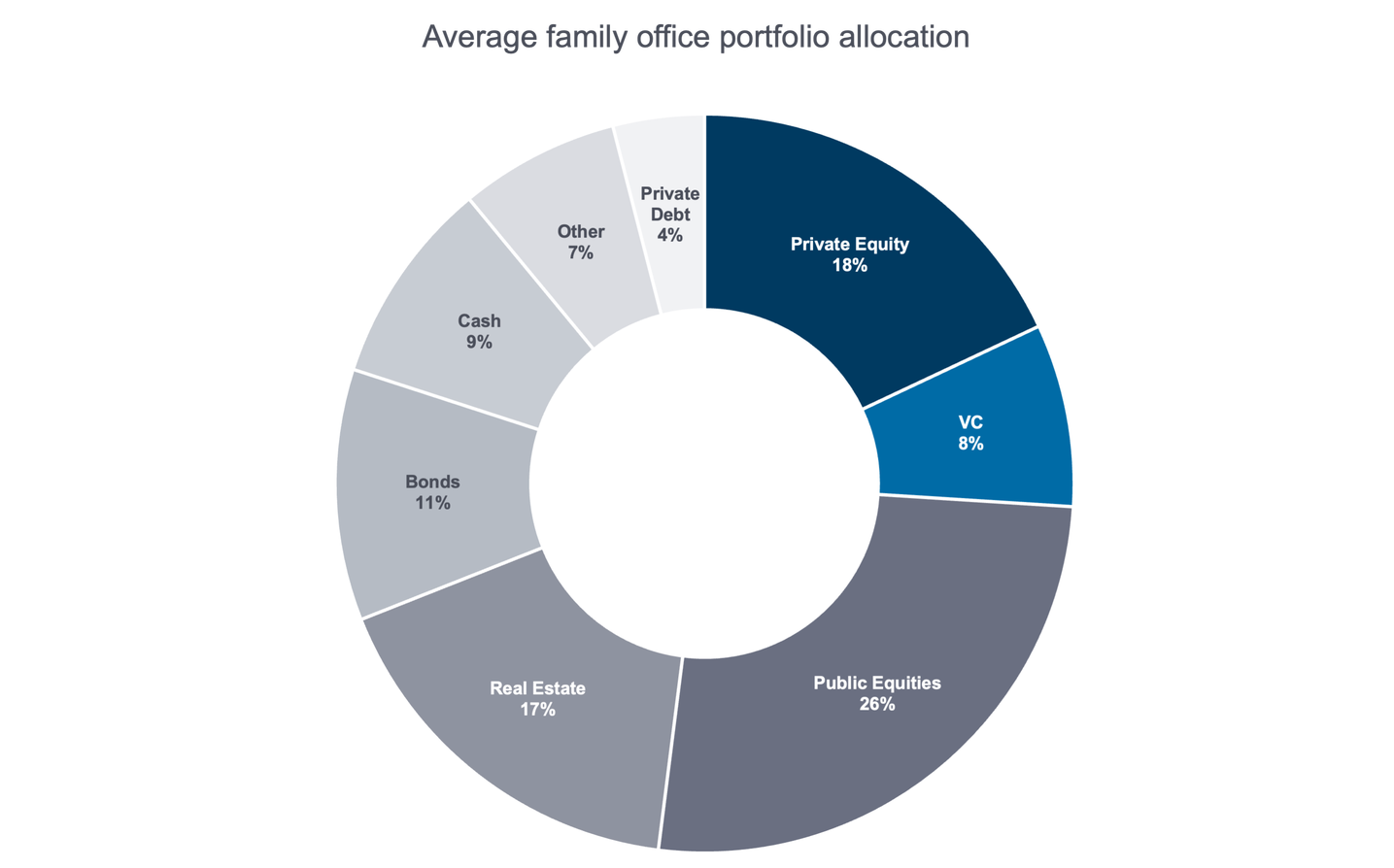
Family offices invest in PE and VC within generally well-diversified portfolios that include fixed income, public equities, real estate and private market investments. According to the 2024 North American Family Office Report (PDF) conducted by RBC and Campden Wealth, family offices allocate an average of 26% of their portfolio to PE and VC.
What family offices are looking for
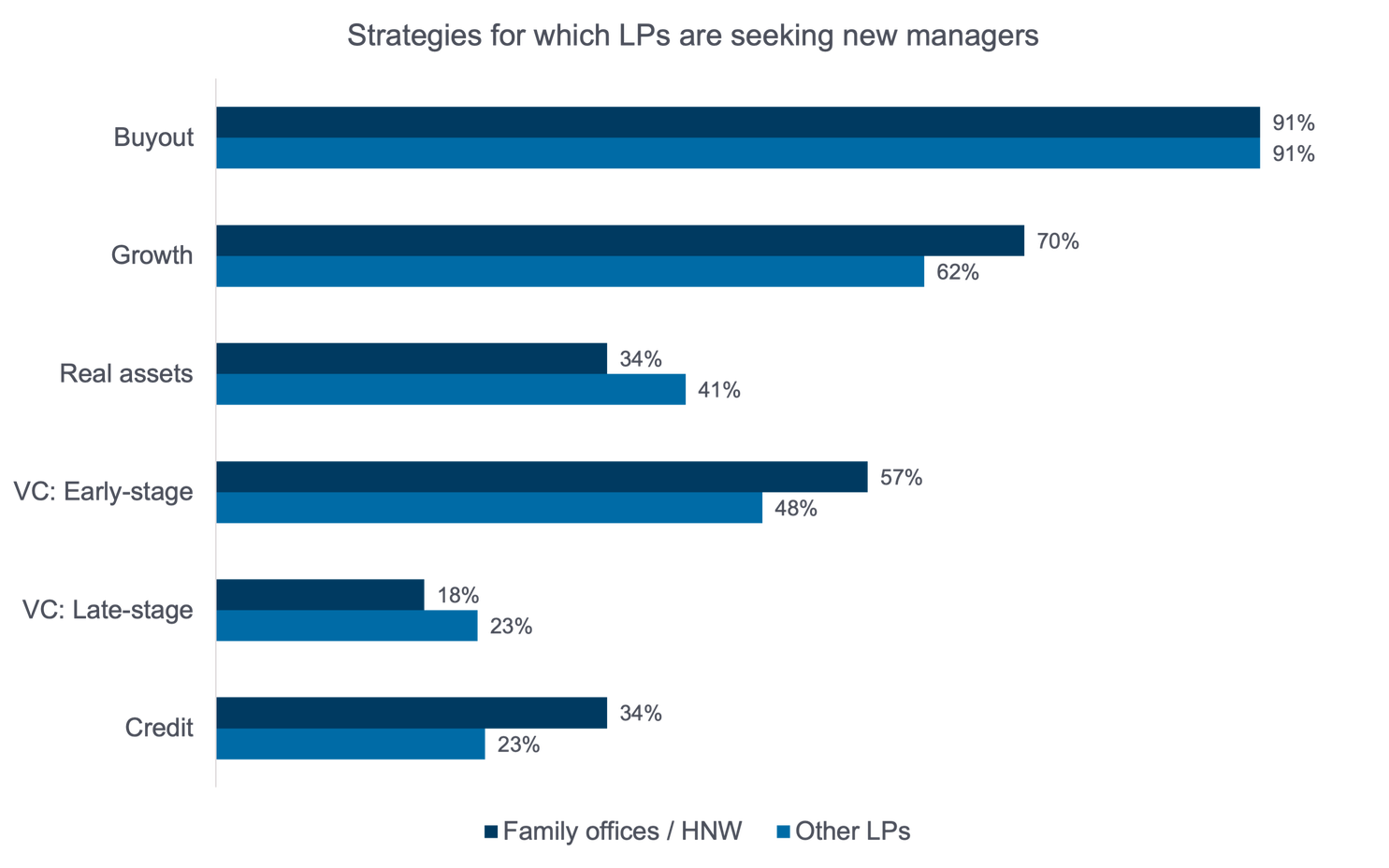
Within the private market asset class, family offices are pursuing several strategies. According to data from SVB's Global Fund Banking practice, in 2025 family offices and HNW LPs overwhelmingly pursued buyout managers, with a focus on the middle market.
This group of LPs was also more interested in growth and early-stage managers than other LP types. Among family offices and HNW LPs, 70% had an interest in growth managers, and 57% had an interest in early-stage managers. This is notably higher than other LPs, 62% of whom were interested in growth and just 48% in early-stage managers.
How family offices invest in private equity
Fund allocations represent just one avenue for family offices to deploy capital in private markets. Increasingly, they seek greater proximity to deals than traditional fund structures allow. This journey often begins with coinvestments alongside existing fund managers, where family offices selectively invest additional capital into specific deals presented by the fund manager. This can lead to direct investments, where family offices invest directly into private companies themselves.
"Transitioning from fund investing to coinvesting isn't a huge leap because ultimately, you're still relying on a manager," explains Dean Saldsman, Principal at 1932 Capital, the family office of the founder and owners of NFI Industries. "The evaluation is manager-first, asset-second. But when a family office moves from coinvesting to direct investing, the mindset changes from evaluating the manager to evaluating the asset itself."
Many family offices have already made this shift. Roughly two out of five family office PE and VC deals are direct investments, according to data from RBC and Campden Wealth. This figure may be expected to rise further as family office deal activity in private markets continues a decade-long surge, according to PwC's 2025 Global Family Office Deals Study (PDF).
The push toward direct investing
While there are good economic and strategic reasons for the increase in direct investment among family offices, the approach has its challenges.
The motivation for direct investing
Family offices are attracted to direct investing for economic and strategic reasons that align with their long-term vision and values, including:
- Control: Direct investments provide greater control over portfolio construction, allowing family offices to concentrate in sectors they understand deeply or to align investments with family interests and expertise.
- Timeline: Direct investing enables family offices to hold assets on their preferred timeline rather than being subject to fund liquidation schedules.
- Value add: Direct investors often have a controlling stake in the company, allowing them to participate in strategic decisions and add value through their networks and expertise.
Nerre Shuriah, Senior Director of Wealth Content and Knowledge at First Citizens Wealth, sees these motivations playing out among her clients.
"Single-family offices with direct exposure tend to be led by families that were entrepreneurs themselves," she says. "This group generally has more of a desire to be hands-on and get more involved in the businesses that they invest in."
What makes a good investment
Hoffmann Family of Companies, or HF Companies, has aggressively pursued a strategy of acquiring companies directly, giving the firm a unique perspective on what makes a promising opportunity.
"The firm targets well-established, family-owned businesses with a strong track record of performance, specifically cash flow," notes Kevin Morrison, the company's CFO.
Beyond the financial markers, majority control and a strong relationship with company management is a critical success factor.
"There is no replacement for multigenerational family knowledge," Morrison says. "We want the executives to remain part of the business and incentivize them to stay."
This is a sentiment shared by Saldsman, who emphasizes the idea of incentive alignment. "We think about incentive alignment a lot," he says. "We like to see founders or owners of portfolio companies retain substantial equity."
While control is important for HF Companies and other firms, family offices have varied approaches. For instance, an investor at a large, well-known, US-based family office who requested anonymity noted that their investments take a variety of forms—minority deals, control deals, coinvestments, direct investments and others.
Rather than strict top-down allocations, the firm follows a more bottom-up approach with flexibility on deal type for the right opportunity. In practice, this means the firm doesn't set a target percentage of coinvestments versus fund investments, for instance—instead choosing the deal structure that makes the most sense for a given opportunity.
Challenges with direct investing
Despite the benefits, direct investments may not be right for every family office.
One of the most important challenges is talent. Successful direct investing requires capabilities spanning the entire investment life cycle, including deal sourcing, due diligence, transaction execution, portfolio management and value creation. Building these capabilities in-house requires hiring experienced professionals, implementing robust processes and developing the market relationships that generate proprietary deal flow.
Saldsman had a front-row seat to the challenges of building out teams with this expertise as the firm grew in size and capabilities.
"The hardest thing about building a direct investing team is finding the right mix of folks," he says. "They need to have a background in PE dealmaking but also be entrepreneurial enough to be at a family office. Most traditional PE firms are very structured, so it can be difficult for professionals with that background to operate at a firm that is in startup mode."
Concentration risk is another important challenge. Smaller family offices may not have the balance sheet to invest in dozens of companies—and therefore run the risk of concentration by investing in a handful of deals.
Morrison notes that for his team, "Diversification is priority one. By setting this as our main priority, we ended up creating our own diversified PE fund in some sense."
Importantly, though, a diversified portfolio of directs requires a substantial amount of capital, limiting the direct investing approach for smaller family offices.
Independent sponsors as a bridge
Independent sponsors have emerged as a compelling solution to the family office capability gap, offering a hybrid model that combines the benefits of direct investing with the expertise of experienced deal professionals. Unlike traditional PE funds that raise committed capital in advance, independent sponsors source and execute deals without a preexisting fund structure. They identify attractive investment opportunities and then raise capital deal by deal from a network of investors.
The appeal of independent sponsors
The independent sponsor model creates an interesting value proposition for family offices by addressing many of the pain points they encounter in direct investing. Namely, they can access deals without having to build out large deal teams, source opportunities or execute transactions. At the same time, they still maintain control over deployment decisions.
Kyun Park, founder of independent sponsor Aperion, has seen these dynamics in action. "For independent sponsors, family offices are the holy grail," he says. "They provide flexible capital, quick decision-making and long-term relationship potential while allowing the independent sponsor to source deals, execute transactions and build a track record."
In fact, 85% of independent sponsors report raising money from family offices, according to a 2025 survey by Axial.
The growth of independent sponsors today
The independent sponsor model isn't new, but several market developments have accelerated the growth in the number of investors pursuing these arrangements in recent years. This led one family office investor to note that they always have a lot of inbound requests from independent sponsors. Perhaps the most notable reason for this proliferation is the exit environment.
A persistently weak exit environment has created zombie funds—funds whose lack of exits make future fundraising unlikely. Even among healthier funds, the exit drought has stalled carried interest distributions, leaving many mid- and senior-level investment professionals at traditional PE firms frustrated and looking for alternatives.
Simultaneously, the fundraising environment generally has remained challenging. According to survey data from SVB's Global Fund Banking practice, the net sentiment on fundraising has slowly shifted more negative since 2024—particularly among VC funds.
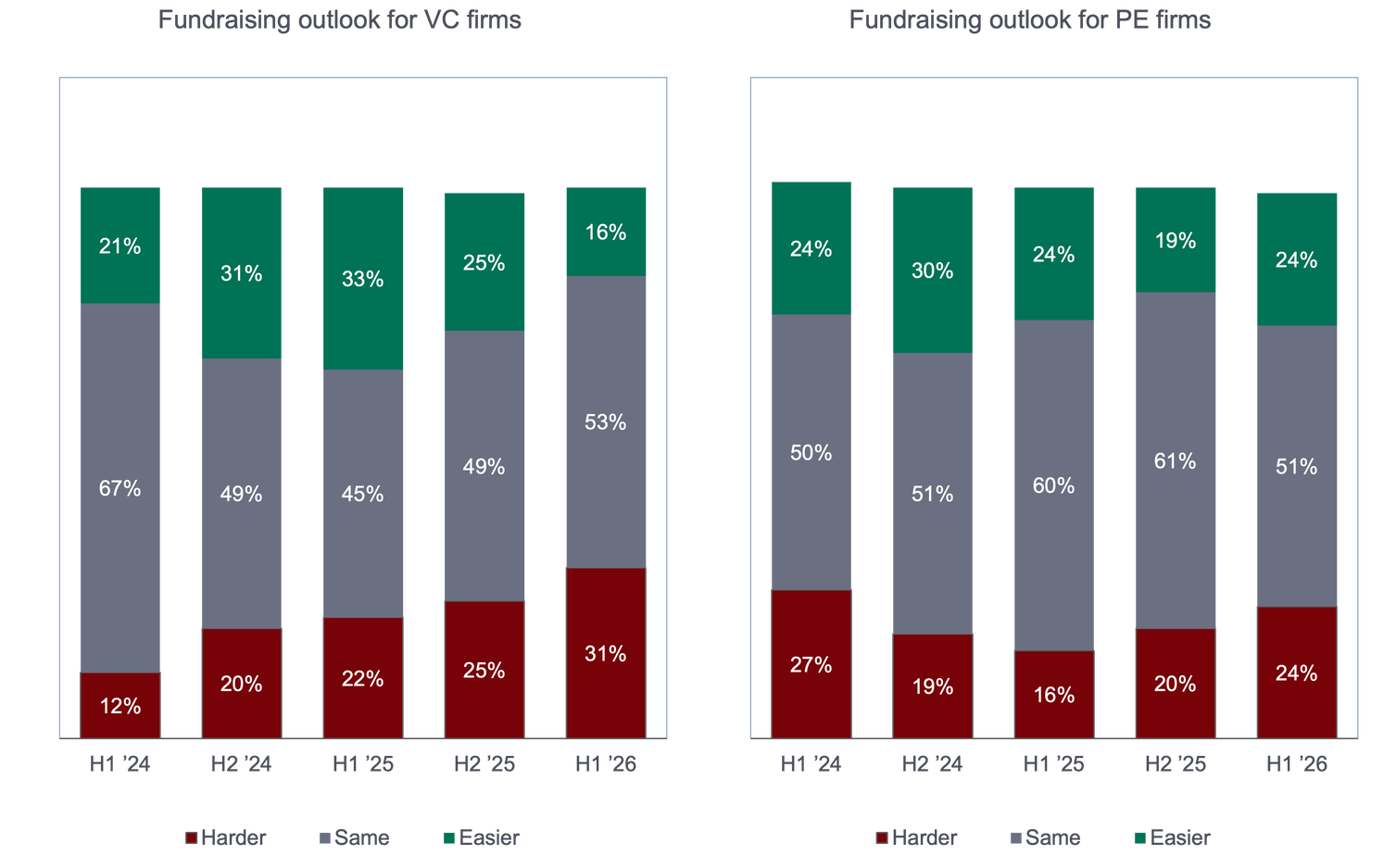
This difficult fundraising environment has pushed talented professionals out of established funds and toward alternative models that don't require raising large funds upfront. These dynamics have created a growing pool of experienced deal professionals with strong track records who are launching independent sponsor platforms.
The challenges of these relationships
Despite the large number of independent sponsors raising capital from family offices, establishing these relationships can be a challenge.
"There has been a proliferation of family offices interested in going direct or backing independent sponsors," said Park of Aperion. "But at the same time, these arrangements are incredibly relationship based."
Park and his team are actively working to address the issue of sourcing investors, by creating CapHub, a platform for connecting independent sponsors with investors.
Perception of the independent sponsor model also remains a challenge. One investor at a well-known family office noted that even though "independent sponsors bring new deal-sourcing avenues and may be able to find promising companies," the firm hasn't worked with any of these groups. The issue is the perception that independent sponsors sometimes overpay for deals and may lack the proper incentive alignment with the capital providers. To alleviate these concerns, the investor suggested that "independent sponsors need to have skin in the game, with personal cash invested."
Implications for sponsor finance
The shift toward family office-backed direct investments and independent sponsor transactions has important implications for the sponsor finance market, creating both challenges and opportunities for banks and other lenders.
These transactions often employ less leverage at the initial investment stage compared to traditional leveraged buyouts. This lower initial leverage can translate into smaller financing requirements upfront, but the borrowing relationship potentially extends over a much longer duration.
Unlike traditional PE funds that typically exit portfolio companies within 5 to 7 years, family office-backed investments often are held for significantly longer. This extended holding period means that companies may return to lenders multiple times over the investment life for growth capital, acquisition financing or other capital needs.
Family offices may therefore focus on longer-term relationships with their financial partners. A sponsor finance relationship today may eventually extend to middle market banking for portfolio companies, private wealth services for family principals, treasury management, and trust and estate planning.
Are family offices disrupting the PE model?
Family offices possess several structural advantages that make them strong players in private markets—patient capital, flexible time horizons and no forced exit requirements. Many family offices are capitalizing on these advantages, evolving how they participate in private markets by moving closer to the deal through direct investments.
The independent sponsor model appears particularly well-positioned to benefit, serving as a bridge between family offices seeking direct investment benefits and the reality that building teams and expertise requires significant time and resources. As talent continues flowing from traditional PE into independent sponsor roles, and as family offices grow more comfortable with this model, expect this segment to grow.
Still, not all family offices are following this path. For many, the fund model remains compelling—professional management, built-in diversification and established investment playbooks. This is particularly true for smaller organizations without the desire to develop a full deal team. For these groups, expect continued allocation to traditional funds with opportunistic direct or coinvestment and independent sponsor partnerships.
This transformation into more direct and active deal activity represents one of the most significant structural shifts in private markets today. For sponsors, investors, lenders and service providers, understanding and adapting to this evolution will be critical to success.