Guide to retirement savings for business owners
Building a successful business often requires prioritizing growth over long-term personal planning—and retirement savings can take a back seat. As a result, retirement savings for business owners can become more complex over time. Many eventually find they need to accelerate their savings, only to discover that traditional contribution limits can make it difficult to catch up.

This is a common challenge among business owners. According to the 2025 Beyond Wealth report, nearly one-third say they're not confident they'll be able to retire on time—despite having higher average retirement savings than non-owners. For those looking to move beyond traditional plan limits, there's a range of retirement planning strategies for business owners designed to help maximize long-term savings potential.
Key takeaways
- Many business owners need to accelerate retirement savings, but IRS contribution limits can make it difficult to save enough each year.
- For those without access to a traditional workplace 401(k), there are several tax-advantaged retirement plans for business owners to choose from.
- Profit-sharing contributions, Roth strategies and defined benefit plans are key business owner retirement strategies that can significantly expand annual contribution potential.
1Start with the right plan structure
Choosing the right plan structure is an important first step in retirement planning for business owners—particularly if you don't currently offer a 401(k) or other qualified retirement plan through your business. The right choice depends on factors like the number of employees you have, the amount you want to contribute for yourself and your team, and the level of plan administration your business is prepared to manage.
If you have a growing workforce—or if you want greater contribution potential and more flexibility in how you structure retirement benefits—a 401(k) may be a good fit. A 401(k) generally offers higher contribution opportunities, employee salary deferrals and greater flexibility in plan design, including options for employer matching and profit-sharing contributions.
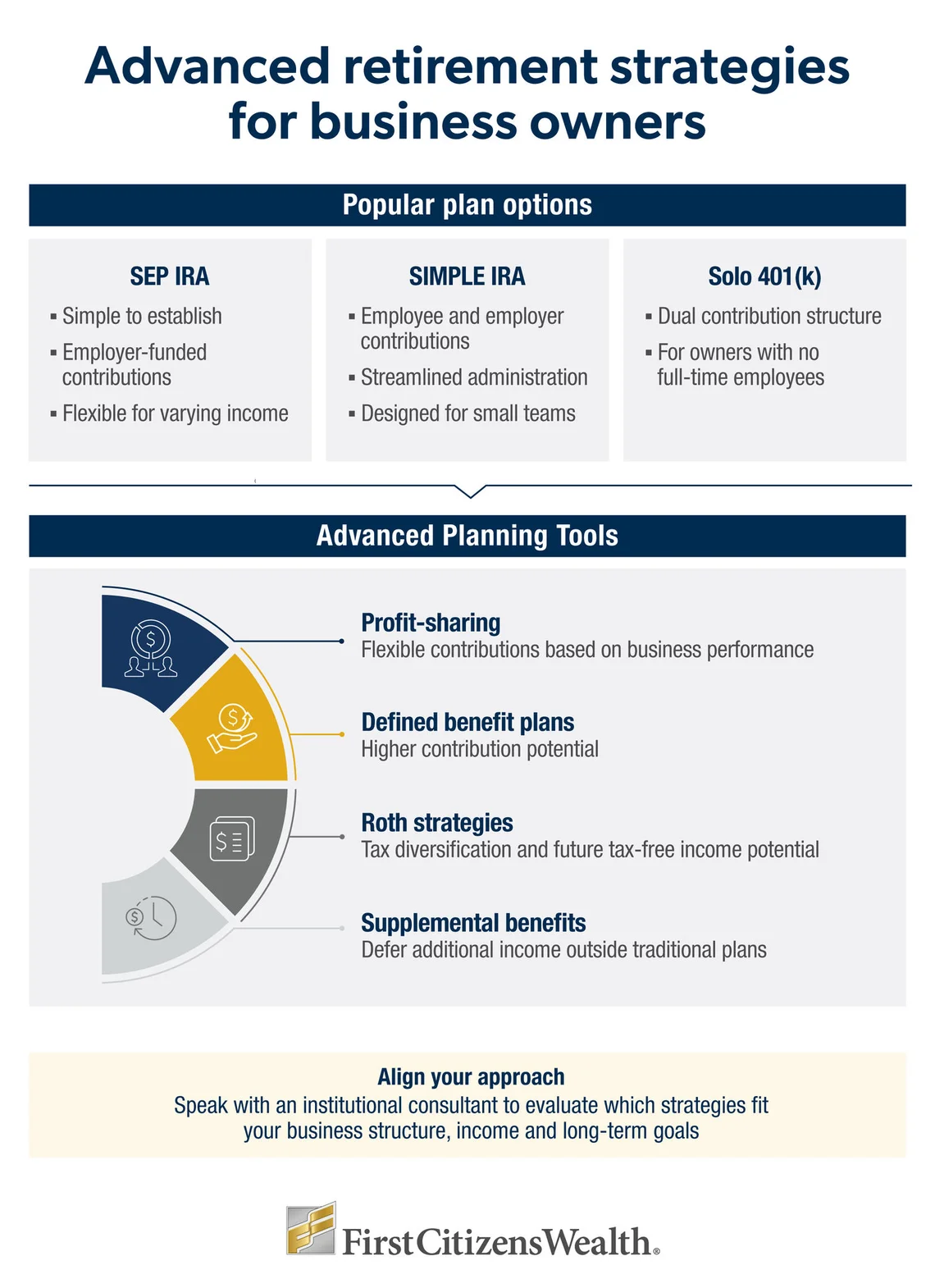
If you're a solopreneur or have relatively few employees, you may want to explore retirement plans for self-employed individuals, such as a SEP IRA or SIMPLE IRA. These options generally have lower administrative requirements, and SIMPLE IRAs also allow employees to contribute through payroll deductions.
2Max out contributions to your plan
Once you've established the right qualified retirement plan—or if you already have one in place—the next step is making sure you're taking full advantage of it before layering on more advanced strategies. Contribution limits increase annually to account for inflation, and individuals 50 and older may also be eligible to make catch-up contributions.
However, while maximizing plan contributions is a tax-efficient way to grow retirement savings, relying exclusively on a defined contribution plan may not be sufficient for high-income owners.
"Because of IRS contribution limits, business owners may not be able to contribute enough to a 401(k) each year to fully replace their income in retirement," says Alex Yarem, Institutional Business Development Officer at First Citizens. As a result, many high-income entrepreneurs must combine multiple plan structures and tax strategies to increase their retirement savings beyond standard contribution limits.
3Consider profit-sharing contributions
Profit-sharing contributions can be used as a stand-alone savings vehicle, but they can also be combined with an existing retirement plan to increase the total amount you can save each year.
Because contributions are made by the employer, business owners may be able to contribute up to 25% of their eligible compensation, subject to IRS limits and overall plan contribution caps.
"Depending on the business structure, there are situations where owners can divert part of their income to profit-sharing contributions instead of taking it as taxable income," explains Austin Pruitt, Institutional Consultant at First Citizens. "That can pair well with other business owner retirement strategies, such as a cash balance plan."
Profit-sharing plans can also provide flexibility, allowing contributions to vary from year to year based on business performance.
4Add a defined benefit plan
Defined benefit plans—often referred to as pension plans—can allow significantly larger annual contributions than other tax-advantaged retirement savings plans. For business owners looking to accelerate retirement savings, these plans can represent a substantial tax-deductible contribution opportunity.
Traditional defined benefit plans are designed to fund a specific monthly benefit in retirement, with allowable contributions determined by factors like age, income and years until retirement.
A cash balance plan is another type of defined benefit plan that has become increasingly popular with business owners. These plans express the benefit as a hypothetical account balance rather than a fixed monthly payout. Depending on age, income and plan design, they may allow for significantly higher annual contributions—often well into the six figures.
Cash balance plans may be particularly attractive for business owners who:
- Earn a high income
- Are age 40 or older
- Have stable, predictable cash flow
- Plan to maintain the business for several years
"Most people don't put a cash balance plan in place for just a few years," says Todd Davis, Vice President, Institutional Consultant Expansion at First Citizens. "It's designed to be a long-term strategy and commitment—often 5 to 10 years or more."
Defined benefit plans must meet strict actuarial and regulatory requirements. As a result, they're typically implemented with the help of a retirement plan specialist.
5Explore Roth strategies
Roth strategies have become increasingly popular as investors seek greater tax diversification in retirement. According to Pruitt, the appeal lies in the potential for tax-free income later in life.
Qualified withdrawals from a Roth IRA are generally tax-free if the account holder is at least 59 1/2 and has held the account for at least 5 years. However, high-income earners often exceed the income limits required to contribute directly to a Roth IRA.
One common workaround is the backdoor Roth strategy where an investor makes nondeductible contributions to a traditional IRA and then converts those funds to a Roth IRA. While this approach may allow higher earners to benefit from tax-free Roth withdrawals in retirement, the IRS requires Roth conversions to include a proportional mix of pretax and after-tax IRA assets. As a result, investors may still owe income tax on part of the conversion—even if they intended to convert only the after-tax contributions.
Some investors address this by using a reverse rollover, which involves moving existing traditional IRA assets into an employer-sponsored plan if permitted. Because employer plans aren't included in the IRS' pro rata calculation, this step can reduce the taxable portion of future conversions.
Additionally, some 401(k) plans allow after-tax contributions and in-plan Roth conversions—sometimes referred to as a mega backdoor Roth strategy. These features can further expand Roth savings opportunities.
All Roth conversion strategies may result in unintended tax consequences, so it's essential to consult with a financial professional before taking action.
6Consider nonqualified retirement strategies
Once you've maximized the savings opportunities available through qualified retirement plans, you may consider supplementing them with nonqualified retirement arrangements. Because these plans generally aren't subject to the same annual contribution limits as qualified retirement plans, they provide additional flexibility for business owners and other highly compensated employees while supporting retention goals.
Common examples include:
- Nonqualified deferred compensation plans
- Executive retention plans
- Supplemental executive retirement plans
"This approach can allow you to benefit key employees in a very specific and intentional way," Yarem explains.
7Periodically review your plan design
Retirement plan design can have a significant impact on how effectively business owners are able to save.
"One of the biggest considerations is whether certain strategies are available within the plan documents themselves," explains Danny Pham, Institutional Consultant at First Citizens. "Some plans may require adjustments before certain features can be used."
Regularly reviewing your retirement plan with an institutional advisor can help ensure the plan's design continues to support both your business and personal financial goals. Many organizations also incorporate retirement plan benchmarking into this process to compare fees, plan features and provider performance.
It's also important to remember that retirement plan design often requires balancing owner contributions with benefits for employees.
"You may be able to make sizable contributions for yourself," Davis says. "But in most cases, you'll also need to contribute something for employees in order to make the plan work."
The bottom line
By combining multiple strategies, business owners may be able to accelerate retirement savings beyond the limits of traditional plans while managing tax liability. Because these approaches often involve complex rules and trade-offs, working with a wealth consultant can help you evaluate your options and align them with your long-term goals.
If part of your strategy involves making changes to your workplace plan, a retirement plan specialist can help you determine which approaches align with your business structure, income and long-term objectives.