A checklist for stress testing captive insurance portfolios
Building a captive insurance portfolio requires balancing liquidity needs with long-term growth objectives while adhering to the domicile's regulatory requirements. Early investment holdings are often concentrated in cash reserves and short-duration fixed income until surplus grows, creating a cushion for the portfolio to take on additional risk while maintaining the ability to pay claims. As a captive portfolio matures and its investment strategy broadens into higher growth investments, portfolio stress testing becomes increasingly important. Without it, boards may be unprepared for how a market decline could affect their ability to meet unexpected claims.

Captive insurance investment decisions don't happen in isolation. Changes intended to improve long-term returns can also affect liquidity and a captive portfolio's ability to pay claims. Portfolio stress testing—along with liquidity planning and asset liability management—help boards understand these trade-offs before market stress exposes potential vulnerabilities.
Key takeaways
- Captive portfolios must balance growth potential against simultaneous market and claims shocks.
- Conducting a portfolio stress test helps boards identify vulnerabilities before market volatility forces a decision.
- An investment policy statement will evolve as a captive portfolio matures and warrants review at least annually.
Market volatility and claim spikes: A two-sided shock
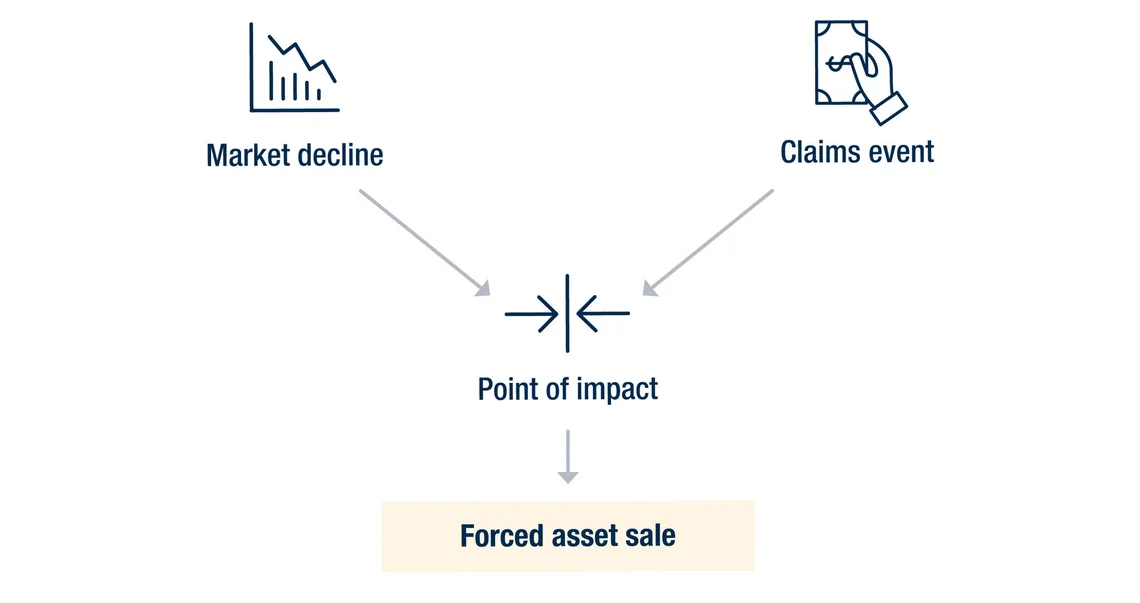
A market decline tests any investment portfolio. For a captive insurance organization, however, markets can fall just as claims spike—creating a two-sided shock. The greater risk doesn't come from either event alone but from their combination, which can force a board to sell assets at depressed prices to cover claims.
Consider the example of an energy company with a captive insurer. Shortly after the captive increased its allocation to equities to pursue higher long-term returns, the market took a sudden downturn. At the same time, the company experienced a major operational incident. The captive was forced to sell investments at depressed prices to meet claims and other funding obligations.
Funding stability versus portfolio resilience
Preparing for a two-sided shock begins with understanding the difference between funding stability and portfolio resilience. In the simplest terms:
- Funding stability addresses whether the captive can meet its obligations, or liabilities.
- Portfolio resilience addresses how investments withstand stress, or assets.
In practice, a captive can have a resilient investment portfolio but still lack the liquidity needed to meet unexpected claims. Likewise, a well-funded captive may hold a portfolio that's more vulnerable to market volatility than intended. For example, bonds have a much lower volatility than stocks. However, more credit-oriented fixed income typically is positively correlated with stocks and could follow stocks during a market decline.
Ultimately, boards must evaluate both, and portfolio stress testing provides an effective framework for this analysis. A portfolio stress test helps boards assess both funding stability and portfolio resilience under different market and claims scenarios.
How portfolio stress testing for captives works
Captives typically rely on two complementary stress-testing methods for assets, each serving a different purpose.
- Historical stress testing: This method applies real market events, such as the 2008 financial crisis or the simultaneous decline in stocks and bonds in 2022, to show how the current portfolio would have performed under similar historical market conditions.
- Forward-looking scenario analysis: This approach uses a risk-based factor model that leverages historical relationships between numerous market variables, also known as factors, to project how a portfolio might respond to a hypothetical scenario. Scenarios may involve a single variable, such as a shift in the 10-year Treasury yield, or multiple variables at once.
"Historical and forward-looking analysis answer different questions," says Aaron Lassanske, Senior Portfolio Strategist at First Citizens Bank. "Historical testing shows how a portfolio would have performed during a real crisis, and there's value in knowing its behavior under historical events. Forward-looking analysis models offer what might realistically happen in future events, which tends to prove more useful because historical crises occur infrequently and are difficult to plan around."
Value at risk is a commonly used metric in stress testing. At a defined confidence level, it estimates the loss a portfolio is unlikely to exceed and helps a board determine, in dollar terms, whether the portfolio could continue supporting expected claims before markets recover.
Stress testing identifies potential vulnerabilities, while liquidity planning helps determine whether a captive can continue meeting its obligations if those vulnerabilities are exposed. For example, a portfolio stress test might reveal that a captive has sufficient assets overall but not enough readily available liquidity to avoid selling investments during a market downturn.
Aligning liquidity planning with investment strategy
Liquidity planning helps a captive meet claim payments without selling assets at distressed prices during a market downturn. Cash reserves, short-duration fixed income and targeted bond maturities to specific liabilities reduce the risk of becoming a forced seller.
As a captive's liquidity needs evolve, so should its investment strategy. Newly launched captives are conservatively positioned with most assets in cash or short-duration bonds driven by a small surplus. Over time, portfolios may gradually shift toward investment-grade bonds, high-yield bonds and eventually equities as the captive's financial position strengthens.
"Surplus functions as the heartbeat of a captive," Lassanske says. "When claims come in below what the actuary assumed, that difference flows through as profit and becomes part of retained earnings, allowing the portfolio to grow more aggressively over time. A captive with 5 years of strong claims performance can carry a different risk profile than one in its first year, and the portfolio should reflect that difference."
For example, one recently launched captive moved a significant portion of its assets into intermediate bonds within its first year—a faster timeline than usual—because early-claims experience gave the board confidence to accelerate the transition out of cash.
Asset liability management in practice
Asset liability management aligns investment strategy with expected obligations, capital requirements and liquidity planning. Boards should evaluate whether a portfolio's duration, credit quality and liquidity profile match the captive's claims pattern, reserve levels and overall risk exposure.
"Every portfolio carries blind spots worth understanding," says Andy Johnson, Senior Director of Institutional Trust Sales and Service at First Citizens. "Stocks and high-quality bonds have historically moved in opposite directions during market stress, which is part of why bonds provide stability. This relationship can break down under certain conditions, though, so boards should stress test for this possibility."
Equity allocation varies by organization, and some captive domiciles cap equity exposure well below what a growth-focused portfolio might otherwise carry. The appropriate allocation depends on the captive's maturity, surplus position and claims history—considerations a board should discuss with its investment manager.
For example, a captive with predominantly short-tail claims—those that settle quickly, like property—faces different liquidity and duration considerations than one with substantial long-tail exposure such as workers' compensation, where claims can take years to fully develop and pay out because the timing and predictability of expected payouts differ meaningfully between the two. These differences are one reason allocation decisions should be tailored to each captive's specific risk profile and type of coverage rather than applied uniformly across the industry.
Questions to ask an investment manager
Captive boards don't need to run their own portfolio stress tests to stay informed. Asking the right questions of their investment managers—and expecting clear answers—serves a similar purpose.
- What shocks have been modeled, and how would the portfolio perform if markets declined while claims increased?
- How does the investment strategy support liquidity, capital preservation, return objectives and overall funding stability?
- What are the best-case and worst-case scenarios for this portfolio, and how would a moderate market decline affect liquidity?
- How would the portfolio respond to a shift in interest rates of a quarter point, half point or more?
"Boards should understand what specific shocks have been modeled and how the portfolio would respond," Johnson says. "Understanding the risks embedded in the portfolio—and how they affect the captive's ability to pay claims—deserves a standing place on the agenda."
How often to review an investment policy statement
An investment policy statement, or IPS, establishes portfolio management guidelines—covering equity exposure, fixed income composition and the use of high-yield instruments and alternatives. The IPS should be reviewed at least annually and whenever there are material changes in claims experience, reserves, market conditions or risk tolerance.
Older policy statements may have been written for simpler, narrower portfolios and no longer reflect today's more globally diversified, multi-asset strategies. A regular review process gives boards the opportunity to update outdated assumptions and incorporate current best practices.
Choosing an institutional asset manager
Asset managers offer varying levels of expertise in captive insurance. The strongest partners understand the industry's unique requirements and incorporate this knowledge throughout the investment process.
"Understanding the regulations, domicile requirements and terminology unique to this industry separates a genuine specialist from a manager handling a generic pool of assets," Johnson says. "Captive boards should choose a partner who speaks this language fluently and applies it directly to portfolio decisions."
Specialized institutional asset managers offer several advantages.
- In-house fixed income and equity capabilities allow for more responsive service and reduce reliance on third-party managers.
- Direct access to portfolio data and performance supports faster answers to board questions and clearer communication during periods of volatility.
- Institutional-grade data and analytics, including detailed fixed income analysis and multifactor risk modeling, leads to more informed stress testing and portfolio construction over time.
The bottom line
Portfolio stress testing isn't a one-time exercise. Over a captive's life cycle, claims experience accumulates and market conditions change. Boards should continue evaluating whether their investment strategy supports long-term objectives while remaining prepared for future claims.
The right investment partner carries this discipline forward, applying the fluency and judgment captive boards need at every stage of evolution.