Using an HSA for retirement savings, not just medical bills
A health savings account, or HSA, has long been a tax-savvy way to pay medical bills. Today, it's also becoming widely recognized as a powerful retirement savings tool.

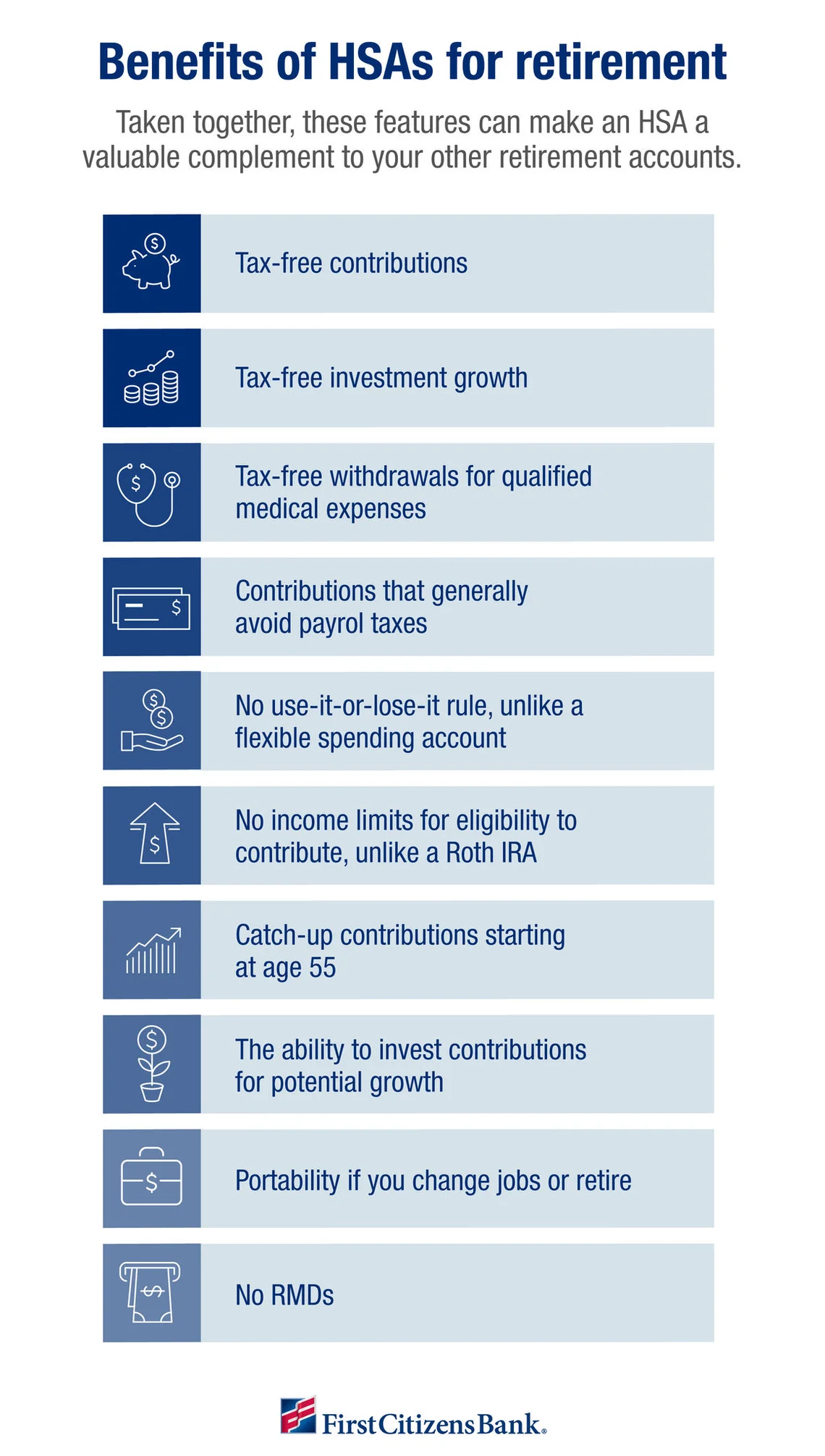
HSAs have a triple tax advantage. Money goes into the account tax-free, grows tax-free and can be withdrawn tax-free for qualified medical expenses—even in retirement, when healthcare costs tend to rise. Left alone to grow, money invested in an HSA can supplement other tax-advantaged retirement accounts like a 401(k) or IRA.
Key takeaways
- HSAs have a triple tax advantage—tax-free contributions, growth and withdrawals for qualified medical expenses.
- Your HSA balance rolls over each year and stays with you if you change jobs or retire.
- Paying current medical bills out of pocket may allow your HSA investments to grow for retirement.
What's an HSA, and how does it work?
An HSA is a savings and investment account that's designed to help you set aside tax-advantaged savings for qualified medical expenses. Unused HSA funds can remain in your account from year to year, allowing invested funds to accumulate for future expenses.
HSA eligibility rules
You must have an eligible high-deductible health plan, or HDHP, to have an HSA. These insurance plans typically have lower premiums than traditional ones but higher out-of-pocket costs until you meet the deductible—the amount you must pay before your plan begins paying for most covered services.
To be HSA-eligible, an HDHP must meet several requirements. One is a minimum annual deductible set each year—$1,700 for self-only coverage and $3,400 for family coverage in 2026, and $1,750 for self-only coverage and $3,500 for family coverage in 2027. Bronze and catastrophic plans sold on state healthcare exchanges are also now HSA-eligible.
How to open an HSA
Employers often offer an HSA along with their high-deductible plans, and some even make contributions to employees' accounts to encourage participation. Workers can then make pre-tax contributions to their HSAs through payroll deductions, similar to 401(k) contributions.
If your employer doesn't offer an HSA with its HDHP, you can still open one through a bank or other financial institution that offers them. You contribute with money that's already been taxed, but you can deduct these contributions on your federal tax return.
How to use HSA funds
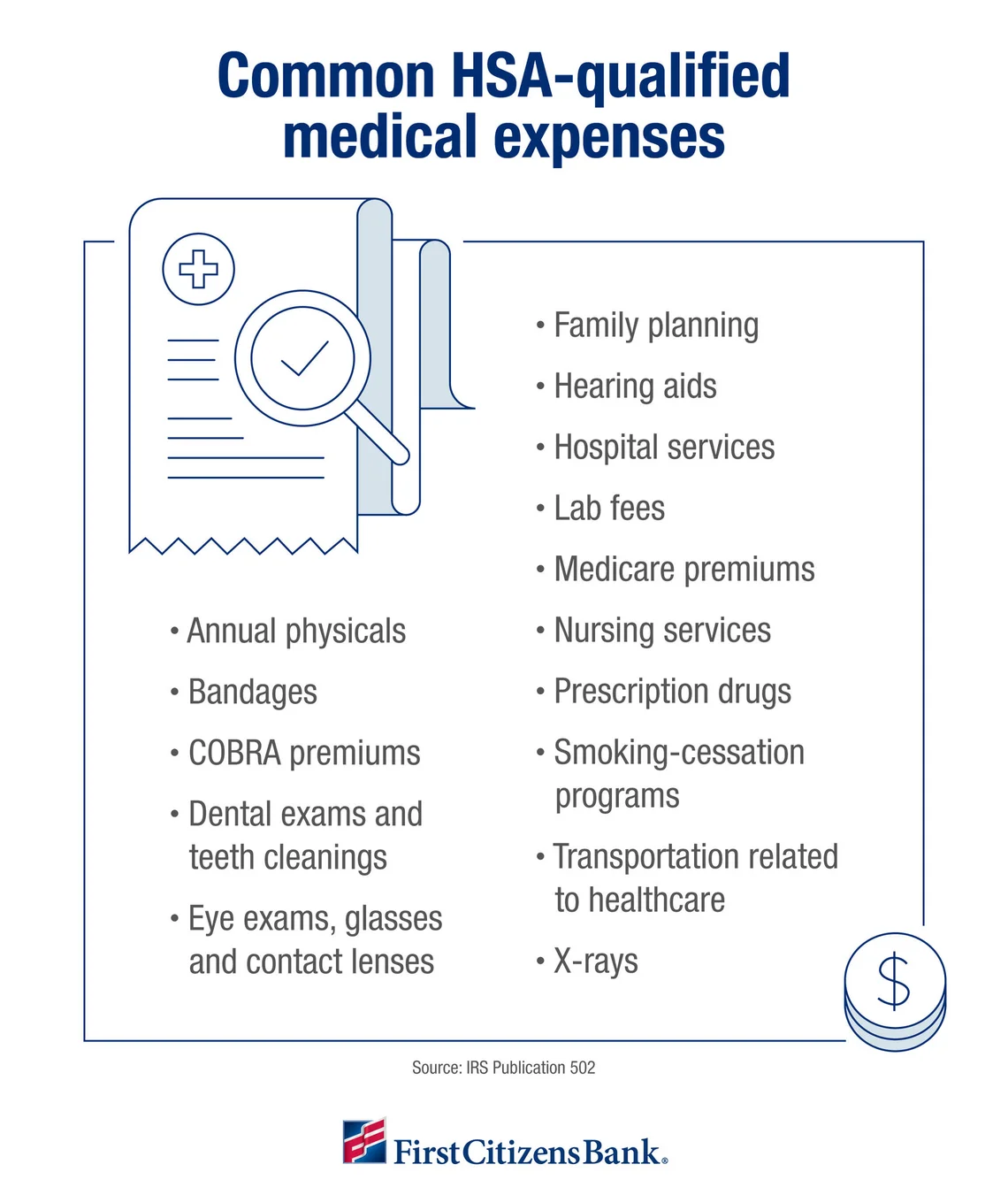
Once your money is in the HSA, you can make tax-free withdrawals to pay for a broad range of qualified medical expenses for yourself, your spouse and your dependents. There's no use-it-or-lose-it deadline with an HSA, and the account remains yours if you leave your job or retire.
Before age 65, withdrawals for nonqualified expenses are generally subject to income tax and an additional 20% penalty. Once you turn 65 or become disabled, the additional 20% penalty no longer applies. You can withdraw HSA funds for any purpose, although nonqualified withdrawals are subject to income tax—similar to withdrawals from a traditional IRA.
How to invest your HSA funds
Some HSA providers require you to keep a minimum amount in cash to cover current medical expenses before you can invest the rest of your savings. If your provider doesn't have a minimum and you don't need the money for current expenses, you may be able to start investing right away. Investment options vary among HSA providers but may include stocks, bonds, mutual funds, exchange-traded funds and target-date funds.
HSA contribution limits
Each year, the IRS sets new limits on how much you can contribute to an HSA, with separate maximums for self-only and family coverage. If you're 55 or older, you can make an additional catch-up contribution each year. Keep in mind that any employer contributions count toward your annual contribution limit.
Using an HSA as a retirement savings tool
While an HSA is a tax-friendly way to pay medical bills, you can turn it into an even more powerful retirement savings account.
To do so, consider maximizing your tax-free contributions to the HSA annually and paying current medical bills out of pocket if you can. This allows your invested HSA contributions to potentially grow tax-free during your working years. And unlike a 401(k) or traditional IRA, an HSA has no required minimum distributions, or RMDs. This means your invested funds can continue growing into your 70s and beyond.
HSA withdrawals in retirement
In retirement, when healthcare costs often increase, you can take tax-free withdrawals for qualified medical expenses without tapping into other retirement accounts that may trigger taxes. And remember, after age 65 you can also use these funds for nonqualified expenses. You won't owe the additional 20% penalty, although you'll owe income tax on those withdrawals.
There's also no time limit for reimbursing yourself from an HSA. For example, you could pay a qualified medical bill out of pocket today and reimburse yourself years later, as long as the expense was incurred after you established the HSA. Just be sure to keep your receipts.
Early retirement and HSAs
An HSA can also help bridge the insurance gap between early retirement and Medicare eligibility at age 65. Along with paying medical bills, you can use HSA funds to pay COBRA insurance premiums after you leave a job or health premiums while receiving unemployment benefits.
HSA versus 401(k): How to prioritize contributions
Both HSAs and 401(k)s offer valuable tax benefits, but the HSA's unique triple tax advantage is hard to beat. Contributions to a traditional 401(k) are made with pretax dollars, and invested funds grow tax-deferred. However, withdrawals are generally taxed as ordinary income. An HSA offers an additional tax break because withdrawals for qualified medical expenses are tax-free.
So if you have limited dollars to save, how should you prioritize HSA and 401(k) contributions? Here are some scenarios and guidelines to consider and discuss with a financial advisor.
- Your employer matches your 401(k) contributions. It's generally a good idea to contribute enough to receive the full match. A common match, for example, is 50 cents for every dollar you contribute, up to 6% of your salary. For a $75,000 salary, this annual match is worth $2,250.
- You've received the full employer match. Once you've contributed enough to receive the full 401(k) match, consider contributing to an HSA. If you reach the annual HSA contribution limit and still have money available to save for retirement, you can consider increasing your 401(k) contributions.
- There's no 401(k) match. You may want to prioritize HSA contributions to take advantage of the triple tax benefits before directing additional retirement savings to your 401(k).
When HSA contributions must stop
You must stop contributing to an HSA if you no longer have a HDHP or when you enroll in Medicare.
If you enroll in Medicare after age 65, be aware that Medicare Part A coverage may be retroactive for up to 6 months. To avoid making ineligible contributions, you may need to stop contributing to your HSA for up to 6 months before you enroll. However, if you enroll in Medicare at age 65, you don't need to stop HSA contributions in advance.
Even after you can no longer contribute, you can continue using your HSA funds tax-free for qualified medical expenses. And if you name your spouse as your beneficiary, the HSA becomes theirs after your death and retains its HSA status.
The bottom line
With its triple tax advantage, investment potential and long-term flexibility, an HSA can be a valuable part of your broader retirement strategy. The more time your invested HSA funds have to grow, the more savings you may have available to help manage healthcare and other costs in retirement.
If a high-deductible health plan is available to you and fits your insurance needs, consider whether an HSA makes sense for you. A financial advisor can help you determine if an HSA would be a worthwhile supplement to other tax-advantaged retirement accounts like a 401(k) or IRA.
Build your retirement strategy
A health savings account can be one part of your overall retirement plan. Explore IRA options that can help you save even more for the future.