Selling your practice to an MSO or DSO

Nerre Shuriah
JD, LLM, CM&AA, CBEC® | Senior Director of Wealth Content and Knowledge
Management service organizations, or MSOs, and dental service organizations, or DSOs, have become increasingly active in acquiring independent medical and dental practices. For many practice owners, it's a sales strategy that can offer a range of benefits, including access to greater scale, resources and financial support.

At the same time, selling your medical practice to an MSO or dental practice to a DSO is a significant decision that can affect your autonomy, financial outcomes and long-term control of your practice operations. If you've been approached with an offer—or are considering whether to pursue a sale—it's important to understand and consider the benefits and drawbacks of selling your practice this way.
Key takeaways
- Selling your healthcare practice to an MSO or DSO can offer meaningful benefits, including a premium purchase price, relief from administrative duties and access to technology and resources.
- These transactions also come with trade-offs, including reduced autonomy, changes in compensation and an expectation that you remain at the practice for 2 or more years after the sale.
- You and your advisory team should properly vet the buyer's experience, culture and financial health before moving forward with a sale.
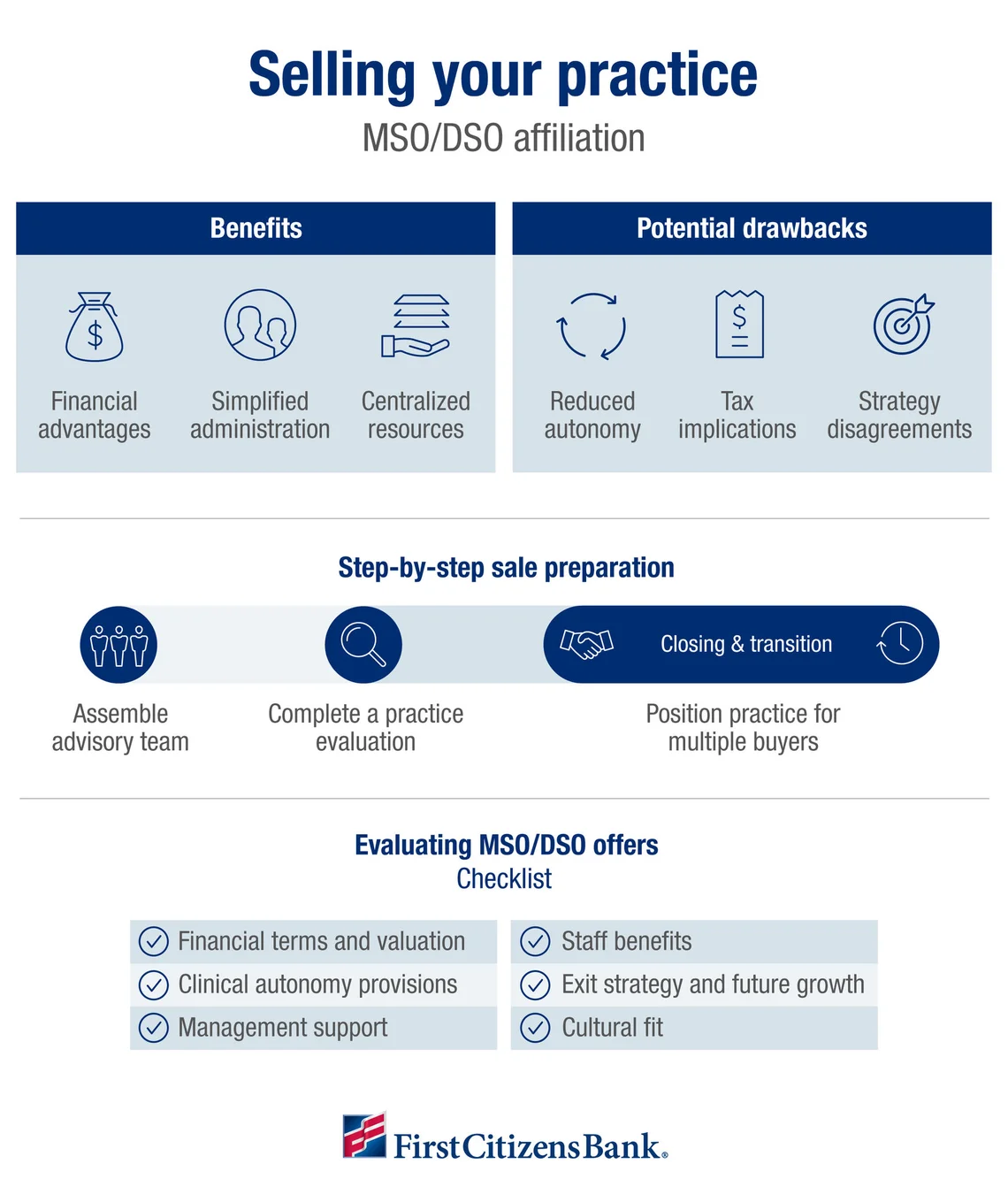
The benefits of selling to an MSO or DSO
Over the past decade, MSOs and DSOs have become increasingly active in acquiring independent medical and dental practices. This trend is driven in part by strong investor interest in healthcare, which is often viewed as a stable, long-term growth opportunity outside of traditional markets.
At the same time, fewer physicians and dentists are choosing to own and operate independent practices. Many face growing challenges, including high student debt, hiring shortages, rising administrative demands, declining reimbursement rates and the increasing cost of technology and infrastructure. For this reason, partnering with an MSO or DSO is an increasingly attractive option.
One of the most significant benefits of selling a medical practice to an MSO or DSO is financial. These organizations are often willing to pay more than an individual buyer for each practice, which can result in a higher sale price and immediate liquidity for the practice owner.
Selling to an MSO or DSO can also relieve you from the managerial and financial responsibilities of running your practice. These organizations typically provide centralized services such as payroll, human resources, marketing and procurement, helping to reduce administrative complexity and allowing you to focus more on clinical care. They may also help manage regulatory and compliance requirements, including OSHA standards, employment rules and insurance claims processing.
MSO and DSO access to capital, along with a broader network of affiliated practices, can also make practices easier to grow post-sale. An acquired practice may benefit from shared knowledge, operational support and expansion opportunities that may be more difficult to achieve independently. And because MSOs and DSOs have greater resources and buying power, it's often easier to invest in new equipment and technology without placing the full financial burden on an individual practice.
MSO and DSO ownership can also offer advantages for your staff. Larger organizations are often able to provide more competitive compensation and benefits through economies of scale, which can make it easier to attract and retain qualified employees.
Potential drawbacks to consider
While there are many benefits associated with selling to an MSO or DSO, there are also important trade-offs to consider. The first potential downside is the inherent conflict that outside equity ownership has within its business model. The drive to maximize enterprise value can be at odds with the provision of quality of care.
You also may not receive the full proceeds of the sale up front. A portion of the purchase price is often structured as an earn-out or deferred compensation, which typically requires you to remain employed at the practice as an associate for at least 2 years after the sale. By comparison, the minimum owner transition period for a dentist-to-dentist sale is typically 6 months.
MSO and DSO sales arrangements are designed to support business continuity, help transition the business and prevent patient attrition. However, you may not receive the earn-out if the measurement requirements—such as profit and revenue—don't meet the agreed-upon levels. Because the MSO or DSO controls financials, it's up to them to determine if the calculations are met.
The impact on your personal finances is another crucial factor to consider. If you transition from an owner to an employee, your compensation structure will change. Instead of retaining full practice profits, you'll typically earn a percentage of collections or a fixed salary plus incentives. For example, you may make 30% to 35% on collections as an employed clinician rather than 40% to 55% as a practice owner. Negotiating the post-sale patient collection percentage is expected with MSO and DSO sales, so it's important to understand your total compensation package when transitioning from owner to employee.
Selling your medical practice also means giving up a degree of autonomy. The MSO or DSO will be making operational decisions such as staffing, scheduling, vendors, technology and strategic direction. While this reduces administrative burden, it also means less direct control over how the practice operates.
You'll also need to consider the tax impact of selling your practice. Receiving a large portion of the practice's value up front through a sale can create a significant tax obligation in the near term. By contrast, independent ownership typically generates income over many years through ongoing profits.
Steps to take before selling your practice
If you're considering an offer from an MSO or DSO, the first step is assembling an advisory team that can help you position your practice for sale and advocate for you during negotiations. This typically includes an attorney, accountant and financial advisor—each with experience managing the purchase and sale of healthcare practices.
Alongside the advisory team, be sure to conduct a thorough evaluation of your practice that includes both qualitative and quantitative analyses—not just a financial valuation. Understanding your practice's patient base, growth potential, payer mix, provider structure and operational strengths can help clarify its unique value and make it more attractive to potential buyers. It'll also give you better leverage during negotiations because it's typically the qualitative conditions that determine whether an owner is happy post-sale rather than the sale price.
A desirable DSO practice: Superb Smiles Family Dentistry
When seeking out new dental practices to acquire, DSOs look for a few key traits. For example, the fictitious Superb Smiles Family Dentistry is an attractive candidate for purchase because it has the characteristics DSOs typically look for, including:
- A fee-for-service or preferred-provider organization practice
- A minimum of $1.5 million in annual gross revenue
- Five or more exam rooms
- An office conveniently located in a metro or suburban area
- A flexible dentist who's willing to work for a few years after the sale is finalized
Evaluating an MSO or DSO offer
If you're considering an offer from an MSO or DSO, thorough due diligence is essential. Beyond the purchase price, it's important to evaluate the buyer's experience, financial strength and operating model, as well as how the transaction will affect your compensation, autonomy and long-term goals.
Your evaluation should focus on several key areas.
- Experience: Understand when the MSO or DSO purchased their first practice and how many practices they currently own in your region. Ask whether they can provide testimonials from other practices they purchased.
- Culture: Evaluate whether their culture aligns with the way you run your practice, as well as their overall reputation and how they treat patients and employees.
- Equity: Clarify whether you'll receive stock and whether it'll be practice stock or MSO/DSO stock, what class of shares you'll receive, whether these shares provide dividends or profit distributions and the organization’s long-term exit strategy.
- Liabilities: Determine how your current liabilities—such as loans, leases and other obligations—will affect the sale proceeds or payment structure, as well as whether any liabilities must be settled prior to closing.
- Financial strength: Request and review the buyer's audited financial statement. If part of your compensation includes stock or deferred payments, you'll want to be confident of their financial stability and ability to meet these obligations.
- Employment terms: You'll likely enter into an employment contract as part of the transaction. This should clearly outline your compensation structure—including salary and commission—whether your earnings are based on net or gross revenue, noncompete terms and exit strategy.
- Real estate: If you own your practice's building, clarify how it'll factor into the sale. If you lease the property to the buyer, the lease agreement should define rent, annual increases, lease terms, maintenance responsibilities, taxes, insurance and the conditions under which either party can terminate the lease.
Take the time to evaluate these areas carefully to help ensure you choose the right partner and structure the transaction in a way that aligns with both your professional and financial goals.
The bottom line
Given the potential benefits of selling your medical practice to an MSO or DSO, the process is worth investigating when you feel like it's time to sell. To understand if this type of sale is right for you, form an experienced advisory team to accurately assess the value of your practice and examine the pros, cons and requirements of this option. Connect with a business advisor to get started.