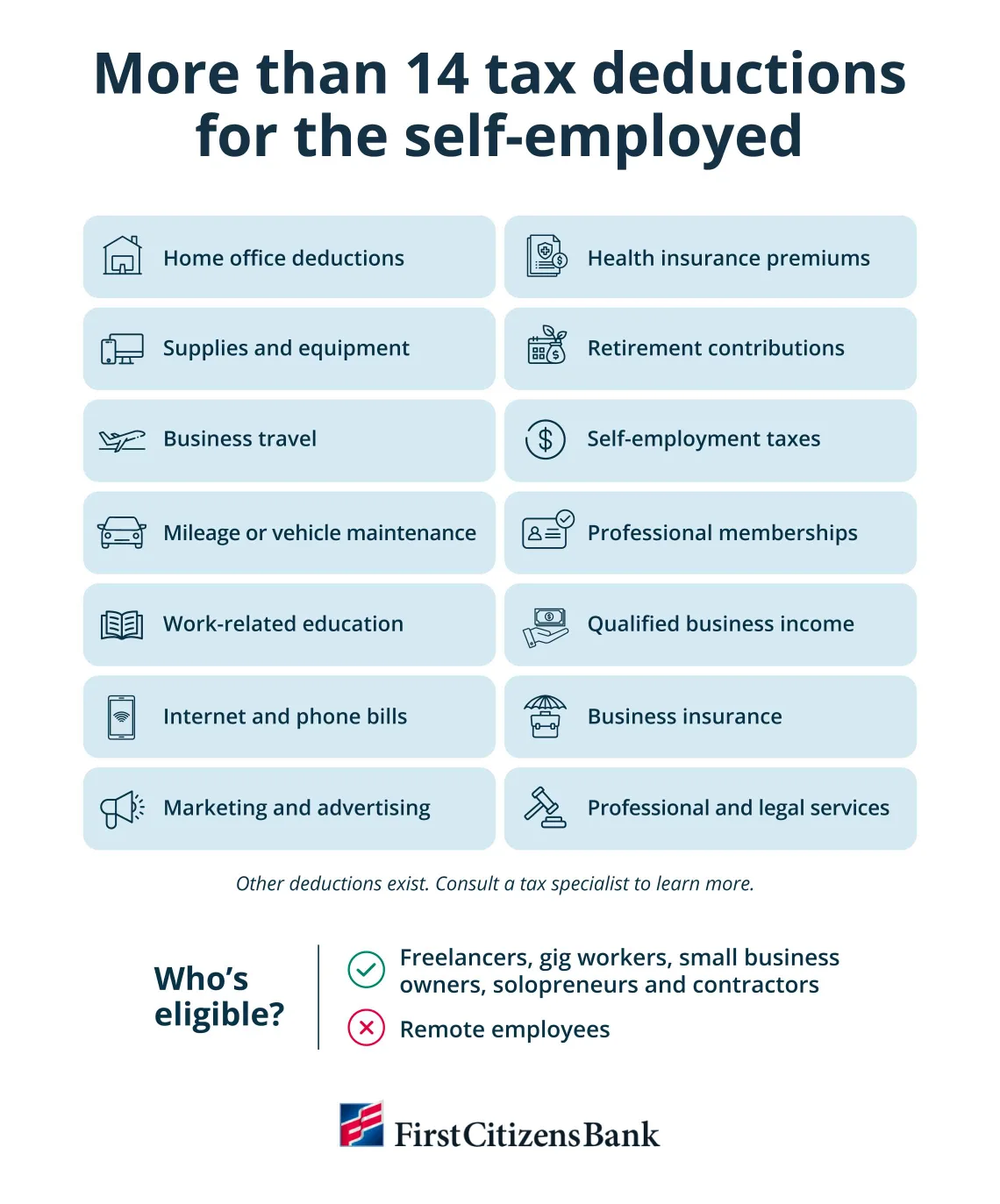
More than 14 tax deductions for the self-employed

Nerre Shuriah
JD, LLM, CM&AA, CBEC® | Senior Director of Wealth Content and Knowledge
When you're self-employed, business expenses like office supplies, equipment, advertising and insurance can add up quickly. The good news is many of these expenses may also help reduce your tax burden.

The IRS allows self-employed individuals to claim a variety of expenses on their annual tax returns, typically through Schedule C or Schedule 1 of Form 1040. Here are some of the most common self-employed tax deductions.
Key takeaways
- Many everyday business expenses—from home office space to mileage—may qualify as tax deductions for the self-employed.
- Certain deductions, such as the self-employment tax and qualified business income deductions, can significantly reduce your taxable income.
- Careful recordkeeping and professional guidance can help you maximize eligible deductions and remain compliant with IRS rules.
1Home office deduction
If you're self-employed and use part of your residence regularly and exclusively for business, you may be able to claim a home office deduction. This tax break is available to homeowners and renters living in many types of residences. The deduction may also apply to work performed from an on-premise structure like a barn or shed. See IRS Publication 587 for more information about qualifying for the home office deduction.
How to calculate the home office deduction
If you qualify, there are two ways to calculate the home office deduction—regular and simplified. With the regular method, you identify the percentage of your home you use for business and then apply this percentage to allowable expenses for things like mortgage interest, property insurance, utilities, repairs and rent.
With the simplified method, you deduct $5 per square foot of dedicated office space up to a limit of 300 square feet or $1,500. Once you've chosen a method, you can't change to the other method until the next taxable year.
Can I deduct my home office if I work remotely?
You must either be self-employed or classified as a 1099 independent contractor to qualify for the home office deduction. Remote workers who receive a W-2 from their employer aren't eligible to deduct any of the expenses associated with working from home.
2Supplies and equipment
Supplies and equipment to run your business—such as computers, printers, software, pens and notebooks—all qualify as business expenses for taxes.
You can also deduct the price of tools and materials you use in your specific trade. For instance, an artist might write off clay, paint or canvas purchases. A delivery driver may deduct the price of thermal bags to keep food warm.
For smaller purchases—especially those with a useful life of less than 1 year—it's common to write off the entire amount in the tax year the expense was incurred. In other cases, you may be required to depreciate business equipment, which allows you to deduct its cost over several years. While the IRS offers guidelines on the types of assets that must be depreciated—and the timeline for depreciation—items like computers, machinery, office furniture and vehicles typically qualify.
Still, keep in mind that Section 179 of the Internal Revenue Code coupled with bonus depreciation allows many businesses to fully expense qualifying business property the year it's placed in service, within generous limits.
3Business travel
If you travel for business, you can deduct 100% of your air, train, bus, taxi or rideshare fare to reach your target location. You can also write off 100% of your hotel stay but only 50% of any business-related meals. However, you must meet certain criteria to claim these deductions. For example, the trip must be longer than an ordinary day's work and must include at least one business-related appointment.
Can I write off personal travel expenses?
Personal travel expenses can't be deducted on your tax return. However, if you squeeze some leisure time into a business trip, you can still claim transportation costs as long as the primary purpose of the trip is business. Be aware that if a friend or family member accompanies you on a business trip, their expenses can't be deducted unless they're an employee of your business.
4Mileage deduction
If you use your personal car for business, you may be able to claim mileage as a self-employed tax deduction. To do so, you'll need to keep a careful record of the number of miles you drive to meet clients and vendors or make pickups and deliveries. Your records should include the date of travel, a description of the business purpose, and starting and ending odometer readings.
Standard mileage versus actual expenses
For many, taking the standard mileage deduction is the easiest way to claim mileage. To do so, multiply your total number of business miles for the year by the IRS' standard mileage rate, which is updated annually. The standard mileage rate often makes sense for drivers who log significant business miles and prefer a simpler recordkeeping approach.
You can also choose to deduct actual expenses. To do this, you'll have to calculate how much you use your vehicle for business as a percentage of overall use. You can then deduct the business-use percentage of allowable expenses, including gas and oil, tires, auto insurance, registration fees, storage, vehicle maintenance and depreciation.
Can I switch between standard mileage and actual expenses?
If you want to use the standard mileage rate method, you generally must do so in the first year you place the vehicle in service for business, as well as meet several other IRS requirements. In later years, you can compare both approaches and choose the one that provides the larger deduction.
5Work-related education
Any courses or professional development workshops can be claimed as business expenses for taxes, as long as the training helps you maintain or improve skills required for your specific business.
Qualifying expenses include the cost of tuition, books, supplies, lab fees and transportation. You can claim these expenses for any courses or programs that maintain or improve the skills needed in your present work, as well as any education that's required to maintain your present status or job.
However, there are two exceptions. You can't deduct expenses if you're taking classes to change your line of work. You also can't include costs associated with meeting the minimal educational requirements for your current work.
6Internet and phone bills
If you require internet or phone service for your line of work, you can deduct the percentage of time you use the service for business purposes. For example, if you use the internet 8 hours per day for client tasks, you could deduct up to 30% of your monthly bill. You can either keep a detailed log of the time spent or estimate your usage.
If you use the phone often, you can consider buying a dedicated line for your business and then write off 100% of the expense. However, it's wise to avoid writing off 100% of your internet bill. The IRS typically views this as a red flag because most people use a single internet connection for both business and personal use.
7Marketing and advertising
You can generally write off costs you incur to market and advertise your business, products or services. Commonly deducted expenses include business cards, digital ads, flyers, brochures and radio, print or TV ads. You can also deduct expenses related to website design, development and maintenance, as well as professional marketing or public relations agency fees.
8Health insurance premiums
You may be able to deduct the premiums you pay for medical, dental and long-term care insurance for yourself, your spouse and any children who are younger than 27. However, you must report a net profit on your tax return to be eligible for this write-off.
Also, you can only deduct the premium for the months you or your spouse were ineligible for employer-sponsored coverage. There's also an age-based cap on how much you can deduct for long-term care insurance.
9Retirement contributions
It can be tricky to save for retirement when you're self-employed. Luckily, you can deduct your contributions to retirement plans, including:
- Simplified Employee Pension, or SEP, IRAs
- Savings Incentive Match Plan for Employees, or SIMPLE, IRAs
- Solo 401(k) plans
Your deduction can't exceed the annual contribution limit of your plan, which varies by type.
10Self-employment taxes
If you earn more than $400 annually in net income as a self-employed worker, you're responsible for paying both the employee and employer portions of the Social Security and Medicare tax. This works out to a total of 15.3% on 92.35% of your net earnings from self-employment income. For example, if your net earnings are $100,000, you'll owe 15.3% on $92,350, which is approximately $14,130.
Fortunately, you can write off 50% of the self-employment tax you pay. This deduction is available whether or not you itemize deductions.
11Professional memberships
If you're a member of a professional organization, you may be able to deduct your membership fee. However, only certain types of organizations qualify. These include memberships in boards of trade, business leagues, chambers of commerce, civic or public service organizations, and professional groups like bar and medical associations, as well as real estate boards and trade associations.
Note that this deduction excludes any organizations that primarily provide entertainment or access to entertainment facilities—such as country clubs or travel-related clubs.
12Qualified business income
If you're self-employed or an active owner in a pass-through entity—such as an S corporation, partnership or limited liability company—you may be eligible for the qualified business income, or QBI, deduction. Also called the Section 199A deduction, it allows you to deduct up to 20% of your qualified business income.
The QBI deduction was originally set to expire December 31, 2025, but the One Big Beautiful Bill Act, or OBBBA, which passed in July 2025, made it permanent. The OBBBA also expanded eligibility by increasing the income thresholds at which certain limitations apply.
Navigating IRS rules for claiming the QBI deduction can be complex, so it's a good idea to consult a tax specialist to determine whether you qualify for this tax break.
13Business insurance
If you carry business insurance, you may be able to deduct the premiums you pay as a business expense. To qualify for the deduction, the insurance must be directly related to your business operations. This includes various types of coverage—such as general liability insurance, professional liability insurance and commercial property insurance.
14Professional and legal services
While the above deductions are some of the most common self-employed tax deductions, there may be other business expenses for taxes that you can deduct. For example, you may be able to deduct professional services fees paid to a lawyer, consultant or accountant.
Other deductions
Additional potential self-employed tax deductions include startup costs, interest paid on business loans and credit cards, bank fees and business licenses. There may also be a variety of tax deductions and credits you're eligible for outside of your business. For example, there are a variety of tax breaks for homeowners for which you may be eligible if you own a home or condo.
Best practices for self-employment taxes
Claiming these tax deductions for self-employed workers may help significantly reduce your tax burden. However, it's important to remain in compliance with the IRS. This includes reporting all self-employment income and only claiming the deductions for which you're eligible.
Also avoid commingling your business and personal expenses. While there may be times when you need to use your personal bank account or credit card for a business purchase, blending funds can make it difficult to track your expenses accurately. It can also lead to more serious consequences in a liability situation.
As a self-employed worker, it's also important to maintain good records. Store your business receipts and tax records in a safe place—you may need them later to prove the deductions you claimed. The IRS recommends retaining receipts for a minimum of 3 years from the date you file your return. Your tax advisor may recommend a longer retention period.
The bottom line
Taking advantage of tax deductions for self-employed workers can help reduce your taxable income and ultimately your tax liability. However, tax laws are subject to change, and the IRS frequently revises the annual thresholds and limits for various deductions. Staying informed about these changes can help you avoid costly mistakes and missed benefits.
For guidance tailored to your unique situation, speak with a tax specialist. They can help you navigate your taxes and ensure you're claiming all the self-employed tax deductions available to you.