
The state of the US wine industry in 2026
The US wine industry is navigating a challenging cycle, but not all wineries are experiencing it the same way. As we show in this year's US wine report and webinar, a clear divide has emerged between those evolving with the market and those struggling to keep up. These patterns offer a road map for navigating slower demand and building toward more resilient growth.
State of the US Wine Industry 2026 Videocast
Recorded January 15, 2026
Rob McMillan, EVP and founder, Silicon Valley Bank Wine Division
Rob: Good morning, wine world. Welcome to another edition of Silicon Valley Bank's annual State of the Wine Industry report. I'm glad to have you all here and everybody in the studio audience. Thank you for coming.
The first thing I want to do is address the elephant in the room and no, it's not what you think. It's my voice. I'm fighting a little bit of a bug, so I'm not a bourbon drinker and a smoker all of a sudden. It just is what it is, so I wanted to let that be known.
And then let's go and look through all of the people that have signed in and that are in different countries. So I always like to do this is Argentina, Australia, Canada, Chile, Croatia, France, Germany, Greece, Hungary, Italy, Mexico, Moldova, Nepal, New Zealand, Singapore, Portugal, South Africa, Spain, UK and of course the US. So this report is morphed into worldwide experience now. So, you know, thank you for watching wherever you are.
So a little housekeeping news first. If you look down at the bottom of your screen, there's something called live transcript. That's the one you want to hit if you have questions. We have roughly 10, 15 of our employees that are, you know, lifelong at this point veterans of the wine business, and so if you have a question, somebody is going to answer that question if you tap that live transcript thing.
With that, let's move on. So let's go through introductions first. Kristen?
Kristen Marchese: Sure, good morning, thanks for having me. My name is Kristen Marchese, and I work with Metis, which is a mergers-and-acquisition advisory firm that serves the global wine industry. And before I worked at Metis, I ran wineries for 15 years so I see the market from both the operational and the transactional lens.
Rob: Janie?
Janie Brooks Heuck, Managing Diretor, Brooks Wine: Good morning. I'm Janie Brooks Hoike, and I manage my family's winery, Brooks Winery, in the Willamette Valley of Oregon. We've been around for 27 years, and I've been there for 21 of them. We are two-thirds direct-to-consumer and one-third wholesale, and we make about 16,000 cases a year.
Matthew Owings: My name is Matthew Owings. Rob, thank you again for having us. I appreciate it. I've been in the wine industry for 16 years now. I came over to Rombauer in 2018 to be the CFO and then the COO. And now I'm Rombauer's General Manager in the Gallo luxury wine portfolio.
Rob: Thanks. I've got a great crew this year. I always say this, it's the best ever.
Kristen: You mean it this year.
Rob: Makes me feel good, yeah. So let's start with, if we could, slide 2.
So what I wanna do this year is I wanna give you guys an idea of how I look at the market and why we've made our forecast the way we've made it. And it really starts with the market itself and the supply chain.
So this is just a picture of California harvest. If you look at the left side and you look at the right side, that's gallons of bulk wine available. Thank you, Ciadi, for getting that slide together for me.
And, you know, as you look at that, it has a very interesting shape because we have this period of time now where California crush is down to 2.2 million tons, and it is as high as 4.28. So it's, you know, roughly half of where it's been. And that's an argument for, you know, how much do we wanna take out? Are we really gonna go to half? And I think the answer is no. So maybe we are, Matt.
Matthew: We will see.
Rob: We'll see. And then the slide on the right, you can see bulk wine available. So we're kind of at record levels. And the important thing to remember is in 2019, when we started this just before Covid, we were already in an acute oversupply position. And so, you know, Covid kind of took it down. You look at January 2021, it was a false signal. It covered up a lot of the things we see today.
But over time, you know, and up to now, it's gotten even heavier. So, you know, when you have supply that's going down and it's not going anywhere, you know that it's backing up. And so that's the first place I look just to figure out where we are.
And then Paul, if you could turn to Slide 3, please. So this is an important one. Well, they're all important, but wholesale alcohol inventory. Now this is alcohol. It's not just wine, but just think of it as a proxy.
So you can see where we got down to in Covid, July 2020, we were at 1.06, and that stimulated most of the larger producers to get busy and start making more wine and pushing it out in the market. And before we knew it, we had that 2019 shortage that got taken away and we didn't have a shortage anymore. And we were that point, you would say, we were growing because on a year basis, we had explosive growth really. And then kind of the wheels came off in 2021, and you can see now what happened, and it happened across all of the alcohol bev categories.
So we went up to, now we're at 1.67. And ideally, you know, let's say if you were growing zero, then you probably want something like a 1.1-to-1 mark, but 1.67 is clearly too high.
That hasn't been coming down at all. And if you look at that dark blue line, that's sales, and you can see sales are kind of trending down. So again, it's going in the wrong direction. It's a little hard to see, but that gap is widening between the dark blue and the light blue line.
And so it's backing up at wholesale. And so, you know, your distributors are gonna have a hard time taking on more just because of this backup.
And so let's go now to slide 6, Paul. So this is some gap analysis that I did just using Sipsource, which is wholesale depletions, and Nielsen, which are volume—pardon me—they are off-premise. So I'm looking to try to figure out, okay, is it getting better or worse at retail? Are we stacking up more stuff at retail? And the answer is no, so the signal line is improving in all cases.
And so basically, the way you think about it is if retail is at 6 percent and wholesale distribution component of it is at, say, 4 percent, then that's draining out 2 percent of that oversupply every time. So we're looking for that difference. That's the thing I look at. But ideally, I'd like to see positive growth.
So this is a mixed sign in some regards. It's improving, but it's negative across, but this is really important because it's across all the major varietals. So, and it's a real data point. There's been so many of us that have been waiting for something positive to come out.
But, you know, looking at the data, it's just been really hard to find something that we can look at and stake down and say, yeah, this is real.
So this is probably a sign that we're at the beginning of a correction—pardon me—the beginning of the change, if you will, the change in the slope of the line.
So, Paul, let's go to slide—if we can for a second, sorry—slide 7. So our forecast this year, it's the first time we've done a forecast, but you can see on the right side, year-end sales growth for 2025 is $74 billion and in volume, it's 29 million in terms of cases. And you can see both are both are down from 2025, probably from 2024. And then our forecast for 2026 is, you can see is $73 billion in sales, and the volume is 322 million. And roughly down next year 1.5 or so.
And we'll see, you know, forecasters are notoriously wrong because they're forecast. And so we'll see where this really ends up. But you can look at the chart to the left and see US wine volume spending: 2020 was kind of the peak, and then the dark blue line is sales and the lighter blue line is volume. You can see where we are today in 2025. That's the data that we have. It's the freshest.
And then you can see from a dollar standpoint, the thing is kind of bottoming. And so this is about what I expect to see happen. I expect that we'll have still negative results for the year, but there'll be some improvements. So it's first derivative change if you wanna do the math part.
So that's for 2026 this year. It'll be, you know, negative still, so it's not great, but there'll be some signs that we're flattening. Now, we're gonna get to a bottom in 2027, 2028, something like that. You know, that doesn't mean January first. It means somewhere in there we'll start to find that bottom. Now it it's not binary, either. It doesn't mean that we're gonna all be at that in the same time frame because remember, that supply chain whole chart. Retail is gonna go first, wholesale is gonna go second and then then we'll get back to the wineries, then finally the grower. The grower the grower will get the last part of that.
So, in regional I think it'll be a little bit different, production size, that'll be a little bit different, so we'll have a bumpy bottom. It'll it's not gonna be, like I said, binary where everything's great.
And I think that that actually gets me to a really important point that I wanted to talk about, which is, you know, everybody has been asking me, you know, when's this gonna end? When's this gonna end? When's this gonna end? And at some point, I started thinking, well, why are we asking that question? I mean, it's a good question because you gotta plan. But I'm a little afraid that that means a lot of us are just waiting for the bottom to hit, and you're thinking that things are gonna take off like they did before.
And the reality is, our growth rate is dependent on the number of alcohol consumers, and it's also dependent on the per-capita consumption. And per-capita consumption right now is not going up, and the population is already baked into the formula. So we're looking at a growth rate of somewhere around 3 percent as far as you can tell going out. So it's not going to flip on its head, and it's not gonna solve problems.
So this is a time where you've gotta jump in—and we'll talk more about this—but you've gotta jump in and figure out how to improve your top line. And we're gonna we're gonna talk a lot about different quartiles, but with that, as an introduction, I probably went too long, but who wants to talk about something else?
Kristen: Well, I mean, do you guys want to talk about the demographic and how you guys are engaging with them? Because I think that was a good point that Rob just made about what's baked into these projections.
Matthew: Well, think, look, at Rombauer, we really try and focus on the consumer and just generating consumer fans. And the question is, how do you do that? And we try and do it one, by having great wine, and then two, by having a personal touch and creating an emotional connection.
So if you look at Rombauer, we're, you know, a mid-sized winery. But I like to say we probably have fewer consumers than you would think, and they're more passionate about Rombauer than you would think. So we spend a lot of time and energy really trying to create deep relationships with consumers and less time and energy trying to seek out awareness, right?
Because just because someone's heard of Rombauer doesn't mean they're gonna be willing to buy, you know, a $40 bottle of wine, right? We want them to know, oh, I've been there or I know the people or I know the team and I know the and generate that really deep relationship with consumers. And we just, we advocate all the time.
We just try and one person at a time, advocate all the time. You're sitting next to someone on an airplane. Hey. I work for a winery. It's Rombauer Vineyards. Have you heard of it, right? And just one person at a time, we expect all of our people to do that.
Janie: Yeah, we have quite a few programs in place because we're so robust with our direct-to-consumer business and hospitality. So we're constantly reinventing new events, new touchpoints.
We've done table-side service in our tasting room since we opened in 2014. And part of the impetus for that was I think that, you know, at the end of the day, everybody is a human being, right?
Matthew: Hopefully.
[LAUGHTER]
Janie: Well, maybe not for long. I know, we're gonna have a lot of robots. But when I sit back and think about what tasting experience do I want, I created something that was what would make me happy, which was not standing up at the tasting bar and having kind of the traditional tasting experience. So we've had this kind of motto and interaction about taking care of the guest and having the best hospitality and experience ever since we opened our tasting room 10 years ago. So and there's just an unlimited amount of touchpoints between events and communications.
You know, I write an email every week, every Sunday—I have since Covid—that comes from me, talking about, you know, different things that are happening at the winery to keep people engaged. It takes a lot of communication and a lot of effort, for sure.
Kristen: Yeah. What's that slide with the opportunity? Was that slide number—
Rob: Oh, she's talking about slide 7—pardon me—8. Slide 8. Yeah, and I'll walk you through that. So this is this looks a little complex, but if I walk you through it, it's not so bad. So what this is, the bottom of it is age by individual year, so that's individual you know, somebody that's 21, 23, 25, 27, like that, all the way up to 99, and the and that's stuff from the Census Bureau.
And then I took stuff from stuff, it's data, from Wine Market Council. So thank you, Wine Market Council, and, you know, added those two together. And then when you look at most consumers today, what you have to acknowledge is that they drink across category a lot more than they used to.
So what I did for an example is I tried to rationalize it. I I adjusted the consumer by, as an example, I think this is the easier way to go. If you had a consumer that was a third wine, a third beer and a third spirits, you need three of those people to make one wine consumer. And so that's what this chart is actually showing is the number of theoretical or adjusted, if you will, wine consumers.
So if you look at this line, it kind of starts to make more sense. The dark blue line is wine, and you can see the gap between beer and spirits that are above the wine line, and that goes all the way out until age about 61. So that's the opportunity. It's those that are alcohol consumers—we're not talking about trying to increase per capita—it's just going after that segment.
And then I'm sorry, Gen X, I didn't include a title for you.
[LAUGHTER]
Kristen: We feel left out.
Rob: Yeah. I know. I'm sorry. But you guys are used to it. And then, you know, here's the ideal consumer. And again, when we're talking about things that have changed, look at how everything starts to align. You know, the wine consumer really didn't drink across categories, not much. And we do more now, but you can see wine actually extends above that line.
So that's kind of the end of the 25 years that we've been in, that have been so wonderful, and we're up. And you can see at age 61, that's that crossing point. So right now, we're at that crossing point, and it lines up with that data that shows that we're actually, you know, is that one piece of data. I know it's a green shoot—but it's a and it's a light green shoot, if you will—but, you know, my instinct tells me that we're kinda there. The worst is behind us. Still gonna be negative this year, but this is part of the reason. So we wanted to talk about population or something.
Kristen: Yeah. Well, somebody—and I don't think it's in this slide—but Paul had a data point which was, I think for the next 17 years, there will be less people turning 21 than ever before. So if we're looking at the opportunity, in this slide, it's drinking less, there are just there are just actively less people. There will be less people drinking, and there will be less people to convert. And so, I mean, that's a pretty important dynamic.
Rob: Well, it's the next challenge.
Kristen: Yeah.
Rob: It's Gen Z, if you wanna think about it that way. We gotta focus on that opportunity right now, that young consumer, and it's interesting when we look at all the wineries and we start to break them out into quartiles for performance. It's really super interesting to see the kind of things that are being done at the winery level for the wineries—that's saying it twice—but the ones that are successful at upper quartile at upper 25 percent, they're saying what they're doing is they're making more investments in the tasting room itself. They're talking about, how do we reshape the way it looks, how do we adjust, how do we change our pattern for a newer consumer, that kind of stuff. So they have an outward view.
And when you look at the bottom 25 percent, they have a tendency to talk about the problems. You know, we have the WHO, we have, you know, everything else that is aligned to create this circumstance, change of generations. And so they have more of an inward view. They don't talk about strategy and tactics. And so that's kinda what we're running into right now.
Janie: So I have an example of something that we've done at Brooks trying to, you know, because you hear a lot about traditional wine clubs are going by the wayside. People don't want that bottle commitment. They're just outdated. So we launched a club last year called Brooks with Benefits.
[LAUGHTER]
I know. It's good. Brooks with Benefits, but it's basically trying to appeal to that younger consumer who maybe isn't into wine, doesn't want the commitment of having to take home X number of bottles on a regular basis. It has a universal amount of benefits, but then they get to choose because that's the other thing we're hearing. They want experience, and they want choice. They don't wanna be told, this is what your club is gonna be like. So they can pick from things like, I want additional benefits or I wanna accrue loyalty points faster or I don't live near the winery, so I want you to do a virtual tasting for me.
And it's really, really been well received. So it's kind of a great thing for that person who might not be ready to join the traditional club, which we all know is really predictable from a financial standpoint and healthy. But it also helps for people who are thinking about leaving the club and say that they have too much wine. We now have a way to capture them and convert them into a club with more choice. So—
Matthew: I think that's a really important point you make because, Rob, you're right. That's the opportunity. But then the question is, how do you do it? And our task has always been to recruit people into wine industry and being wine consumers, that's always been the case.
But it does feel like how you do that is shifting a little bit. It's not a quantum leap, but it is shifting a little bit. For example, it feels like wine scores don't have the impact that they used to. It still matters, but it doesn't have the impact that it used to.
So doing clever things like your wine club idea, which we may steal, is a really great thing. Doing things like partnerships, right? How do I engage in a brand-building way with people outside of wine, you know, doing these partnerships. Spirits guys have done that for a long time. Maybe wineries need to do that.
And a lot of this is gonna be uncomfortable. Like, people say, oh, why aren't wineries going after the next generation? No, we are. We're working really hard on that, but it's hard and it's uncomfortable.
A silly example of that is on Cinco de Mayo last year, our tasting team said, hey, we wanna make a rambarita. We're gonna have a slushie machine, and we're gonna make a rambarita with our Sauvignon Blanc and some lime and some other things.
And my initial response was, you're gonna do what with our finely crafted Sauvignon Blanc? Are you kidding me? But we did it. It was really fun, and it was entertaining and the and the guests loved it. So these slightly uncomfortable things are really gonna appeal, I think, potentially to the next generation. And then how do you do that without necessarily alienating who you are as a brand or alienating your current consumers?
Janie: Yeah. And super alienating, super uncomfortable for your winemaker, winemaking team.
Matthew: It was a little bit. Yeah. They roll with it pretty well.
Rob: I think the real important thing is actually to try, you know. This is one of the things that I hate is when I have lots of ideas—they're not all good, I recognize that—but when I have somebody, I pitch an idea and I have somebody say to me, well, who's done that before? As if we'll never have original thought if that's the guidepost for an idea whether it's good or bad. And the other one I hate is, that'll never work.
And so, you know, slushies, okay, fine, you know, try it. You may have a different point of view at first, but we have to try things before we can actually get to the next stage.
Janie: That's been my motto I think since I got in the business. Is someone else doing it? No. And I'm like, it's probably a good idea. Let's give it a try.
On the the thought too that you just had about engaging the consumer in ways that may be different and about how you can collaborate with different partnerships, like one of the things that we found in this younger generation that's in this opportunity and younger, they care about sustainability, right? So we at Brooks, we're certified and we're a B corp, we're Demeter certified for biodynamics. But we collaborate a lot with other B corp wineries there. And, you know, we have a lot of them in Oregon and that helps reach, I think, a broader audience too. I mean, we're fortunate that that is such a big part of our local marketplace, but the idea of sustainability and amplifying that and talking about it, because I think often wineries and vineyards may farm in the most sustainable way, but they don't talk about it. And that is really something that is I think endearing to this younger generation.
Rob: Yeah, and in past years, we put together a piece of the report that talks about differences between older and younger consumers, and those are all points that we've gone through. Maybe I'll send that in an additional deck or something. We are gonna send out the decks, and some of these slides aren't in the report. And so we'll send out an addendum deck, or we'll let you guys get a hold of that in some form or fashion as well.
Matthew: I think that's, if I may interrupt briefly, I think the sustainability discussion is very important. I also think it's a key part of the larger discussion around health and wellness. Rob, you've been carrying this flag for a long time that somehow wine is perceived negatively from a health and wellness point of view. It's a natural product. It's made from grapes, right? That's it.
That seems like a discussion that we should be winning and instead we're losing. And like I said, you've been making this point for a long time and we haven't cracked the code necessarily, but talking about how we're sustainable, talking about how we're a natural product, I think is gonna be really important, especially for those younger generations.
Rob: Things like locally sourced, handcrafted. We have to do a better job. We have to meet that consumer where they are. Speaking of which, you know, and I'm again back to the quartiles. When you look at the upper quartiles and what they're doing, they have that outward view. I talked about that. But I was really surprised to not find much in the way of new ideas, you know, they're trying new things.
There just wasn't much of that in the data. So, you know, the ones that are being successful are kind of doubling down on the old playbook, with that outward look, that's what the data say. And yet, if you're doubling down on the old book, you know, the tasting room model, and you're depending on the tasting room, we have lower visitation, at some point it starts to change unless you do the right thing, which is address the opportunity and figure out how to attract those consumers to the winery.
And I've had something, I've talked about it before, I talk about taking the experience on the road. I've said often, we as a winery, or as a wine industry, worry about us except, you know, we have the other 49 states that we can still get to. And so when I say, you know, take the experience on the road, that can mean a lot of things to a lot of different people and I know when I talk to wineries about that concept, normally the response I get is we're already doing that, we're going to country clubs, we're having wine dinners in certain spots.
I'm talking about probably 2.0, which is actually going into a market that maybe it has a little bit of a bunch of dots on a paper on the map, and that shows you that you have a kind of a heat map of people in, let's just say, you know, Phoenix. And, you know, you have a little bit of distribution and you notice that, you know, not all of the wines—pardon me—not all of the restaurants where wine is sold have your brand in there, and so that's another opportunity. And then you want to see where this, you know, where you're selling on premise as well.
But you find somebody in Phoenix in this case, and you pay them on commission for improving sales in that market. And I think that's a doable thing. You have to focus on one market at a time, but that's, you know, that's an opportunity is that the rest of the United States. And I say that with a little bit tongue in cheek because of course everybody is doing pieces of it already, but I think we can do better.
Janie: Yeah. I would agree with that, Rob. We're actually launching this weekend, it's called the Brooks Shared Table. Because I did a lot of in-home tastings and that kind of thing when I was in the market anyway last year, and they were super successful. And I think that, you know, when I think about too, like, the resource use of like a national salesperson and the people that are on the road, if you can get them to cross over and understand the DTC side and the wine club side and to be able to be kind of a cross promoter too when you're already traveling to a particular marketplace, I think that's another way to really get good utilization out of those dollars that you're spending for those resources, as well as just engage with your customers where they're at instead of assuming they're gonna come to the winery someday.
Matthew: Yeah, I totally agree. You know, we talk about Rombauer on the road. We literally do hundreds of events outside the winery every year, right? All geared towards creating that consumer relationship and making people Rombauer fans. And we know that a lot of people can't come to the winery for whatever reason, so we wanna take Rombauer to them.
It's really easy to spend a lot of time and energy and money on those things and get an uncertain return, right? Or am I spinning my wheels or am I moving the needle actually here? So it is tricky. We do try and just recap every single event and say, okay, what do we put into it? What do we get out of it? And then bottom line, when do we do it again? So in the report you talked about, it's less about really big events and more smaller tailored.
That's sort of how we think about it. We really think about, can we get a deep engagement with a consumer, right? Is there an educational piece to this where they're learning about the wine, they're learning how we make it, they're learning about our history? If we can do that, then in general it's a thumbs up.
And if we feel like we're effectively just being a bartender and pouring wine, then that's probably something we won't repeat again. So that's how we tend to think about it.
Rob: Do you call people at the tasting bar bartenders?
Matthew: Absolutely not. They're wine educators.
Rob: They're wine educators. Yes. So that's a little bit of a pet peeve of mine because the next generation, they don't wanna be told, you know, they do wanna be educated but they don't wanna be embarrassed, which I understand. That's that problem that we have in the industry that we're so fragmented and there's so there's so much to learn. Some of us geek out on it and just really get into it. But we need not wine educators. We have to have people that are ready to educate. We need, you know, it's really just hospitality that we're thinking about.
Janie: Yeah. We had a whole program last year called Brooks University that we thought was, and we've done actually, we've done it for years and realize that, you know, when you read a lot of the reports on this younger generation, they don't wanna go to school. They just got out of school. They're not interested in going to school. So we actually rebranded the whole thing to Brooks Wine Lab this year, and it's much more experiential-based. Yeah, and the logo's fun, and it has a lot of energy around it.
Matthew: There there's a way to do it that's fun, right? You don't have to make people feel like they're sitting in algebra class, right? If you have a pretty savvy person, you can read the group and see what they're interested in and what they're not interested in, right?
In fact, in our tasting rooms, we have a little sign that says be interested, not interesting, right? I'm not gonna have a canned spiel I'm gonna give you. I'm gonna try and engage with you like a person.
And you may wanna hear about how we make the wine, or you may wanna hear about the family history, or you may wanna hear, you know, about the person who's talking to you and what wines that person likes, right? So you have to adjust and read the room a little bit. But there's ways to do it that make it fun. It's wine. It's fun. People like to talk about it.
Kristen: I think it's dialing back the reverence and kind of adding some levity, which is that there's an important balance there, particularly when we're looking at the, you know, the kind of older consumer and status in wine and the younger consumer and lifestyle and value-driven choices. It's, you know, it's just communicating differently.
Matthew: Yeah. And I think people are tailoring their experiences a little bit to try and do that a little bit better. You were talking about how you've kind of revamped and changed your experiences in the tasting room and maybe you can give some of the thoughts and logic on that.
Janie: Yeah. I mean, for the for that very reason. I mean, we have elevated experience, and again, we used to call it, like, Brooks 101 and Brooks 201, and now it's just an elevated experience, and we're doing it in the tasting room. So other consumers see kind of a special thing going on over here, so they're curious. It's a lighter lift for our team, which is also I think a really important consideration as you're looking to add different things, like what's the easiest lift for the team, right, that can still execute. And they're curated to what that person wants to know, right? And we've done that same type of training with our team forever.
You know, I think Wise does a great job of read your customer, right? And and what box do they fall into? And then how do you and with all the information now that we have in our POS systems about our customers, right? They're tagged with what wines they like and when they were in last. I mean, if the team does it right, they have so much information to immediately personalize that experience and make that person feel important.
Kristen: How did you guys train your team to really get diligent about that? Because I think when things are busy, people often can sort of put that to the wayside and lose some of that data. Are there things that you put into place to get your, you know, that your DTC team to actually start tracking people's experiences? How did you engage them in that process?
Janie: We do a couple of things. We have pre-shift meetings every day, so we do go over who's coming in. Everybody knows whose table they have. They do their research on those people, but we give them the time to do that, to come in early to do that, which is super important.
We also have an outreach program. And really, anytime that we touch the consumer, we're making notes back in to our POS system. So in case you're serving them next time, but I took all the notes. You have a record of what was important to them, what their questions were, their concerns.
Kristen: Bake time into their day to track that.
Matthew: Yeah. We do the same. It's difficult obviously on a busy Saturday afternoon, right, where you're just trying to keep your head above water. But it always comes back to generating an emotional connection with that consumer, right? So we try and have—same as you—multiple offerings. If you want a full formal wine flight curated tasting, we can do that. If you want to come and do a self-paced tasting, we can do that. If you want to come and just buy a bottle and have a picnic with your friends, we can do that, right? So we want to give different experiences so we're available accessible to everyone.
And then the other thing we do, our Saint Helena tasting room is at the top of a hill. And Koerner Rombauer always said, hey, if you can make it up that hill, you should be able to drink some wine. So we try and never say no. We may not say yes to exactly what you asked, but we're gonna say yes to something.
And we keep our tasting fees low. We don't see tasting fees as a means to drive a profit. Our goal is to get people in and create that emotional connection. Then hopefully, whether it's in the club or when they go back home, they're Rombauer fans for life.
Rob: And we didn't talk about this last night, but in direct to consumer survey that we did in the report in June of last year, we asked that question about tasting fees, are you dropping them? And the response was yes, but selectively. And that's really what you want. You're looking for people to do that in a thoughtful way.
And, you know, I did the same thing this time. We didn't put the question in report, but it seems like there's a greater level of the number of people that are actually trying to lower tasting fees to actually offset us to bring in more people.
We have to remember, the tasting room used to be thought of as an entry point for our wine, it was marketing. And if you want to go back a long ways back to the 70s, you know, it was served in really bitty glasses, and there was no tasting fee at all. It was pure marketing. And so in some ways, I think we have to get back to that.
Let's bring up slide 17 if we can for a minute. So in this slide, it kind of references the report, the changes that I made in the report this year. I started off trying to look more forward. That's one of the reasons we did the forecast, and we wanted to be a little bit more thoughtful and data-based on the way we do that. So that's what we did.
And so there's a lot more of these kind of charts like this, which get really boring on the screen, but I think they're worth talking about. So you can see the ones that are successful, the top 25 percent versus the lower 75 percent, what are they doing? Well, just in terms of identification, the sales growth is positive, so that's still happening in a number of wineries, you know, that are doing well.
Wine club contribution, that's for most small wineries, that's an obvious, it's about 70 percent of sales, sometimes more. Price discipline, you know, can you raise your prices? And the answer in most cases is no, but you know, how do lower them?
Tasting room strategy, this is another interesting one, is they're looking at strategies that include fun, and that gets back to what we were just talking about is identifying that consumer.
Digital presence, skip that one. Now, additive to the consumer experience. So, you know, digital ends up being part of the strategy. It's integrated with every other point of marketing versus just, you know, doing a mass mailing kind of a thing.
Staff, let's see, allocation strategy, club first. I'll let you guys read those, but, you know, the top 25 percent isn't really doing anything that is just totally an amazing thing. They're doing well, though, in a good market, and there are reasons. It's external focus, I think.
Kristen: And discipline. I mean, I'm seeing is a lot of discipline there. You know, building your strategy and staying true to it. I'm sure there's some dialing in, but some real discipline.
Janie: Well, the other thing I would say too is the investment that it takes to make a lot of these things happen. You know, I remember talking with the marketing consultant. She goes, well, your marketing budget should be 8 percent of your revenue. And I thought, what? But really, you know, you can't you can't have a singular person that can understand all the different digital marketing, right? And be the expert on Klaviyo and segmentation and social media and social media advertising.
It takes an investment and either more people or an outside company to make that happen. There's just so much expertise that's needed because things are moving so fast and I think that, you know, often wineries will invest in new barrels because that's why they got into the industry was to make wine, not to necessarily, you know, market it, selling wine takes a lot. It takes a lot of people, a lot of time and a lot of money.
Rob: And it's always been that point of differentiation is, you know, you have a winery that does have that outward view. There's so many of our clients and prospects and such that came into the business with stars in their eyes and they said, oh, you know, I want to be in the wine industry. And so there's that side of who we have and, you know, you really didn't have to market in the last 25 years because we had increasing demand anyway.
And so now, you know, kind of the rubber hits the road and we really do have to get out there in a more difficult market. And again, I'm not trying to be demeaning with what everybody is trying. I wholly endorse all the things everybody is trying, but we have to market, we have to do different. And if you're still doing the same thing and you think that new customer wants that same thing, you're probably going to find that that's not the case.
Let's see, we should talk about M and A real quick. So you wanna go, Paul, 16?
Matthew: Yeah, there was a slide, think that's a slide you're pulling up, that showed probably for unfortunate reasons increasing interest and increasing willingness to sell. Kristen, what does it take?
Kristen: Obviously, yeah, that's a lot of question that a lot of people have. You know, I think, you know, if you can get a buyer engaged at all right now, you know, the deals that are really happening are obviously just great, established, profitable, highly respected wineries are still trading. That's just happening. And then there's the puzzle pieces. There's still buyers that are engaged out there who are, you know, they need something specific for their larger vision, whatever that is. And that's, you know, you have to really know your buyers to be able to find that. And then there are now, you know, there's a lot, the market got a lot quieter, but there's certainly now are the opportunistic buyers.
But there's still some fundamental challenges. So I mean, the expectation versus what, for buyers and sellers is very different. I mean, I think a lot of sellers think, well, maybe I'll have to do a 10 percent discount, maybe 15. But the reality is unless you are A plus plus plus, you know, I just did a bunch of data kind of looking at it, you're probably and if you're in a well-respected nested AVA, you probably need to be thinking more like a 20, 25 percent discount.
And if you're not, we're seeing, if you can get a deal done as much as 40 or 50 percent discount from where you thought it was worth in 2021. So I think recalibrating what your expectation for exit is is gonna be important. And then beyond that, I, you know, I think sometimes I say to people, you know, if you don't have to sell now, don't sell. But in order to do that, why?
Rob: Why?
Kristen: Well, because it we're at a tough part of the market. And if you're trying to maximize your exit value, then maybe you should wait, but we don't know what you're waiting for, right? We're still waiting to see what that looks like.
So those who aren't selling need to be willing to make the investment to grow their business, not necessarily in volume but towards profitability. And I also think we have to be kind of honest at ourselves and look at our business. You know, is this a lifestyle business? Do I, you know, have I been running this like a business, or has this been my life and I love it? And what do I have to sell Because if the answer is what I have to sell is my vision to somebody without much profitability, then it might be pretty hard. And so I think there's some real moments of real honesty with themselves about what there.
Rob: How do you how do you treat multiples? Somebody says, what's the multiple? What am I gonna sell for?
Kristen: I mean, I think there's some really great fairy tales about what multiples are, and then there's a reality.
Rob: Twenty times.
Kristen: Yeah. That wouldn't that be great? Everything. That would be wonderful. We'd all be so happy. No.
Rob: Strike that from the record.
Kristen: Yeah. That's not real. I think it just really depends. A lot of things we're just seeing are asset sales. But right now, a lot of buyers are looking for asset-light brands. And so, you know, I would say maybe the average is 10, probably eight. It just honestly, it just depends on how strong your business is.
Rob: Or and the real estate that goes with it.
Kristen: And the real estate. But again, people are looking for asset-light brands, so sometimes there's not real estate. So just the, you know, the appetite has dramatically shifted in the last 4 years, and we're still kind of watching that shift out. And we're seeing who's engaging and who's disengaging, and I would say to wineries, the best thing you can do is work on your business. And if you really, really if now is the time to sell, be honest about what you have to sell. Because your most, you know, your most powerful exit may be winding your brand down and keeping that margin and just selling your assets.
Or maybe it's selling the whole thing or finding someone locally that you know is gonna love what you did and loves what you did and wants to carry it on and then maybe it's a different structure. So I think there's several different ways, but you have to be very clear about what you're doing.
Rob: And then one of the important things when I talk to customers about this, one of the things I say is you gotta get your financial records in order. I've had many clients over the years that have said, well, I only get these reviewed financial statements for the bank, I'm getting them for you. Well, this is a time where you're getting them for you. Because those financials, that's really what you're selling. You're selling to somebody what your profit and loss looks like and, know, what does it look like? You gotta strip out all of the personal stuff and reposition it. So you'd like to have 3 years of that, and you can go back and redo some of this stuff, but that's one of the places really to spend some time too.
Kristen: True, yeah. If you're not doing GAAP accounting, you should go back with your CPA or your bookkeeper and recast that. That's going to be sort of the first step we really need to look at, you know, your margins and profitability that we can't see, unless you're doing GAAP accounting.
Matthew: The timing question is really tricky, really tricky. And there's not a good answer, I don't think, right now for a lot of folks because like you said, you may want to wait. But we saw Rob's forecast, and I think it's probably right. There is no big upturn coming in the next 5 years, right?
And we also see books of folks who we think, man, they should have done this 5 years ago and not waited until now. So it's just, you know, you've put your heart and soul into this business and it's really tough to be honest with yourself but at some point you have to and think about, hey, how is this going to play out?
The other thing I would say as a theoretical buyer at least is, you know, if you want to sell it for money, then the buyer needs to somehow make money from this, right? And what do you have that they're buying that they can do something with? Is it a market-leading position in a certain varietal? Is it a differentiated asset? Is it a unique branding? Is it a consumer base? Like what do you have that's really, really special that a buyer says, hey, I can do something with that. I can grow it or scale it or what have you, and be really crisp and clear because there's a lot of just nice wineries out there. And it's tough to sell, unfortunately, just a nice winery.
Kristen: True. A true differentiator. A real differentiator is key, I think.
Rob: Let's go to slide 12 for a second, Paul. I think we kind of drained that one, I think.
Kristen: I think so.
Rob: So this is something we've been running for quite some time now, just to try to get a sentiment of the population. And you can see on the right-hand side of this chart the overall. It's the lowest it's been.
And you have to realize that when you're asking people these questions, you're asking how to substitute—let's go to foreign competition—how does that impact your brand? You yes, it impacts, no, it doesn't impact, or neutral is kind of the questions that we ask.
And, you know, in order to when we ask those things, you gotta kinda have a starting point as a brand. So we're really looking at what people kind of expected to do versus where things are. And I think this is actually more of a recognition of things, they thought things were better and it's not quite as good. You guys had some thoughts about it?
Janie: There's some grape supply out there.
Rob: Yeah, there's definitely grape supply. It's one of the things that, just a note, a little bit of a jog to the side, there is one positive segment. As you look at restaurant, restaurant is down, as you look at, you know, off-premise, that's down. You know, you can go through price points—as matter of fact, why don't we do that—I put a little chart together that's not in the deck, but if you want them, we'll get them out to you, and that is slide, sorry, let's go to slide 5.
So as you as you look through this slide, what I did is I took Nielsen—and by the way, thank you, Nielsen, I appreciate your support—we took Nielsen's data, and we basically looked trying to figure out, are things getting better or worse again? And we did it by varietals. So those are major varietals. Those are, you know, they're statistically significant in the scheme of life.
And, you know, once again, you're getting a, you know, kind of a mixed bag. So when you think about it, you want, what you'd like to see is with negatives, the 52-week, you'd like to see that, it just is what it is. But you want the shorter-term part of that to be less than that. It indicates that maybe there's some things going on.
So in the green, it's, you know, we have a it's kind of a double negative. It's decelerating decline. So that's good. There's still parts that are accelerating as well. Let's go to the prior slide 4.
Matthew: I think, can I comment on that? Can we go back real quick? Couple takeaways I get on this slide. One is, sorry to be negative, there are no bright spots out there right now. There is no solution, oh, I just need to make this varietal, it's hot and I'll be fine. That is not the case.
It's down across the board, right? There's no saving-grace varietal that's gonna really, really help you other than trying to carve out your differentiated space, right?
Kristen: I was gonna say, Riesling.
Matthew: So we talked about using that so well. Riesling is not huge. It's not on the list, but you have a differentiated position in it, and it's not nearly as competitive as Pinot or Cab or Chard, right? And you do a great job with it.
Rob: What about dealcoholized? It's taken off.
Kristen: Yes.
Rob: Now this is an interesting point because Janie's got actually a thing that you do with the alcoholized, talk about that.
Janie: Yeah. We have two things. So since last year, we have a full wine flight. When you come into Brooks, you can choose from four flights. Three of them have alcohol in them and one of them doesn't. But we want the guests to have the same special experience of the tasting as somebody that has wine. Because you know, you have designated drivers. You have people who don't drink. You have pregnant wine club members. Like you, there are people who maybe they've been to two other wineries and they want a chance to have something that's nonalcoholic and it's been great. Like we now are kind of the go-to for a lot of the books in Oregon that carry nonalcoholic wine. They want to know if we want to carry it.
Sparkling and whites and roses tend to be better quality across the board. It's harder to find red wines. But we have, and then it's really the flights have been enjoyed. And then this year, we actually have launched a quarterly educational program called Sip and Savor. We just had our first event last Saturday, and there were 50 people there and we had nonalcoholic spirits. We had kombucha. We had nonalcoholic wines. Clive Pursehouse from Decanter was our moderator.
We had so many people too from the industry and consumers that showed up to talk about that space. You know, there was even the 25-year-old kid that said, I don't wanna go to bars, but where can I find this kind of beverage or beverage alternatives in community gathering places? Like, it really raised a lot of really interesting questions.
Kristen: And none of those are your products. You're featuring other people's products.
Janie: None of those are our products, yeah.
Rob: Which is part of the issue why I've always said, I I don't think dealcoholized wine has a real place, and it's gonna top out I think at some point soon.
Right now, there's so much bulk wine in the market and great bulk wine that you could cut the alcohol out of that and probably find a really good dealkalized wine. Personally I've never tried one that I think is great or can compare with something. But I think eventually that just kind of tops out. But, you know, I like the way Janie's doing it. She's trying something. She's actually, you know, I would have been the person that said that'll never work.
Janie: Well, mean, you know, it's funny because we were actually on a couple of news stations last week with, you know, the headlines being a winery is supporting the nonalcoholic movement? A lot of people paid attention and were curious and wanted to know what it was about, and we have three more events coming up this year that we're super excited about.
Rob: Yeah. So it's getting people in the door. Let's look at slide 4. So it looks kind of like the other chart, but this is by price tiers, and so this is, again, 52 weeks and 26 weeks, and then there's a change in the 26 weeks, and they're all just trailing. So it's trailing 12 months, or trailing 6 months in the middle. And you can see that this probably reflects what you hear out there, which is pretty much everything under $12 is in a little bit of a problem, say it that way.
The space between $8 and $10.99 seems to be slightly positive. These are all slightly, but if you look at below $8, those are difficult categories to be in.
For all intents and purposes, I say that it's above $15 where the heat is, to the extent there's heat, and you can see the 25-plus category. That's decelerating decline. So that that's saying it's not getting worse. And, you know, again, back to the forecast, we'll see more of the, you know, it's not getting worse. Are there any green shoots, like Matt said? Not a lot, but we're moving in the right direction.
Janie: I thought it was interesting when we talked about the slide yesterday too because to have that $8 to $10.99 in a decelerating decline. You mentioned that that also is a conversion of all sorts of packaging types into nine liters and so volume may be in alternative packaging from bottles is probably what's really driving that decelerating decline.
Rob: Because the way Nielsen does this—and I'll probably get a phone call that I'm wrong—but the way Nielsen does this is they equalize like box wine. And so some box wine is actually doing pretty well. And so when you take that and you convert it back to 9-liter cases, that maybe infects the data a little bit.
We've got some questions over there, I think.
Matthew: Well, I think we appropriately talked about consumers a lot. We've talked about DTC a lot. We have not yet broached the topic of wholesale and wholesale distribution. A lot happening in wholesale distribution right now.
And I don't maybe, Janie, start with you in terms of DTC is your most important channel, but you do a fair amount of wholesale. How do you think as a smaller winery, how do you think about structuring those partnerships, and what does your outlook look like going forward?
Janie: Yeah. I wouldn't say that DTC is more important. I think that trade and wholesale relationship, that's what got us to the point to being able to build a winery to have a DTC business. You know, we were 100 percent wholesale before we had a new winery.
For me, it's about deep relationships. You know, we pretty much work only with small family-owned wineries or wholesalers. We work really hard with the relationships with the trade and all of our markets as well. And you know, a lot of the times the trade will drive some of our business and our sales.
The people that are out showing wines on a daily basis, you know, I really look at distribution as a part of our ecosystem, right? And when we look at things about pricing and discounts and, you know, I feel responsible for the person who was out repping my wines and dragging the bag, right? And doing really the really hard work in this process.
I'm part of their livelihood, right? And so I think you have to think about that. It's not just what your prices will do for you and your time does for your own winery, but we are an extension of this industry and a very impactful extension of this industry, and it's about people.
Rob: Do you have a lot of the big guys?
Janie: We don't have any of the big guys. That's kind of what, we had one of the kind of mid-sized that we were with for 20 years, parted ways with them in nine markets, ended up with seven new distributors and my sales were tenfold in a year?
Rob: How many states?
Janie: We're at about 25.
Rob: Twenty-five. So you're spreading it out?
Janie: Spreading it out. Yeah. You know, it definitely falls into the 80-20 rule, right? I have five markets that are 80 percent of our business. But it's, you know, constant communication, right? I talk to my distributor, my portfolio managers at least once a month verbally and multiple times.
Rob: So the smaller and medium-sized ones, they answer the phone still.
Janie: They do. Yeah, they do.
Kristen: But you're also talking to the trade directly, sounds like. So you're engaging both sides of the wholesale process, not just your wholesaler, you're not relying on them.
Janie: Yeah, for sure. Yeah. I mean, we just added a new market and it was, you know, part of it was we had so much demand from the trade already in that market for people who had never seen our wines in that market. So they were excited to bring them in.
But, you know, we have a couple of our distributors we've worked with for over 20 years, right? Those are deep relationships. We went through the recession of 2008. We went through Covid together, you know, you're partners, and you have to I really think you have to look at it that way.
Matthew: Yeah. We try and partner closely with all three levels, right, with our distributors, with accounts. We love going into accounts, and obviously with consumers is the most important thing.
But we want to shepherd our wine all the way through that channel, and it takes a lot of work. And I am concerned a little bit how things play out going forward.
Rob: I think unifying your brand across all the channels is the right thing to do.
Matthew: What do you mean by unifying?
Rob: A message. And so the message is in the tasting room. Is that the same one that the wholesalers are pitching?
Matthew: It should be. It should be. We're a little bit unique. There are some brands—and there's not a right or wrong, we're not unique—but there are some brands that have a very different portfolio. They sell DTC versus what their wholesale portfolio is, right? Because they're like, well, DTC, that's my special stuff, my higher-tier stuff. Why would someone buy directly from me when they can just go to the local store?
At Rombauer, we don't necessarily think about it that way or approach it that way. Our top-selling wines in wholesale are exactly the same as our top-selling wines in DTC. And you say, well, why are you selling the same wine across multiple channels? And it really does come back to, we want to be wherever our consumer wants to be. And we just want to be as flexible as possible to make it as convenient as possible for that consumer to buy our wine. So if that's in a store, that's great. If that's just part of our wine club, that's great. But it really, for us, comes down to flexibility and just trying to create sustainable demand across all channels, whatever channel they prefer.
Rob: Do you have your wholesale partners actually repping your wine, I mean actually selling it, or are they moving boxes? Oh, you can't answer that. I'm sorry. I'm sorry I asked you that question.
Matthew: I'm sure they're ramping it fantastically well.
Rob: Yes, yeah, yeah, yeah, I'm looking for an honest answer, but I shouldn't have asked for that question because you've got the partners out there. So let's go to slide 13, if we can. So how was your year? This is a question that we ask a lot. We've asked it every year since we've been doing the survey. This is I think year 26, I think it is.
And so as you look at this, it's the most difficult year in history on the left, one of our more challenging years, so it's a scale. Middle is disappointing, neither good or bad, so that's kind of an ambivalence. Good year, one of our better years. So the data show in this that there are some good wineries that don't answer that it was a bad year. About 30 percent didn't see 2025 as a bad year.
But you gotta say the trend is weaker. It's going down last year to this year. And then you can look on the left side, the most difficult year in our history. I used to, when I asked this question years ago, I would put dead as one of the indicators every now and then, just as kidding around. But every now and then, somebody would actually fill that out positive, and I wonder how they talked they were dead.
So that is the mood, and I do think we have to remember the kind of the place that we work in, how fortunate we are. You know, I wake up every day and I'm blessed to breathe, first of all, but I go through all the things that you know in my early-morning thoughts that I'm blessed for. The people that are around me, I think this is the most fascinating industry of any that I can even think of. The number of differentiated people that are out there, you know, different nationalities, different races, different cultures, it's really fantastic. And just I don't know of another industry that would be like ours.
Janie: Right, which is why wine is so important for community and the passion and that it does bring people together, right, on a whole different level in a way that so many industries don't. And it's very important.
Matthew: It's really enjoyable to be a part of an industry that is fun and that people like to talk about, right? You say, I work in the wine industry and it's like, that's great. Let's talk about it.
I love to go to our tasting room and you see someone pull into the parking lot and they're a little stressed. They're running behind. You know, who knows what's going on? And they get out of the car and they look out over Napa Valley and you hand them a glass of wine, you can just see them relax. And you can just see them enjoy life again, right? We get to deliver that. We're blessed to be able to deliver that to people, so we can't lose sight of that.
Janie: We talk about that a lot in our tasting room, I or I do at least. Like, I wanted to be a safe space, right? That's how I felt during Covid. Like, I want people to be able to come here with their friends and family and enjoy life and just like leave all the troubles at the door and just have a great time.
Matthew: Yeah, when you're drinking a bottle of Brooks or you're drinking a bottle of Rombauer, life is a little bit better.
Rob: Well said. Yeah, and the dietary guidelines, when those came out here recently, we got a, I was grateful for the way it came out. I think it's kind of a mixed bag, though, with the way it came out, but it's better than the bag that could have come out where you know cancer warnings were mandatory, that kind of thing.
But I don't I don't know the person that said it, but they actually went through the whole thing about wine being an important part. It's fun as it brings people together. Actually, you know, so that showed up on national news. And so that's a really positive thing. And you know, the dietary guidelines and as far as I'm concerned, the whole, well, I mean, it's just science. The J curve has always been out there since the 20s, and WHO and the big anti-alcohol industry is doing all they can to really push the no-safe-amount kind of thing.
And, you know, this I think is a victory in some respects. We haven't had many on this front in particular. You know, we get a metric and then the big anti-alc industry starts to, you know, whittle that back. You know, what is moderate as an example. I kind of like the idea that we took out, you know, the numbers out of it.
Janie: Yeah.
Rob: Because it's different for everybody. You know, what's the amount where you shouldn't anymore? I think that's it's just different.
Kristen: It'll be interesting to see next year how if those dietary guidelines will have affected things, know, like what the net effect. We talked earlier that it was sort of net-neutral, but you know, how will it change the industry, if if at all?
Rob: I think it's yeah. It ends up being more like follow-up because you can't just have one thing like that impact everything. So, you know, we need to kinda pour the heat on the back of that and continue to talk about the—nobody's talking about, you know, people getting drunk or, you know, overconsuming, binge drinking—we're not talking about that. We're talking about moderate consumption.
And that's the battle line and the big anti-alc industry is doing everything they can to remove that because it's inconvenient for them to actually believe that, have people believe that moderate consumption actually extends your life, and that's what the science says. So that's the battleground.
Janie: Well, and our industry is very fortunate to have organizations like Wine America because they are doing the hard work, right? They're meeting and representing our industry and making sure that there is at least a counter to everything that comes out about anti-alcohol.
And people have to remember that they're a resource. You were saying yesterday that you actually emailed them proactively to ask questions about different regulations, and they get back to you and they provide you information so they're not just sort of like faceless entity.
Janie: No.
Kristen: They're actually a tool that we can use.
Janie: Yeah. I was on the board there for a long time, and it's great people who care a lot and that's what they're there for us, to provide us tools, right? I was specifically asking about like, what are the rules from the TTB about what you can say about health and alcohol, right? For advertising for, you know, because we all think we're not allowed to say anything, but there's plenty of wineries at least in the social space that are talking about it.
Rob: Well, I mean, if the TTB says it and it's in it's in those guidelines, then you can say it. So why wouldn't you?
Janie: Right.
Rob: So you have another question?
Matthew: We did. It'd be, perhaps we can change gears significantly. If we can go back to slide two. Jason submitted a question, and it was something we were debating last night.
When you look at that 2.2 million tons, Jason asked, have we overcorrected And I think it's a really interesting question. You suspected perhaps not, just given the amount of bulk. I suspect perhaps we have. I think it's going—and I don't have good data. I admit I don't have good data on this. I will soon—look at the magnitude of that drop from over the last 25 years. It's a good 20 percent to 30 percent below even the lowest number we've had historically in the last 25 years. And it was not driven by bad weather. You know, you get occasional dips that were, oh, that was just a bad harvest. It wasn't a bad harvest. It pretty moderate. That was solely driven by people either not harvesting or pulling vines out.
If there is an overcorrection, we probably won't see it supply back in balance until 2028, I think, probably, because there is that much bulk. But people have it figured out ahead of time, right? I think a year from now, there's gonna be a lot of savvy people that have looked at the 2026 harvest and looked at another year of sales trajectory and have a pretty good handle on whether we overcorrected or not. And we're even starting to see some of the early birds starting to try and figure this out a little bit as well.
Rob: I don't think we have. I think we actually still need to pull out more. But you're talking about really two industries. You're talking about high-production industry and then you're talking about fine wine. And they act differently, but, you know, both sides are pulling stuff out of the ground.
And I think the ripples of this thing are gonna be felt for a very long time, decades of this downturn. And that might be one of them, is scratching to find that balance point. You know, what I've talked about in other places is varietals, you know, what's planted. And I think when you look at the younger age group, the things that they like to drink, you know, talk to kind of the hipsters, if you will, know, the orange wine. So, you know, that kind of stuff gets a little bit of head headway. It gets a little bit of appeal if you will.
And, you know, if we can find something that does appeal in terms of varietal, you know, Sonoma's not gonna change or Napa, from Cabernet. Sonoma's not gonna change Pinot Noir, Chardonnay, et cetera. But, you know, if you go back into the 1980s, you can find plenty of information about stuff that was planted in your region, and it did well. And so if we can find the right grape to work with—and I think it's not a big stretch because your club is always looking for new things—so if you plant a test plot, you know, 10 acres or maybe smaller even, and do a bottling, it might not make money, but, you know, it's marketing. If you just if you figure out that it actually takes off, you're gonna want more.
And I think Sangiovese is one example. It used to be planted in the north coast a lot more frequently and it's just there's very little of it now.
Janie: I think, you know, there's a different demand in Oregon than when I got in the business 20 years ago. We've always made a Alsatian-style white blend and nobody was ever coming after those grapes. Nobody was knocking on our door for our Riesling sources. But now, we're getting a lot more people that want our Pinot Blanc and that want our Muscat and that want our Riesling and things different than the Chardonnay and Pinot Gri that have been so prominent in Oregon.
Rob: Yeah. And I think a big part of what you do, though, is the marketing side. That didn't just happen overnight, it happened over a long period of time and you kept—it was consistent marketing. And the word gets out about the kind of wines you're pouring and they are different, they might be priced a little lower than some other places where we have to find an on-ramp. We have to find more on-ramps for the young consumer. And you do see growth in 3-7-5's cardboard packaging, the smaller packages, Tetra Pak. You see growth in those kind of things.
And, you know, that's an on-ramp. Those are people sampling. And not all people are doing that, but it's some people.
Matthew: The taste-profile question is really interesting. I'd be curious to get your feedback right, especially for younger consumers. Do they have a different preferred taste profile that wine needs to adapt to or not, right? There's conversation one, is it lighter and brighter or is the human palate, it is what it is?
And then two, there's a food element to this too, culinary tastes are changing, right? There's less French and Italian and more Asian and Mexican. Does that impact wine? And maybe not even directly in terms of literal food and wine pairing, but is that impacting younger generations' palate and taste preferences in a way that we need to be aware of? I actually don't know.
Rob: Yeah, and I think it's kind of the opposite. It's not waiting for something to emerge miraculously. It's not the way it works. You gotta plan something, you gotta try it out, and you got to see if it works.
I, you know, for me, if I'm in, you know, grower shoes or thinking about that side of the business, I wanna find something that has maybe it'll carry a heavier load because of price, I've gotta be able to get my price down in certain spots. And most small wineries protected their high-end brand price very, very well, but you're not gonna find many that have entry point at $15 or $20, and that's probably something that we have to be better at for a lot of small wineries.
Janie: I do think that the younger generation is more willing to experiment, right? You show me what wine I should have with what food. You know, whereas we're very, our generation's grown up while you always have Cabernet with your steak, you know? And I think that's helping, right?
I think they don't have the same biases that we have had for so many years, and they're really open to looking at different varietals and different food pairings.
Matthew: But who do you think is influencing them in those decisions, right? Like, we love to do our well-educated fun educational pieces, but we're not reaching out to everyone, obviously, none of us. So how are they being influenced to make those sort of decisions, you think?
Janie: I think trade.
Kristen: It's an opportunity. I think there's a vacuum, a little bit of a vacuum that are communicating with a much younger generation because probably a lot of education for people in their early 20s is not gonna result in sales immediately, but there is a vacuum and likely needs to be filled and someone can take an opportunity there.
Rob: And your early 20s are typically the experiment years. Those are the those are the times when you try to discover and hopefully discover wine, but, you know, wine's very expensive for that younger generation based on their financial outlook.
But, you know, again back to the on-ramp, you got to somehow address that. How do we get hold of those consumers? There are fewer of them, and they don't they got wine in the bottom. And in some respects, if you know, when you talk about how much wine do you drink, and it's, you know, it shows up.
It doesn't matter what age group, all the age groups, they're wine consumers on some level. You know, when you look at younger people, you have to kind of start from the recognition that they're not wearing footed pajamas anymore. You know, they're grown-ups and they've actually tried wine, they had their own experience, but they haven't tried your wine. And so how do you get your wine into their lips and how do get them to fall in love.
I mean I remember distinctly moving from, I was a scotch drinker and I'd never really gotten a nice taste of wine of a good wine And I used to say, I learned how to drink wine from my dad, who had a gallon bottle under the sink in perfect storage conditions, and I'd go take a little bit out of that. So that was my wine upbringing.
But, you know, if you can get some good high-quality wine in people's lips, you know, it's a price-point thing. There's a lot of different things that'll get it there. But I distinctly remember when I was like, this is wine, this is really good, you know. And so that's, you want that moment, I think.
Matthew: I think that's critical, and I think that's where we need ambassadorship. Sometimes we have this notion of will people start out drinking, you know, less expensive wine and kind of graduate their way up, if you will. I think that happens, and I think it's important, but it's not the only way.
If that was the only way, we would imply, okay, we just need to sit around and wait and eventually they'll come to us. That's not the case, right? I think a lot of people, especially for luxury wine, get into luxury wine because someone told them about it. A friend, a colleague, or one of us said, let me tell you about this. And they're like, I don't know anything about wine. They may have never had wine. They may have been beer or bourbon or what have you. But someone introduces them to that and shares their passion for wine with them.
So how do we generate that ambassadorship? We all try and do it. I know we can. I know we kind of gently ask our consumers, hey, they're as passionate about Rombauer as we are. Like, share that passion with your friends. They do a great job of that. And I think the whole industry just needs to keep doing that one person at a time. Share our passion with others.
Rob: Yeah. You know, my son went to ASU, Arizona State, and he would have every week something with all of his friends and they would each bring under $10 wine and then they'd blind taste it. It was kind of funny because everybody thought that he knew everything about wine because he grew up in Napa, but he was never 2021 in Napa. But he kind of grew into it, so he knows wine now.
But that's a great point, Matt, are there ways that you can actually send out a package of something that has got, you know, that kind of a game theory in it? I think there are.
Kristen: Well, and given our how much bulk there is available, there's actually real opportunity to offer a higher-quality wine at perhaps a lower price for a window to educate these younger consumers. There's a secondary opportunity that might solve a couple problems.
Matthew: We're heading into a few great years to be a wine consumer.
Kristen: Yeah.
Rob: Now it's the best time ever.
Matthew: It's unbelievable. It's a little scary because, you know, there's a lot of competition, but it is a great time to be a wine consumer. I think you're absolutely right. It's a great opportunity to share that with folks. And then you get into the, have we overcorrected question, and that'll be a question down the road.
Rob: Well, and then the one thing that is growing is private-label. When you look at Costco and Aldi and Lidl and beverage, Total Beverage, and Total Wine, there we go. Those kind of businesses, they're all selling wine. They're doing something right. So there's a price quality ratio that is a, it's always attractive price quality, but that's an opportunity right there to try and get those wines in people's mouths.
I think that's the industry naturally correcting itself when you have that growth in the private-label because those guys, they're already finding some wines that they're falling in love with. So if we could get our hands on the mailing list for those guys, every winery would want that.
Kristen: Yeah, they would.
Rob: Yeah, yeah, yeah.
Janie: I do.
Rob: Yeah, you know, and I'd like to see private-label, you know, it competitor? No. And it's actually the fact that they have positive growth, they're taking out some of the excess wine that's on the market right now. A lot of excess wine.
Kristen: Yeah.
Matthew: I think that's a really important function they're serving. They are introducing people to wine and making it more accessible. And they are helping with the current supply situation. So, yeah, wholeheartedly agree.
Rob: We've got time for one more question.
Matthew: Yeah, I think, you know, there's we could go a couple different directions, but, you know, you're a bank, we're finance people too. Any advice you have, you know, on the finance side on how people should be managing their cost in a challenging environment. It's really easy to say, you need to cut cost. Okay? It's actually pretty hard to do. A lot of our costs are fixed, you know, it's just it's assets and it's people, right? And we we don't wanna cut those. Sometimes you have to, but you don't want to, so any levers or steps or advice any of the three of you have on managing your cost structure—always important, but especially right now, that much more important.
Kristen: Yeah. I mean, I think Janie touched on it, just how important investing in marketing is, which is an expense, but I think it can't be ignored and it can't be cut. But also, I think when you're building your annual budgets, it to be realistic about what you think is achievable. And certainly, you know, what you give your sales staff might be different from what you're looking at internally and on the finance side, but really truly looking at what you can do and can't do and knowing what you need to hit and putting clear goals out that about—it's surprising to me how many people don't actually have a budget and how important it is to create one and give yourself goalposts and being realistic with them.
Rob: Yeah. We ask for budgets all the time, and it's amazing how generally, the smaller wineries, and, you know, I get it, know, you have to have it, well, I don't know how you run your business without a budget, but, you know, some do. But, you know, that's an important one. Let's bring up slide 19.
Matthew: Yeah. I think there's, it's hard, but I think you can just ask yourself simple questions. If I didn't do this, what bad would happen, right? And if the answer is actually nothing, then stop doing it. And that's true of whether it's spend or just time or energy or whatever.
Just, you know, take a take a moment and think what am I doing that I really don't need to do anymore. And nothing bad happens and I can focus on what really moves the needle. That's a little bit of a platitude, but it it it's such a nice way to think about how to run your business.
Janie: I think assigning ownership too. I mean, in our small company, invoices go to so many different people for different things. And who's owning that? Who's saying, I got this bill from my trucking company. Did I really ship that wine? Did I need to? And, like, just giving it attention leads to reduction.
Matthew: I don't love acronyms, but we have an acronym we use DRI, directly responsible individual. Everything we do has a DRI. And you're in charge. And you're and if there's a question or something, you're in charge of this. We don't want multiple people in charge of stuff. One person has to be it. Obviously, don't that doesn't mean they do it by themselves, but they're responsible for looking at our copier cost, right? We have somebody who's looking at our copier cost and saying, hey, can we renegotiate this a little bit? And it's not a huge amount of money, but it all adds up over time.
Janie: Yeah. And I think doing some of that pushback and asking those questions. I've I've made some good, I've negotiated some good things in this last year, and you just don't have to swallow the increase that you're being handed because we're as suppliers, think just continually being handed, right? Increases.
Rob: So on that slide, slide 19, hope you guys got a look at it while we've been talking. But, you know, look at the top quartile is still growing. Medium is not, and the bottom is not. And so there's some pretty big sales growth numbers that are there, and then, you know, negative that are there as well.
And they're not all small wineries, by the way, that are in the top. One thing in common is that they are drilled down in the way that they manage their business. They're focused. And so that's one guarantee all those people that are in that upper, they have a budget. And that's the way you run your business, I think.
Operating income, they're still profitable, and even the median is still profitable. Gross margin, 68, 59, so a little stronger gross margin. Net margin 11 minus minus. Current ratio, that's current assets over current liabilities, 6.5, 2.6.
And then look at the inventory days on the right. Top quartile is they've increased a little bit, and you look at the change, 2025 to 2024 on the bottom, they've increased a little bit, but they're also growing a little bit. So they're doing the right things. That's managed change. And then the median has gone up 223 days, and then the bottom is up one 177. I'm sure you could probably outline many reasons why that's the case. But, you know, fortunately, when we came into this time in 2020, we had a couple of things that hit us, which fires in the West Coast were one, and it was, you know, the whole West Coast. So we had a lot of that vintage that got snuffed out by smoke.
And then we also had, at least in California, a light vintage. I don't remember what happened in Oregon or Washington, but.
Kristen: I mean, it was light because so many people so much smoke issue.
Rob: And smoke. That's right. You had smoke up there too. So the sellers were kind of a little bit empty actually when that when the time to sell that stuff came around. We actually had wineries that were stretching it out between 2-year periods to sell it. So that help that helps us. You know, I've heard people say, look, I gotta get some of this bulk wine that's out there. It's such a great deal. They're giving it away. I can't afford not to buy it. And the answer is you can afford not to buy it, unless you've got a sales strategy to move it.
Kristen: I think that's a good point also for just people even with the state models, know, we grew all this fruit, we have to make it, we have to put in bottles, it's beautiful, but if you can't sell it, then then you're you've wasted a lot of money on it.
Rob: Well, that's a difficult question is, know, are you gonna pick or not when you're in a state model? Do you still pick everything because that's what everybody's used to? Yeah. You know, here's my state, this is how much I make, so I pick it all.
Maybe, maybe not. I mean, there's some for lower-tier wines out of your estate. There's an argument to be made that you might wanna go and get some different bulk wine even. I know it's an anathema to the way people think, but maybe it's a bad idea. I say I have a lot of ideas, but, you know, it's an idea and it's one worth thinking about.
Kristen: Creative thinking.
Rob: Yeah. Yeah. You just gotta think out of the box, and you can dismiss ideas once you've thought about them a little bit, but you gotta think about them.
Well, I think the time has come. I think we've already spent an hour-and-a-half talking pretty much. And so first of all, thank you all of my panel. I appreciate your help, especially at this time where I'm just not at the top of my game, and I'm sorry to everybody that's listening in the studio audience here as well.
But it's important to remember that the State of the Industry Report is now live, and you can go on that and get your own version of it. You're gonna find it's little bit different from some of the stuff we talked about.
If you want a complete set of the charts, then we actually give about 100 slides away to the respondents that actually take the surveys, and we really need your help on trying to get those surveys out. So if you want 100 slides to look at, that's one way to get them.
So I'd like to thank everybody. Remember, we're in a great industry. Every day we wake up is a good day for me. That's the way I think about it.
I hope it is for you, and I hope you've learned something in this last hour-and-a-half, and I hope to see you at Silicon Valley Bank at actually some point in the future. Thank you for coming.
About the Silicon Valley Bank Wine Division
Silicon Valley Bank, a Division of First Citizens Bank, is the premier commercial bank for emerging, growth and nature companies in the technology, life science, venture capital, private equity and premium wine industries. Its Wine Division specializes is commercial banking for premium wines and vineyards.
SVB boasts the most experienced team of commercial bankers dedicated to the wine industry of any bank nationwide. Established in 1994, SVB's Wine Division has offices strategically located in Napa, Sonoma and Oregon. It caters to clients in the fine wine-producing regions of California, Oregon and Washington.
By virtue of its dedication to the wine industry, Silicon Valley Bank is able to support its clients consistently through economic and growth cycles and offer guidance on many aspects of their business beyond traditional banking services. Silicon Valley Bank, a division of First Citizens Bank, is a member of the FDIC.
Disclosures
This material, including without limitation to statistical information herein, is provided for informational purposes only. The material is based partly on information from third-party sources that we believe are reliable but have yet to be independently verified. For this reason, we do not represent that the information is accurate or complete. The information should not be viewed as tax, accounting, investment, legal or other advice, nor should it be relied on in making an investment or other decision. You should obtain relevant and specific professional advance before making any investment decision. Nothing relating to the material should be construed as a solicitation, offer or recommendation to acquire or dispose of any investment or to engage in any other transaction.
Silicon Valley Bank, a division of First Citizens Bank & Trust Company, is not selling or distributing wine or wine-related products. Through the online informational platform SVB Cellar Selections, Silicon Valley Bank provides material to employees about a variety of premium Silicon Valley Bank winery clients and their wines. These communications are for informational purposes only.
Silicon Valley Bank, a division of First Citizens Bank, is not responsible for, nor is it a participant in, the sales of any winery products in any fashion or manner and makes no representations that any promotion or sales of alcoholic beverages will or will not be conducted lawfully. Further, Silicon Valley Bank disclaims any responsibility or warranty for any products sold by wineries or other wine industry service providers.
Silicon Valley Bank provides banking and financial services, along with industry insights to vineyards and wineries.
The views expressed in this report are solely those of the author and do not necessarily reflect the views of Silicon Valley Bank, a division of First-Citizens Bank & Trust Company, or any of its affiliates. Matthew Owings, Rombauer Vineyards, Janie Brooks Heuck, Brooks Wine, Kristin Marchesi and Metis Mergers & Acquisitions are independent third parties and are not affiliated with Silicon Valley Bank, a division of First-Citizens Bank & Trust Company.
©2025 First Citizens Bank & Trust Company. All rights reserved. Silicon Valley Bank, a division of First Citizens Bank & Trust Company. Member FDIC.
Key takeaways
Performance hinges on behavior, not conditions
Wineries in the top quartile reported 8% sales growth and an 11.9% operating margin, while the bottom quartile saw a 10.2% sales decline and a negative 10.5% operating margin. These results reflect fundamental differences in how they're repositioning in response to demand.
Stabilization is coming—but not for everyone
The older, wine-focused cohort is aging out, and younger adults aren't replacing them at the same rate. Millennial and Gen Z drinkers are spread across more categories and drinking less overall, particularly for those younger than 29.
Top performers prioritize customers and digital tools
Leading wineries focus on customer alignment and brand clarity, treating direct-to-consumer as a loyalty engine rather than just a sales channel. Tasting rooms and wine clubs now account for 53% of the average winery's sales.
Report highlights
The data helps clarify the forces behind the performance gap and what they may signal for the year ahead.
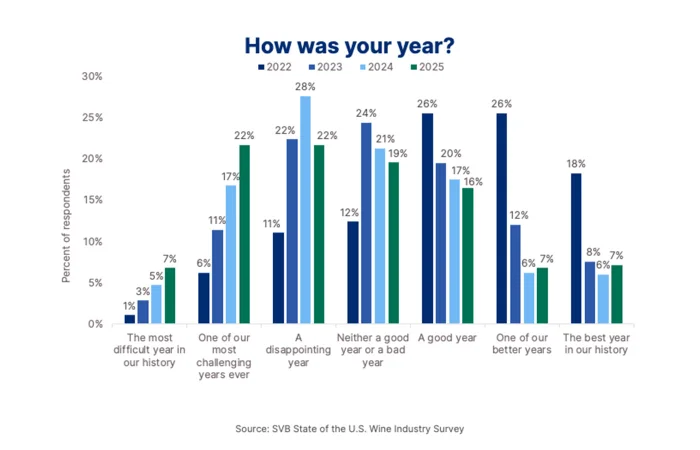
2022
- The most difficult year in our history: 1%
- One of the most challenging years ever: 6%
- A disappointing year: 11%
- Neither a good year or a bad year: 12%
- A good year: 26%
- One of our better years: 26%
- The best year in our history: 18%
2023
- The most difficult year in our history: 3%
- One of the most challenging years ever: 11%
- A disappointing year: 22%
- Neither a good year or a bad year: 24%
- A good year: 20%
- One of our better years: 12%
- The best year in our history: 8%
2024
- The most difficult year in our history: 5%
- One of the most challenging years ever: 17%
- A disappointing year: 28%
- Neither a good year or a bad year: 21%
- A good year: 17%
- One of our better years: 6%
- The best year in our history: 6%
2025
- The most difficult year in our history: 7%
- One of the most challenging years ever: 22%
- A disappointing year: 22%
- Neither a good year or a bad year: 19%
- A good year: 16%
- One of our better years: 7%
- The best year in our history: 7%
The share of wineries reporting a good year increased
Roughly half of wineries rate 2025 negatively, and about one-third rate it positively. However, the share of wineries reporting one of our better years or even the best year in our history increased slightly.
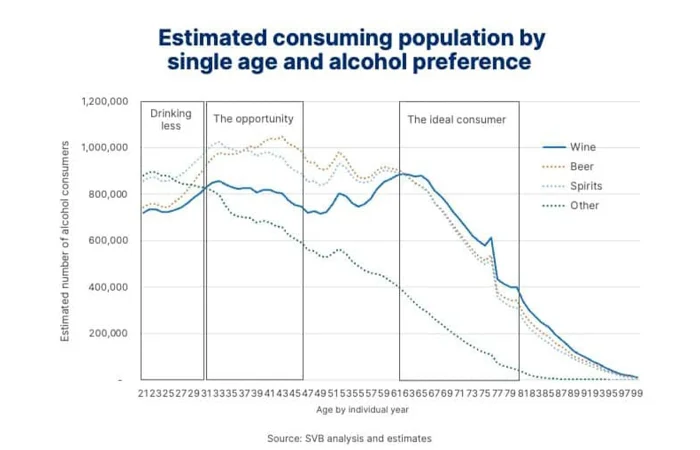
The chart details how many people consume based on age and alcohol preference. The estimated number of consumers ranges from 200,000 to 1.2 million from age 21 to 99, with steady rates in the higher range for wine, beer and spirits but a decline in all categories as individuals age.
Consumer patterns are rewriting the demand curve
Younger consumers are engaging with wine on different terms. These expectations influence the way demand shows up across clubs, tasting room activity and online, requiring wineries to rethink their messaging.
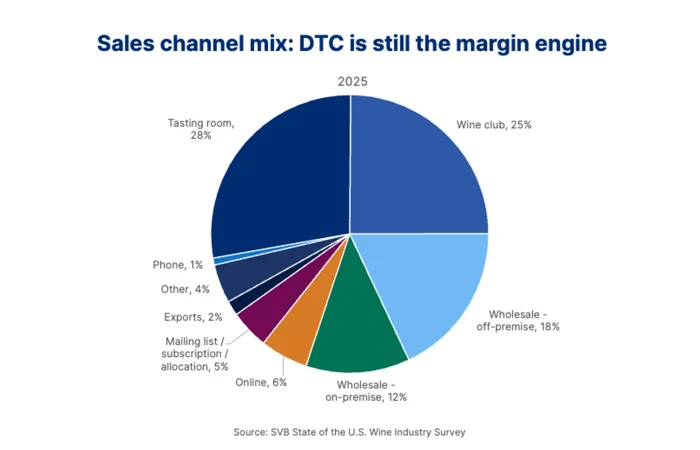
The chart illustrates the mix of sales channels used in the direct-to-consumer market in 2025.
- Tasting room: 28%
- Wine club: 25%
- Wholesale, off-premise: 18%
- Wholesale, on-premise: 12%
- Online: 6%
- Mailing list, subscription or allocation: 5%
- Other: 4%
- Exports: 2%
- Phone: 1%
Top performers treat direct channels as a relationship strategy
The most resilient wineries are shifting from transactional tactics to hospitality-driven strategies that emphasize connection and retention. They're personalizing offers, refining brand experiences and aligning digital tools to reinforce—not replace—the in-person connection that drives loyalty.
Contributing author
Rob McMillan
EVP & Founder, Wine Division
As one of the US wine industry's top business analysts, Rob assesses current market conditions and provides a unique trends forecast in his annual report.

Timely Resources
Insights from our wine industry experts
Read the latest news and insights on key market indicators that impact what you do every day.

2026 Direct-to-Consumer Wine Report
This year's report delves into the US direct-to-consumer wine industry, where it's past the worst of the downturn but not yet at the point of a return to positive momentum.

2025 State of the US Wine Industry Report
The 2025 wine report highlights digital sales strategies and the evolution of wine tasting rooms and provides valuable industry benchmarks to help guide your business.

2025 Direct-to-Consumer Wine Report
Explore how things like marketing tactics, pricing and inventory levels are affecting the evolution of the direct-to-consumer business model within the industry.
