
Market conditions shaping the direct-to-consumer wine industry in 2026
The direct-to-consumer, or DTC, wine industry in the US is past the worst of the downturn, but a return to positive momentum has yet to materialize. This year's DTC wine report and webinar cover this trend in more depth.
2026 Direct-to-Consumer Wine Report Videocast
Rob McMillan, EVP and founder, Silicon Valley Bank Wine Division
Good morning, wine world. Welcome to another edition of Silicon Valley Bank's annual direct-to-consumer wine report.
I'm Rob McMillan. I should start, help you guys know that. I'm executive vice president and founder of Silicon Valley Bank's wine division.
I always like to welcome all the people from around the world. It always cracks me up we have that many people because I was actually writing this report a very long time ago for our customers, and so to think it took off like it did is kind of strange, but it did.
We still have people from Argentina, Armenia, Australia, Canada, Chile, France, Italy, New Zealand, Portugal South, Africa, Spain, Sweden, Switzerland, the UK, the US and as I like to say lower Slovobia. So it's got interest from across the world and, you know, the US is the largest consumer country still, and that's another reason why we get so much offshore attention.
Before we get started, a couple of housekeeping notes. If you turn on the closed caption feature, there's a live transcript button on the bottom, and we have I'm gonna say, Paul, 14 people that are from our organization answering all your questions, and they have for the last couple times answered everybody's questions, so feel free to ask whatever you want and you'll probably get an answer. And then we'll send the link to this recording at the end of this next week.
So with that, why don't we start with introductions. Paul?
Paul Dugoni, Senior Associate/Credit Analyst: Thanks, Rob. I'm Paul Dugoni. I am a senior associate with the wine division at Silicon Valley Bank, and I've been assisting Rob with reports for the last 4 years.
Ed Feuchuk, General Manager, Farm Collective Napa Valley: I'm Ed Feuchuk from Farm Collective Napa Valley, which includes Tank Garage Winery and James Cole Winery, the general manager there.
Barbara Gorder, President, Undisclosed Location: I'm Barbara Gorder. I'm the president of Undisclosed Location, a consulting firm, and I'm also the co-managing partner for the direct-to-consumer wine symposium held in Monterey every January.
Rob: So let's dig in. This is a really fascinating year for me. The survey that we did, we had a good number of respondents—over 400 again.
Paul: Four hundred and fifty.
Rob: Four hundred and fifty. He knows everything. We had a really solid response rate from around the country. And, you know, there's no question that the industry is in a level of transition right now. We're moving from point A to point B.
And the reason that it's more difficult for me this year is because the purpose of the survey was really to see if we could pull out what the folks that are actually still growing and profitable, what they're doing from the ones that aren't—so the successful from the survivors, as I say.
And when you're going through transition, what you end up with a lot of the times is, you know, data that really hasn't been around very long. So we started asking questions like about discounting tasting fees. Well, you know, the industry really started getting serious about trying that really only a year ago. So, you know, you have to pick through a little bit extra hard to try to get it at data.
And, you know, what I like to say right now in this kind of a marketplace is, we have to try things. We have to try new things, and we can't start with the question when somebody has a good idea to say, well, who's done that before because if that's the way we're gonna do this, we'll never have original thought and we do have to change.
The interesting finding that I came up with is when I asked people what they were doing, 95 percent of the survey audience said essentially the same thing, which was we're investing in our tasting room—whether that was, you know, putting additional T and I into it or training tasting room staff or changing hospitality presentations The list that was there is, it was pretty much the same across the board.
But what I'm looking for is next. That's what I want to find, and I hope we can peel some of those questions out of our panel today.
Why don't we start with the forecast on slide 2. So this is the forecast that we had from the state of the industry report that we released in January. And the reason that I want to put this up because this is DTC—not this, this isn't an industry thing, it's DTC—but it's important to understand where we are in the cycle.
And what I said during this presentation was that we were, coming down into 2026, we would have a lower rate of decline, but it would still be declining. And then after that, 2027, 2028, we would see the bottom. It would be bumpy. Not everybody's going to heal at the same time, so it'll just be bumpy. But what we what we find in the in the data is actually encouraging to me, so let's look at Slide 3, please.
So this is a little hard to read, but it's gap analysis and so think about it this way. If you if you made 1 percent profit one year, the next year you'd like to make more so, maybe 2 percent. And so the gap between there is 1 percent, right, 1 percent minus 2 percent, 2 percent minus 1 percent is 1 percent, so that's kind of it.
But you have to look across this—and it's a little bit of a math exercise—the parts in gray are, where things were in the far left side, that's latest 52 weeks—this is all Nielsen data or pretty much all Nielsen and Sipsource—so the 52 weeks in 2025 from, I think this was April. It might have been March. Should, yeah. March 21st.
And then the next gray band is latest 13 weeks. And so what I'm looking for is the change. I wanna know, okay, if we're minus 2.2 percent taking the top column, ultra premium glass 15 to 19.99, if we're minus 2.2 percent, I'd like, when do I get to zero?
And what the latest 13-week argument says is it says 0.3 to the positive, and if you look down that whole line there's a lot of black in there, which by the way I did this when I did the state of the industry report too and there was no black in it there—was I think there was one data line I can't remember what it was, and if you go down that right side what you notice is everything in there is green. Everything in there is a positive change, and that's a sign that we're getting through this. It doesn't mean that we're through it. It doesn't mean that we're not having negative growth. We are. We're having negative growth in revenue, negative growth in dollars still—pardon me—in volume still. So we're not done with this, but there's something to be hopeful about because we're on the path. Whatever we're doing is starting to work.
And then I like to go to that bottom part of the slide, which is looking at wholesale and retail. So if you look through the entire supply chain at this point, what you would like to see is the retail component lead the correction, lead the change. And so in the same way, what I want to see is the difference between wholesale and retail, so wholesale using Sipsource and retail using Nielsen.
And so we have the same kind of math that we do, and if you look at the gap, retail to wholesale, again it's green. And so again it doesn't mean that it's positive. It's not positive, but the difference between wholesale and retail is a positive, and we're not shoving more into retail than is being taken out is I guess the best way to look at that, and so that's positive too. So that's all I think good.
Let's go to slide 6 and see if I can remember what I was going to say—oh yeah, so what I was going to say on this one was the data show themselves not just in in syndicated data. It shows itself in the survey data as well. So this is from 2027 to 2025, and you can see the shape of that line. We can argue over different points of it, but the reality is that we're moving in the right direction on that right side, and I can go through a bunch of other data and show you where it looks good, but the good news is we are moving in the right direction.
Again, I can't say it enough, we're still negative, and we'll be negative at the end of the year, but I think 2027 and 2028 are the bottoming periods before we kind of turn this around.
And there's a lot of work to do before we get to that point, so that's all I got for an intro. Barbara's always got something to say.
Barbara: Generally speaking, yep, but I think the important thing about this is that we talk about this slide number 2 where you spoke about. This is obviously not a DTC slide, but it's an overall slide. And it's really important to understand that this was a period of time between 2019 and 2026. We went from 7,500 wineries in the United States to 11,000. That's baseline economics in terms of the increase in competition, and that's overall.
And that's something that people are facing. That's a real thing. So, in any CPG, any kind of thing that is sold, once you face competition of that type, what do you have to do? You have to advertise, and you have to recognize the competition, and I think that's exactly where we're at and that's what that slide sets you up to do.
Rob: So that's the word next. That's the that's the word for the day is next. What is next, and advertising is one example in some form or fashion?
Barbara: In some form or fashion, and I think that the wine industry has to get serious about it. I think that there has been the boomer-esque phrase my wine sells itself. We all understood that that wasn't terribly successful. Now somehow—
Rob: Except in the 90s.
Barbara: In the 90s, yeah, there was that. When there were a lot fewer wineries.
Rob: That's right.
Barbara: But then now it's like my wine is so authentic, it's so good, it's this or that, my audience doesn't expect or want to be advertised to. Actually, they do. They want to hear from you. They wanna identify with you, obviously in a way that's emotional. Maybe it tells a story, maybe that's it. Ed, you can speak to that certainly.
Ed: You know, there's lots of things hitting the industry right now that's no surprise to anybody. I think, though, the silver lining is there are lots of opportunities in the entire funnel to address. Some of the ones we're gonna talk about today are really about wineries that are successful or having a lot of success in the middle of the funnel. But to your point, there's a lot of low-hanging fruit in the top of the funnel. These are things through brand awareness, advertising campaigns.
And the funny thing he mentioned, which was what's next and your thing is it's advertising, is that's a that's a total winery trope, which is it that's been for every other industry for decades advertising has been sort of crucial to what they do. But us in the wine industry have been reluctant to do it. You know, Instagram and Meta ads have made things a little bit more democratized, so smaller wineries can get in. But I think some of the other opportunities are kind of more large and collective potentially, which we've seen in a lot of other industries. Got Milk campaigns and California raisins.
Barbara: We are at the juncture of where AI and the possibility of AI from a from a democratization point is meeting media at OTT and CTV, over-the-top television or connected television, where you're seeing systems like Klaviyo and actually able to put your own customers into a media mix, into top zip codes at a way that's affordable. You don't have to be a huge enterprise.
And I think it's important for us all to realize what we need to talk about is DTC, which is luxury marketing, which no one really likes to talk about and never likes to nail, but very few DTC brands are selling wines that are less than $25, which would be considered ultra-premium. And obviously, way up from that.
So there's the juxtaposition also, it's we're a luxury brand, but we wanna be approachable and we wanna be able to talk to people and talk to consumers in a way that makes them identify and wanna be with us, right?
And that's emotional and that's the opportunity that we all have. It's no longer what I like to tell call guide-dog truck where you see the same the same image over and over again in the flyover of the fields. It's let's do something really cool and really interesting.
Rob: It is fascinating to think, anybody that is in business recognizes the things that you need to do. Like, you need to go where there's opportunity, obviously. Advertising is kinda normal. You wanna differentiate yourself.
And this is again one of those super interesting things I found out about the survey is largely the winners or the successful from the suffering, if you will. They're all doing about the same kind of things. There's the ones that are winning, they're actually growing like by 20, 21 percent, something like that, Paul? Yeah. And then the they're profitable, in that upper quartile.
Barbara: It's the trope that in good times, you should advertise and in bad times, you must advertise. That's what people will say.
Rob: Yeah, and what we see is the less successful—and we draw them out and you'll see it in the report—but the difference with the less successful is all they're doing is focusing on the inside. They're focusing on the tasting room, they're focusing on the people, they're focusing on metrics that all identify cost savings, budgeting—and both sides do the same thing. The other side's executing in a different way with an external focus essentially.
Paul: Do you want to jump to slide 8? Just a second. Yeah. I was trying to figure out which way I wanted to go. Thank you.
So here's some comments that we just put—these are real comments or they're maybe agglomerated comments, in some cases, we had more than more than one person say pretty much the same thing—so as an example of doing something different, it's interesting to me that, you know, we have an industry that has right now declining visitation and has gone through a real difficult reset if you want to think about it that way.
And so the answer to that is that we're going to invest more into that part of the industry that is on a decline, which is really fascinating to me because when we have an opportunity to differentiate ourselves, try to find next, you know, in a different way, there's so many different ways to do it.
When you look at the people that say what they're doing in terms of the channels, here's what some of them say. So they're having virtual tastings and remote engagement, shipping tasting kits for off-site experiences, private events outside the winery. And by the way, the small events end up working out far better than the large events.
I think part of that ends up being, trying to think through, we selling wine? Are we selling an experience? And okay, I get that it's an experience. We're kind of providing an occasion for people to come together.
We're probably not identifying enough occasions for outside the tasting room. If we continue to insist that people have to come from wherever they are in the United States or world for that matter, and they have to make it to our front door, let's just call it there's opportunity. I've said many times, I'd worry about the industry except we haven't marketed in the other 49 states yet. And so there's a wide opportunity.
Here's a couple other things that the successful ones said. They're spending more time in key markets with customers. Some of this sounds pretty obvious, but this is what's showing up right now.
Hosting events in our top consumer region, taking the brand to the customer instead of waiting for visits—kind of a pet peeve of mine—and building stronger relationships with fewer customers. And I we didn't talk about it, but I know data, know, falls into that thing as well.
So let me let me throw out one example. And I've never run a tasting room. So, you know, my idea is taken with a grain of sand. Sand or salt? I think it's salt, yeah. A mixed metaphor. I don't know which one has the sand. Maybe there's not.
Barbara: Like sand in the hourglass? I know, that's where I was going.
Rob: Yeah. I know. One of the things that I'm thinking of is, you know, what would I do if I was owning a winery right now? I would want to build my brand, and I would want to build my brand outside the tasting room. I don't care if that's by internet. I don't care how you do it. Find a channel because we've got to replace the decline in that one channel that we do have.
So one example of out-of-the-box, I don't think it's been done yet, but it's going to another region. Let's take it, you know, down the Rockies as an example. If you go down the Rockies, there's far more affordability with consumers. There's a lot of working professionals, especially post-Covid, a lot of people move to those areas. So they're growing. They have families, they have disposable income, which is, you know, that is what we're looking for. And so I talked to, when I was in Washington, to one gentleman who has an employee in the tasting room who's moving to Bozeman.
And I said, you know, perfect time to try this. You know, get that person in Bozeman, give them a card that says ambassador, whatever you want to call it, and let that person get involved in the community. So when I say taking the experience in the road, it's different from going to a country club and having a wine dinner, which is fine. Do that.
But if gonna build a brand, it's how you're gonna repeat that. How are you gonna go and layer on top of that, you know, different touch points? How are you gonna manage that data? And we don't have any examples of that as far as I know yet. But, you know, you're gonna wanna track that and you're gonna wanna figure out over a period of time how to how to do it better. And then you're gonna want to repeat it. So that's one example.
Barbara: But there's a lot of people that are doing really interesting things right now. We're talking about for Blood of the Gods in Walla Walla, which is heavy metal, art, wine. I mean, those putting those three things together, wine isn't necessarily the leader, although there are people who are very serious about wine who are attending it and showing there. And so, you have people that go across all different ages from boomers all the way to Z, and they might be more interested in the art. They might be more interested in the music, and wine is there. So I think we're gonna see more of that, and I would say that's an admirable effort. That's what we should be doing.
Rob: No question, I think people are working harder, and now it's trying to figure out how to work best. I think that's another component
Barbara: Yeah, find new folks.
Rob: Paul, you have a slide you wanted to go to?
Paul: Let's jump to number 12. I think we're here to talk DTC. So let's talk about the different channels of DTC and where we're seeing some success.
I think the thing that stands out to me on this chart—we're looking at 2016 through 2025—the growth in wine club throughout that period, and if you add in the allocation members too, that growth, wineries need to really lean into their core members. The people who keep the lights on for your business, lean into them, support them, take care of them, make sure they have great experiences when they're there, make sure they tell their friends about your winery. Those are the ones that are gonna really keep your lights on. What do you guys see at Tank Garage?
Ed: That's huge. Yeah. I can get deep into the weeds on that and how we've sort of, you know, sort of expanded our subscription club models out.
Rob: Weed away.
Ed: Oh, man. You know, there is a sense to, and we talked about this a lot, which is like, they're our best customers. There's still probably capacity for them to spend more with us, but there's a fine line to walk, because if you squeeze them too hard, then they're gonna start churning pretty quickly.
And that's one of the things that kinda, you know, it stands out in the data for me, which is the rate of growth of club membership is declining and, you know, I think last year, we were about the responders were about 2 percent in growth, and we're becoming, you know, with the allocation data in here, we're becoming more reliant on wine club than ever. It's becoming a bigger composition of it. And then there's some data later on that we can talk about, which is—I don't wanna say it's alarming, but you can see compared to 10 years ago where our conversion rates pretty much across the board by every region have been halved.
So it's easy to say, hey, we can take this wine club, we can increase their average order value, we can jack up prices on them. I don't know if that's a solid long-term strategy. But I think the data is borne out that a lot of wineries have, you know, at least increased what they've gotten out of the yield out of each member.
The interesting thing from this slide right here, slide number 12, is that to me, the internet one, which is, if you went back 4 years ago, we were all, you know, singing the praises, hey, we're all going digital, we're converting digital.
Rob: That's the red line when you can see it, 16 percent over 2020.
Ed: Yeah. So we peaked in 16 percent in 2020, which, you know, is an outlier with the knowledge we have now. And we've kind of just descended down since then, and we've settled back at 7 percent, which is, you know, a mere 2 percent more than we were 10 years ago.
And, you know, I think a lot of us were optimistic during Covid that, hey, consumer behavior is changing, and then this is also giving wineries an incentive to invest in digital strategies and technology and people that understand how to successfully sell online.
But I can't sit here and say, based on the responding data, that we have had overwhelming success, on average in a broader sense. I know there are certain wineries that are just crushing it, like just killing it online right now. And it goes back to, I think it's slide 6 here, we're just talking about the wineries that are winning versus the wineries that aren't winning. But overall, we haven't successfully turned digital and online into a meaningful channel.
I think maybe in its best use case, we've used it as, you know, to Barbara's point, we've used it to drive customers down our traditional funnels, which is getting them in person and then converting them to members there and then, you know, extracting money from them. But it's—
Barbara: Yeah. But you also have to think about the K-shaped economy, right? I mean, this is this is not done in, you know, people. Wine is a product that you don't have to have. So it's a luxury product.
Rob: Well, speak for yourself.
Barbara: Talk to my husband, he thinks so. But it's a luxury product and it's being hit by the economy, quite honestly. And so how are different portions of that and how are different portions of the DTC overall stratosphere going? And, you know, in the larger, higher-end wines where you're talking about $75 plus. You can talk about, they're doing pretty well. Most of the people that I know anecdotally are doing really well. But it's people who are in the middle where it's casual. I mean, it's the middle class consumer, upper middle class. And so, it's the lack of tourism as you pointed out, the K-shaped economy and so it's not just about digital, right?
Paul: Yeah. Should we lean into that top K?
Barbara: Should we lean into those people who have seen asset appreciation and have Napa Valley?
Paul: Yeah. But even the even the visitors who come to visit us. Some of those people in other regions have done really well when they come here.
We give them the best experiences and really try to go over the top to lean into those.
Barbara: I think that the more that people can align with their tourism bureaus and from an efficacy standpoint, I mean look at what Temecula's doing is great. I mean, Patricia O'Brien, who's on our committee, is very involved. Vintners have a seat at the table, how they're working together. So that's, you know, where tourism is doing really well.
Paul: Yeah. Good way to drive traffic.
Rob: Big elephant in the room, I guess, when you get to this point is discounting.
Barbara: Uh-oh.
Rob: Yeah, because if you if you say, well look what look what's happened to price over this long period of time and if you believe that that might be impacting sales in some form or fashion, then what are you gonna do for discounting?
And let's go to let's see, what slide was that with that had the tasting fee Sorry. I should have been prepared for that. Let's go to tasting fee. So let's try slide 13.
And so this is kind of what we're talking about, you know, by the year. If you look at standard tasting fees versus reserved tasting fees, they both show that they're trending down.
And we were talking about this last night over dinner. When was the last time that anybody went into a luxury-brand store and there was a 20 percent off sign on the front door when you walked in? You know, that really doesn't work. And so we're talking about, okay, well, as an example, what are people doing with tasting fees in order to reduce—they're reducing the fees, you can see at least the rapid per-person revenue.
But here's the thing is that they're not generally speaking just taking a 20 percent off strategy, and it's really difficult to do that in a luxury product.
But and by the way, that our luxury, if you look at what's happening in luxury around the world, it's the same stuff. It's same stuff. The K shape. The wealthy are doing one thing, and then everybody else is doing something different.
And then most of the wine clients typically are above $100,000 in income, which is in the Bay Area not very much. But, you know, that's where they sit. And so that's when you look at the K-shaped economy we're talking about, the wealthy doing better than the people that don't have wealth at all, which, you know, that that kinda makes sense. You see that in many different countries as well. But the upper part of that is still resilient, and so the opportunity is there to do something.
One of the things that is happening here with tasting fees, and I think it's really important to bring out, is it's not necessarily somebody saying, well it's 20 percent off everything. There's plenty of examples of people that are trying something new, and again I keep telling people that'll listen, don't say who's tried that before. Try it. Just try whatever the idea is. If you think it's got a chance of success, because somebody—and your staff has got an idea they think is great—listen harder and test it out. Test it with your wine club. Try the idea.
But I see a little bit of something that's happening that I appreciate, which is to try to attract a novice consumer. I don't care what age you want to put them at, but if they're a novice consumer I'm going to bring them into the tasting channel with probably whites that I make.
Whether that's if you make sparkling, fine, but, you know, a few whites and then you hear about some people that are actually having experiences that are shorter, and kind of going back to the old style of tasting where you show up to the bar and what do you, you know, what do you want? We can choose from, you know, four of these different things and you could be out of there in 20 minutes. And so you charge less for that. So in a way that's discounting, but you're engaging with that novice consumer.
Objections I hear all the time—matter of fact, there was one of the questions that one of the respondents sent in—is how do you how do you spend money on these consumers that don't buy? And my answer is always the same, is how do you not engage with those consumers that are trying? How do you not engage with them yet? You have to.
Barbara: It's also interesting in this particular chart if you can compare that chart to the chart that's the number 2 chart that we looked at. So the increase in tasting fees happens to just be exactly how people are trying to recover sales revenue. So if you look at the dip in revenue that goes on between 2020 and 2026, people are raising tasting fees in order to mitigate their losses. Yeah. And so, I'm not sure that as a sales strategy that's working for people.
Rob: Go ahead, Paul.
Paul: Yeah. Even, even though it's declining there, can see it's almost two times what it was pre-pandemic. Like, they're still up pretty substantially.
And so finding a way to engage more people in general. If people come in to the tasting room and they're not buying, like, give them a better experience. Take them, give them an extra pour. Take them on a little walk around the seller to further engage them and introduce them to your product.
Barbara: I think it's an emotional component too. I think that seeing what people love, whether it's the manufacturing process, the picking process or looking at the barrel room or understanding the people that are actually making the wines and learning about them, at a really personal level. When you know those people and you like and identify with those people, that's investing in the brand. And I mean, there's, you know, that's definitely what you guys are doing at Tank Garage. I mean, in terms of some of the people that are working there and some of the people that you want to attract as customers.
Ed: Yeah, I think so. I mean, this is an interesting one because there's other data later on, I think some other data that may not be in this report, that just talks about wineries that decreased their tasting fees or introduced a lower-price tasting fee, like a lower barrier to entry, and whether it had had an impact on their visitation. And I think the data so far is pretty much unconclusive.
Rob: They haven't been doing it long enough.
Ed: Yeah. So that's not to say, like, it won't have an impact, but we were having this discussion at a micro level whether, you know, decreasing your tasting fees from $75 to $50 will have an impact on the consumers, and I think generally we're like, the consumer's probably not even aware of that, right? And you're probably costing yourself money, but perhaps over a long period of time and across multiple wineries at a macro level, it will make the cost of participating in wine less expensive.
But there's other things that, you know, airfare needs to go down and hotels need to go down and driving services need to go down. So I think it'll be interesting to see how this pans out if wineries continue to kind of shift downward a little bit and sort of just rebalance out where things have been. But I think it's gonna be a long time before we have any conclusive data whether this is actually beneficial or not.
Barbara: Because you can't test for it.
Ed: Not really.
Rob: People are trying different ways to do it. Bundling is an example instead of, you know, a case you're selling four bottles and you're bundling in different ones instead of discounting, you're blending them in with the four so you really can't tell what's happening. But people, you know, they get it. I think AI is gonna end up being a really interesting thing to apply toward pricing strategy. I think you'll be able to actually take that and do something really interesting with it.
Barbara: I think the other thing that's gonna happen and has been happening—and this was a subject to the conference last year—is collaboration.
Rob: Which conference would that be?
Barbara: That would be the DTC conference that you're coming to.
Rob: That would be in Monterrey in January.
Barbara: The 19th to the 21st of January 2027.
Rob: Be there.
Barbara: Yeah. Because you will be.
Rob: I very well might be there.
Barbara: You just said you were presenting. Exactly.
Rob: The state of the industry report. So yeah. That's an interesting thing we're talking about too, but she spilled the beans.
Barbara: Yes. It's always my fault. But the point in in point of fact, what you're thinking about, though, is how are you taking these tasting fees and then turning it into something that's palatable for the consumer? Well, you know, Wine Atlas has been doing a great job with, you know, all the different wineries all over the country.
There are different organizations. The Hall family's been doing a great job. There's a lot of different organizations in a lot of different places, and that gives value to the consumer because they're not just going to one winery or even two, they're going to four or five or eight. And so that a winery I'm gonna wanna keep on my list when it comes to, hey, I've got so many wineries, the one that gives me the most opportunity, it's probably the one I'm gonna be more likely to keep.
Rob: I think the thing that everybody's pretty clear on at this point is that when we talk about the price of wine in these, you know, it shows up in these tasting fees, but we're also paying for an experience as well. And so the basic issue is value.
You're trying to provide value, you're trying to provide some stickiness for a consumer, get it to come back, which is I always screw this up but it's quality over price or perceived quality over price and so—
Barbara: Price-to-quality ratio.
Rob: Price to yeah. What she just said. And so the idea is to not just focus on price there. I don't know, how many Ps in marketing did we decide there are?
Barbara: I'm sure pretty sure that there are three or four, depending where you went to school.
Rob: So it's, you know, they're all the P, pricing, promotion—
Ed: Placement.
Rob: Which one?
Ed: Placement.
Paul: Product. There's the four.
Rob: There's at least four. I always like to add the seven dwarfs, and you always forget Doc.
Barbara: Sleepy. Sneezy.
Rob: So, you know, we can go down those other areas, and we start to think about value. And again, my biggest encouragement is think outside the current construct. We can't just hang on to what we're doing and make it better in a declining market. And it's showing in the numbers that we're doing some of the right things, and I do think like I said earlier, I do think we're trending toward a bottom in reasonably shorter. It doesn't mean we're gonna turn around, you know, and everything's gonna go back to the way it was. That's not gonna happen in my lifetime, I don't believe. Not like it was like say 2020 at the peak. That's a long way to go from here.
Barbara: It's not a reset, it's a reinvention of the category.
Rob: I think that's a great way to say it.
Barbara: That's what we're in the midst of doing. But back to the collaboration piece of it, it also provides one of the great things in wine is gifting. I mean, what are you gonna do with it?
You know, I'm part of Wine Atlas. Blenheim, you know, is on the other side of the country. I can gift it to my East Coast relatives. It's something to do before their wedding. So it's like it gives you different opportunities for wine. And anytime you give the customer different opportunities in gifting and interaction with the product, that's opening up another channel for you to make money.
Ed: That's true. The one thing that we you've led off with, Rob, is, what's next? And I think what we've been talking a lot about are, you know, we talked about the K-shaped economy, but I think we're seeing like a K shape, wine industry, where the wineries that are winning are just accelerating what they're winning. And there are a couple of key traits, which I think you narrowed down that I think are the most interesting part of this thing. And I don't necessarily think this is like a sort of everyone should follow this advice, but this is slide 8.
And it basically talks about top 25 versus lower 25. We talked about this a little bit earlier. And the thing that's really interesting to me is not necessarily, hey, everyone needs to follow the things the top 25 is doing, but just calling out that there is success happening right now, and then, you know, at a smaller level, kinda dissecting, like, what is it with these brands that are kicking ass, that are doing well, that we can sort of take for our brand? And so one of the things I thought was really interesting, but I don't know if it's the message should be that everyone should adopt this, is that these brands are less likely to discount, and they're actually more likely to have held prices or carefully raise them.
And so, you know, a takeaway could be we all need to jack up our prices and then capture as much money as possible, but, the question I ask Rob is, how many of these brands are being successful because they've increased their prices versus they're strong brands and so they have the luxury of not having to discount?
Rob: I don't know the exact number obviously, but we do know by looking at the response rates that by far the successful ones are the ones that you don't necessarily have to raise price but you at least one of the respondents said, you know, holding price the new raised price. That's an admirable strategy to try to hold price, but you've still got to improve value so you just can't stand still, you know, in this especially in this market everything outside you changing to think that you can continue to do the same thing doesn't make sense to me.
Barbara: Being distinctive is super important, and I see that in whether it's varieties that you have that are able to sell like a white Grenache or an Albarino or something that's unexpected. I've never tried that before. I think people across all generations want to try different things than the top eight brand, you know, varieties that we all know and love.
And I think that the other thing is is, how are we actually going to be talking to them about what it is that you have to do? In other words, how are you interacting with that brand and keeping it consistent and doing that? That's hard work.
Rob: And we don't want to do it and lose our soul either. Whatever we're gonna do, it's gonna be additive to what we do, who we are as an industry, and that's hard.
Barbara: Transparency, you know, all of those things, organic, really important. You're seeing it up 8 percent year over year.
Rob: It's a little unfortunate, but right now I finally believe that everybody understands what the issues are and they repeat them over and over without trying to hide from them. And in order to fix a problem, you have to identify the problem and you have to be willing to accept that that's a problem, and then you can start to find solutions. I do feel like we're at that solutioning point, and that's the part that I think we all should focus on in the next couple years in particular.
I don't spend a lot of time anymore talking about where things are going from a standpoint of, you know, what's happening with the consumer. I don't spend a lot of time talking about because everybody gets that now. So let's start to talk about something else. The success guide is one of the ways that we're, you know, we're trying it, but, you know, we'll evolve ourselves.
We're gonna find new things to do to make ourselves relevant in Silicon Valley Bank. And actually, it's Silicon Valley Bank is actually First Citizens Bank, and that'll be official for us in October. So this is the last Silicon Valley Bank videocast as it turns out. And I didn't intend on saying this, but I'm actually very proud to be a First Citizens Bank employee.
And the reason is because when First Citizens rescued us, honestly, they came to us and said, look, we don't know what you do. You do. So keep doing what you're doing and let us know what you need. And they've given us all the support that we could possibly imagine. They've given us more people, they've invested in us. I mean, when I see what's happening elsewhere, we're very, fortunate. And so I'm gonna be very proud to be branded First Citizens Bank. And I think I even have a—you can't quite tell, it doesn't work very well—but that's a First Citizens logo.
Let's see. We should go back to change the subject. We touched briefly on AI. I think you got a question though, Paul, about AI.
Paul: Yeah, maybe we'll start with like, Ed, what are you guys doing in your business to like utilize AI?
Ed: Oh my gosh. That's a 3-hour question to answer here, and I'm sure people would have responses.
Rob: Is it gonna fix everything?
Ed: AI is not gonna fix everything. I saw this quote from a software developer I think on Threads 2 weeks ago, and his overall stance, which I think is one I've slowly adopted was, the people that are way into AI are way too into AI, and people that are afraid of AI are way too afraid of AI. And I think—
Barbara: That sounds true.
Ed: There's also this phrase, you can say this in a meeting, can always say, all about finding a balance and everyone will nod their head. That is kind of, I think, where we're at with using AI because the large-language models have made things like writing tasting notes easier and coming up with subject lines easier for our team.
There are tools like from everything from Commerce7 to analytics that are using machine learning and AI to surface more information for us so we can get more insight and target segments and cohorts more efficiently. But we're not there yet from like an AI standpoint where a human is removed from the loop and these brands build and run themselves. And so right now, it's use utilizing the technology the best we can in a way that's tasteful.
And, you know, to be frank with a brand like Tank Garage Winery, all of our wines are one-offs. We have big marketing launches for every single one of them. There's a big creative onus for us. I'd say there's nobody out there that has more experience building and launching small little products than we do. And so AI has been helpful for that. It's sort of replacing or augmenting the more menial tasks of that.
But we also have to be careful because, you know, if we push too far using generative AI to make a graphic, then there's pushback because our customers are saying, hey, that's not what we came to you for. We want, you know, we want human experiences, we want artists to work on these things. So our experience with AI has been pretty interesting so far, but I think as this conversation continues to permeate our society, this is going to be a long-term story that I think 10 years from now we'll be able to look back and have a clear idea of like actually where it got its tentacles in and where it made our lives better and where it didn't.
So what have you been using AI for?
Barbara: I mean, I use it as an editor all the time. It's a terrible idea generator. It's not far along enough yet.
Rob: It says everywhere underneath it, it says AI makes mistakes.
Barbara: Yeah. And it wants your sympathy but, it's great as Ed said for some of the real baseline things. If you wanna take 500 words of copy and then drill it down to 250, it does it. And then you just go over it, know. That's a great thing. You know, I showed you the—we're launching ticket sales today for the DTC wine symposium, so I showed you our little, you know, graphic and that's all done in AI with the angry grape. Fantastic. I mean, I couldn't have—that would have been way over my budget.
Rob: For those of you didn't see it, but it's a video. But where is that video gonna be played?
Barbara: It's gonna be on LinkedIn, and it's gonna be on the DTC wine symposium site.
Rob: It's a mad grape running through a golf course.
Barbara: Doing a lot of different things.
Rob: Yeah, so it's pretty cool and that's AI-generated and so it's possible. I think one of the things about AI is, first of all, there's fear of the unknown. It just exists.
Barbara: People are afraid of it.
Rob: They're afraid of it. But, but second of all, I think that kind of fuels this adoption problem with I don't know how to use it, so I'm not going to use it.
And I feel like I'm a late adopter, but I'm an early adopter I think for people around me. I really started getting into it lot last, I'm gonna say, January a year ago, so 18 months, which sounds like it's not very much time but in the AI course of the world, it's actually a lot of time because it hadn't been around that long in a useful way. But the growth in AI is so extreme that I consistently tell people, look, you just got to start. You gotta start, you gotta understand and the only way you're gonna understand is just to get in it and just start by using it like Google. Instead of searching on Google, search in, you know, in your AI app that you've uploaded.
And yes, the way we're gonna use AI most is everybody's gonna embed it into what they do, like Google for instance. When you search on Google now, it's screwed up all their paid placements now, but when you search on Google it actually, you know, uses an AI back end and it's everywhere.
It's LinkedIn, it's, you know, name your place. So we'll adopt it. I think we're already adopting it in a lot of places, you just don't see that you're adopting it because it's embedded in the company that's doing things. And you brought up analytics and Commerce7 customer vineyards is another one, and I know all of those guys use AI to try to sort out the opportunities to go find that customer. If you if back to one of the questions that people asked about AI is like, well, can you tell me who to go after? Can you tell me how to segment my opportunity? And yeah, it'll tell you something.
It may not be right, AI, when you talk to it. It doesn't always say, I'm guessing here, but it does a lot of that. So you have to be a little bit careful with it, but there's a lot of stuff that you can't get still. So I don't care if you want to use AI to the highest degree unless you have a database that backs it up.
For instance, consumers that you can look at. You bought a customer list of people that make over $250,000 for instance, that send their kids to private schools that take Cigar Aficionado if that's even still a magazine that's around.
Paul: That's a deep cut. Thank you. That and Cat Fancy magazine.
Rob: I don't know any of them. I'm showing my age. But, you know, you can buy those lists and so that's a possibility too. But all these other companies that we just mentioned, they all have those lists, they use them and that's probably for that kind of a thing more the way we'll more the way we use it. But beyond that, I think in the vineyards for efficiency in particular—not only efficiency but just doing it better—and then really efficiency in the tasting room, it's just going to drive a lot of things.
I'm kinda going on too long here, but back to the fear of the unknown. There's a lot of people who say well, I'm gonna lose my job. Well, things don't always work out like you think. So everybody says that we're gonna reduce the job force. Okay. Fine. But I remember in the early 1980s, 1980, as a matter of fact, I was a new employee at a large bank that still exists, not on the West Coast anymore. That'll narrow it down.
And somebody came up to my desk and they said, if you've ever seen The Graduate, the movie, you know, the line from that was the plastics, you know. And so this guy comes up to my desk and he says, recreational goods. And I said, what? He goes, that's what you want to invest in, you know, like Coleman and Brunswick, sports equipment, stuff like that. Why do you want to do that? Because we're gonna have personal computers. Everybody's gonna have one, and it's gonna save us all this time. This is gonna save us some, give us all this free time. Well, guess what? We produced so much data that we had less time and we created more jobs. So don't be afraid of it. Just jump into it.
Ed: I've got an example of that back to the AIF thing, which is, in a way, it has commoditized certain things. I had a good conversation with someone on LinkedIn a couple weeks ago about writing blog posts for like a SEO funnel. And, you know, historically, it's been a big moat because it takes a lot of time to write these blog posts. But now, everyone can write these blog posts, right?
Rob: And they all look the same. And it's crap.
Ed: They've lost their value.
Rob: Can I say crap?
Ed: I think so. Like, our experience with us is, you know, we've always prided ourselves in writing really interesting, irreverent tasting notes, and we still do.
But we can see in our data, our consumers are reading it less and less, and so the value of text has gone down as, you know, being able to generate this text easily has gone up. And so this has shifted consumer behavior I think, but it's also shifted the way we've had to do things, which is now we're like, alright, we're not gonna write we're not gonna spend a lot of time writing these tasting notes. We're gonna spend a lot of time making video tasting notes because we know people are consuming them in small, you know, chunks. And so in a lot of ways, AI is coming in and it's making a couple things obsolete.
It's shifting consumer behavior, but there's lots of opportunities for people, especially in like wine marketing to be like, okay, I no longer need to be awesome at writing. I no longer need to be awesome at spreadsheets. I have technology to do that. I can focus on something that has more of a like a creative onus to it. A human aspect to it. Acquisition's a good one. And those things are probably, you know, at least the data's showing are where things are most valuable still. So there's silver linings there.
One more thing on that, we had a good conversation about this yesterday driving down here, is I think there's a really good opportunity for AI in what we know as wine clubs or subscriptions. And we've talked long about this sort of evolution of subscriptions in wine clubs, whatever you wanna call them. But I think the big opportunity is using AI to help make recommendations for consumers.
So we went from, the winemaker picks out what they think is cool, and that's what you take, and you're happy to get it. And then 10, 12 years ago, we have, hey, you can now customize things, but it still requires the consumer to go in there, log in, make a choice. They often don't know anything about the wine. And I think the best opportunity for, you know, platforms like, you know, Commerce7 and OrderPort and Shopify, Atomic, Winehub, is to figure out a way to profile customers, and so you can build default releases on their behalf.
And that not only will help, you know, ensure they get the wines they will probably like the best and keep them in the club, but it's actually like a really easy, compelling selling point in the tasting room where you're like, what do I gotta do to join this club? It's like, we're gonna figure out some things what you like now, and then it's gonna just get you the stuff you want. You don't have to worry about it, and then people will sign up.
Rob: Got another just, and then we'll get off AI. But one day when I figured out that I could upload a file into AI and say, make sense out of this, and it's something as little as that, and then it can take and do the advanced math to get you things and ideas off of your own data that maybe you just missed, you know, like it could be something—I know a lot of people do this—but figuring out when are people going to leave a club, that kind of behavior, but there are all sorts of ways to use it.
I'm gonna switch gears in a big way, Paul, because I'm gonna put you on the spot because this is your chart but on its chart 29 and Silicon Valley Bank, First Citizens Bank—I'm gonna have to get used to saying that—but we have financial statements that we have in a database. We've been doing this for since before 2020—I'm sorry, since before 2000. We came up with, and way back when it was an access database that was handwritten for us by a programmer in 90days and that lasted for a number of years, but we've always been able to take these financial statements. So this is real data, and take a look at them, and it goes a lot deeper than this. But Paul, this is kind of your area.
Paul: Yeah, so this is average of about 100 different wineries. And so you can see to Rob's earlier point, the sales growth is actually there. DTC-heavy brands, we bank a lot of DTC-heavy brands. There is some growth in those categories. Margin's been pretty flat. There has been some discounting. There's also been some channel shift, whereas wine that used to be sold in wholesale may now be selling direct, a little bit higher margin. And that's kind of helped stabilize margins.
And then the biggest thing right now is profitability, right? So it got better versus last year, but it's still negative, right? We have almost 50 percent of the wineries are not profitable, and so it's driving more revenue. It's trying to increase your average bottle price. Different ways to increase that. It's cutting expenses.
The wineries that are having the most success that are in that upper quartile, they're very detail-oriented. They're looking at SKU-level information to see what wines are profitable. They're doubling down on the SKUs. If a wine is not profitable, they're getting rid of those SKUs.
They're hyper-focused on their OpEx expenses. They invest in their tasting room. They invest in their staff. They make sure the customer is having a great time and appreciates the brand.
Ed: What about the mix of, are there any other traits whether they're in wholesale or not in wholesale, whether they have estate models versus they source their grapes or their juice? Are there any sort of indicators you're showing, you know, this quadrant's doing well and this quadrant is over born with burden?
Paul: Yeah. Think I think it's pretty obvious that the best-performing wineries right now are sourcing grapes because they're taking advantage of cheap fruit prices and they sell directly to their customers. The channels that are having the or the segment that's the hurting the most right now is wholesale-heavy. They don't have a lot of control over their sales channel. They're just kind of at the distributors' good graces if their brand moves. And then also, they are sourcing or they own all their vineyards, and so there's a lot of—it's not easy to adapt, right? There's not a lot of optionality they have. They have these vineyards. They have to bring in the fruit.
A lot of wineries have excess inventory right now. That's why we're seeing a lot of discounting. That might be an opportunity to bring, you know, people on who are marginal wine buyers or on the lower half of the K, try to bring them into wine. If you can get them really, really good bottles at a good price and find value in it, maybe they become wine drinkers for longer.
Barbara: And what's the average case, you know, in terms of the size of the people that are on this chart?
Paul: Probably about 20,000 cases.
Barbara: So that's the average?
Paul: Yeah. Around there.
Rob: So what's the average price point?
Paul: Average price point? About probably $75, $80 per bottle. Somewhere in that range. A lot of Napa, a lot of Sonoma, a lot of Pacific Northwest.
Barbara: Are you able to segment to lower sizes like 5,000 cases and low below and versus larger?
Rob: Well this is our own data, and we're very protective of it because it's client data and by regulation we have to be protective of it. But, you know, we can do benchmarking for our clients and show them okay, you know, you're one of five Cabernet producers on Highway 29 that has 15 percent Chardonnay and, you know, here's what your metrics look like in terms of financial metrics. So we do that for our clients.
Paul: About providing information to the industry. All the information is so private. It's hard to get comps and giving people information. Information is power.
Ed: Are you seeing some of your clients making efforts to become more nimble? And if so, what are the things they're doing?
Paul: Those are definitely the customers that are having the most success. It's really hard to pivot quickly in the wine industry. It's really hard to downsize your vineyards. If you have a big tasting room or big where, you know, a cellar where you make wine, it's hard to find excess capacity.
Rob: We get one harvest a year, which is part of the reason why the things that are brand new don't really stand out yet as being brand new, and we don't have the background data on it yet.
Paul: Just takes a long time. It takes a long time to get into this mess, and then it takes a long time to get out of it. So we're adjusting, just not as quickly as everyone would like.
Rob: Yep. Let's see, what else should we talk about. You got some more questions in there Paul. It's a good time to bring out some of these. The questions, by the way, what these are when you signed up, there are questions that are stuck, and the last question I think, of the sign-up thing, is what do you have, and so we take these questions and we try to narrow them down so that we're prepared with some of the answers.
But you can still ask those questions when you signed up, you can ask in the background. There's like we said 14 people that are answering those questions, and this is what they do for a living. So they probably have a good answer for you.
Paul: So this might be a good one for you, Barbara. What do you believe are the top three pressing issues for small luxury wine brands? This is from Sam from Windsor.
Barbara: I think that making sure that you are distinctive in a way that makes you stand out. Understanding who your competition is and being distinctive from that competition. And then figure out a way to go and get more customers, and that's going to probably involve some kind of expenditure.
One of the things that we talk about a lot at the DTC show is having a budget be part of your COGS, cost of customer acquisition, so that it's more in line with CPG brands, which is something the wine industry isn't used to.
And then also, I think being out there and being in touch with those customers and understanding what they really want. Because not all of them want the same thing. They don't. You know, they're individual people, and it's essential.
Paul: Do they even know what they want?
Barbara: Sometimes. And sometimes you have to offer them things. You know, do what Steve Jobs said is you have to come up with the idea before, their customer isn't going to tell you what they want. Just to have that idea.
Ed: Yeah. I think, this is the drum I've been beating a while because you see it happening in the broader consumer product space, which is, you know, it used to be, hey, I need running shoes. Well, I'm gonna get Nike because that's what's dominant. And now what you see in that category specifically is there's all these really niche brands And they tend to be high end, even above Nike, like Satisfye running and Bandit that are coming in and like just eating Nike's lunch.
And I think that's something that we're starting to see in the wine industry and something Tank Garage Wineries had success with is serving a specific niche or cohort, because we're not meant to be for everybody, but for the people we're for, we really galvanize them. And I've always been a big believer that, you know, marketing is the effort of standing out, not fitting in.
Barbara: Totally.
Ed: And I think going back to the one slide about brands that are winning right now, I think if we did a deep dive on like their brand analysis, we would find differentiated brands that have a reason to exist, that are serving their segments and their cohorts better than ever.
And so what I'm hoping for is that, you know, with this data, with the consumer sort of changes, and potentially with AI, we see more nicheification, if that's a word, I don't think it is, of wine brands
Barbara: You saw it here first, folks.
Rob: You went to a good school, so you can pretend.
Ed: Yeah, I went to an SEC school so.
Barbara: To build on what Ed just said, I want people to also stop talking about people strictly in generational terms, Gen Z, millennial, Gen X and boomer, because that's not how consumers work. We tend to overdo that in the wine industry because we know everybody's birthday. So it's a piece of information that if you are going to have it, that is what we have.
In the real world, what happens is when you have a CPG brand, have people who, I like, run wines and tacos and dog-friendly places and, you know, somebody who has something other than wine to, give my husband to drink.
Ed: I believe the term is vibe segmentation. It's not necessarily bound geographically or, hey, I'm a, you know, a millennial mom that lives in the suburbs that makes this much household income. It's the interest and this other interest you're sort of used to identify who you are and or maybe who you aspire to be.
Barbara: Again, it's like the things outside of wine that define you. Your taste in art, your taste in music, who you, you know, your taste in information, you know, whatever that is. It isn't just about the wine product.
Rob: I probably am to blame for a lot of that discussion about generation because I've started probably 25 years talking about that because it really when you looked at the boomer generation it was European, you know, not a lot of race in terms of color, and just you know it was your—Madison Avenue's best thing was you could really market to one cohort pretty much.
That's not the way it is anymore, and I don't know if you guys have noticed but I don't think I said until just now I don't think I said the word boomer and I don't anymore. When I talk state of the industry, I talked about the 31- to 46-year-old, and I guess that does fit one of those things that are pretty close to it, but you can't really identify that and say that's, you know that everybody within that, let's just say millennial class is the way to market to them because they're just so diverse now with different ethnicities, and we have to recapture their occasions.
Barbara: Millennials are 30 to 45 years old, so there's a vast difference between a 30-year-old and a 45-year-old in terms of how many kids do they have? Are they married? Do they own their home? Do they You know, are they still having fun? I mean, so just even in the millennial class, that's probably, I think, around 80 million Americans.
Rob: And those data are available, but you gotta buy them.
Barbara: Right. But my point is that your customers at the DTC level are probably not just of one or two focused groups, multiple. Figuring that out's important.
Rob: One idea that I had a long long time ago but I know it works is to figure out how to release something, if you want to question whether or not something's gonna work, if you're looking for a consumer panel, your wine club will definitely get involved. They love nothing more than hearing from their winery. They actually pick up the phone when they see the winery's name.
Barbara: I think that's a huge point, and I think it can happen in the tasting room. It's your space to experiment. And if people think about that from an ownership standpoint, you can really learn about your customer and expand the possible channels to talk to them.
Rob: I think people actually do wanna help. I ask dumb questions all the time, I mean, and I've consistently done that because I'm not done learning. And so I have no problem asking question after question after question. And I've never found anybody that said, I'm not gonna answer that. You know, go about your way or judge me because I'm asking questions. It just doesn't happen. Everybody feels better about you asking a question, I think.
Let's switch to slide 10 for just a second. It's a it's a little bit of a change-off again. So we haven't talked much about regions, and we brought this one up yesterday and, Ed, when we were at dinner talking about the deck. Ed, you had some comments about it I thought.
Ed: About the regionality of it?
Rob: Yeah. I think you were asking a question about the top one.
Ed: About Virginia? Yeah. I think I don't know who brought it up, but we were talking about, we're all California-focused brands, and so I think we had some just questions on, the kind of lay of the land in Virginia and how things work out there and why it's such a heavy emphasis on DTC.
And their theory is both from the sort of wholesale demand side that had impacts there, and then just sort of, you know, localized consumer behavior in the area that we found pretty interesting. But it's really, you know, most of these regions listed on here are California ones, and it's been really interesting to see data coming from places like Virginia—Texas isn't on this, but there is Texas data—Washington, Oregon, just to see how it compares. And all throughout this report, it's breakdowns regionally based on, you know, average bottle price, average tasting fee, really interesting data where I think, regionally, there's a lot certain areas can learn.
Like, we were originally a Napa Valley-focused brand. We opened up a tasting room in Paso Robles. We went down there. There are slight differences and variations in the way tasting rooms operate there, how consumers visit their region, and we've learned a lot that we were able to bring back.
So I think, you know, the more dialogue we can have between regions, I think it's beneficial. I think that's one of the reasons the direct-to-consumer wine symposium has been better and better because we're getting more regional participation.
Barbara: Twenty-two states last year—strong Texas, strong Michigan, strong East Coast people. So I think that people can learn from each other, which I think is essential because us all trading information and networking is what it's about.
If you're trying something in Virginia, you're trying something in Temecula, talking to your colleagues is one of the most important, you know, places that you can do.
Rob: Paul, do you know from the data about how many states we get? Well, I mean, let me back up one thing. What is important to mention is that unless we get a statistically significant number of responses, we can't really do present anything. So that's why it gets down to Virginia. It actually had a good response rate. Texas is just I think, Texas is a little short.
Paul: Yeah. That that number is about 20 or so. So if you have 20 responses, it's hard to kind of break out that segmentation. We probably had maybe 25, 30 different states participate. Some states only get one or two responses. So the more data we have, the better. We wanna break this stuff out as much as possible, but we can only do so with the data we have.
Rob: Other US ends up being a good placeholder for those states, I think, in a lot of ways. We do have conversations all the time with both government and educational institutions across the United States that are trying to do something with their wine program.
And what we noticed, what I noticed anyways, in the rest of the United States, a key difference was the age of the consumer and the price of the wine and the experiences that they were delivering at the winery. They are into the experience thing too. Some of them, like Virginia, has a lot of hotels that are involved, a lot of weddings that pop up in there.
But the average age, I think, is super interesting because it's a lot less than what you see on the West Coast. They are doing a better job of attracting locally, and obviously, it's a different kind of a category from the standpoint of, it would be a little harder to attract somebody to let's just say—don't hit me, Illinois, but let's use you as an example—you know, how do you attract somebody to Illinois if you if you live in Texas? Do you want to go to Texas? Do want to go to California And inevitably, that's where you wanna get, but you gotta start with your region. What's around you? And in a lot of ways, they're having more success than the established regions because they're a little more nimble.
Paul: They're not relying on big wholesalers.
Barbara: They're probably less regulation about what they can and can't do, what food they can and can't serve, and what kind of events they can and can't have, which is a thing.
Paul: Definitely a correlation with the traffic that, like, Virginia sees in terms of weddings and lodging and food. Big events and food.
If we could jump around, maybe slide 22. I thought this one was interesting just because of the conversion rates we used to see 10 years ago versus last year.
Ed: The good old man.
Paul: Really across in you know, across regions. You know, like why is this? I think I have a thought that maybe it's people who used to go to three winers in a day are now just going to two. The tasting fees are more expensive, so you're really just gonna, you know, stick to the wineries that you do one in the morning, one in the afternoon. You're not going to three, four stops, but what do you think, Ed?
Ed: Well, this one's interesting because, you know, that in theory would be proportional. And right, I don't have an answer to this because I think there's more data you need. There's this shifts in consumer behavior. People might be less likely to commit to long-term subscriptions like this. The cost to participate in the wine category has gone up. We've seen that data.
I think that you can even potentially argue that maybe there's been less of an emphasis on the actual wine as a product and more as the experience, and so people are less likely to commit to the product because they really value the experience. So there's a lot of variables here that make it really hard to tell, but the data's undeniable that things are not the way they used to be. And now the question is, hopefully, these conversion rates are also sort of leveling out, and we don't look at this 5 years from now, we're like, well, now they've been halved again and things are even harder.
But you did touch on something that shouldn't really necessarily directly affect conversion rates, but just talking about a lot of winery strategies now have been, hey, we gotta get visitation back up. When visitation recovers, we'll be fine.
And to your point, it's a reinvention that it doesn't look like we're going to reset things to the visitation levels that they were before, and that's, you know, that's multiple-fold, which is one, you look at a lot of the tourism data and we're seeing fewer bodies in these regions. And then two, the thing that you just mentioned, is that consumer behaviors change when they're not going to four wineries a day, they're going to one or two. And so we're, you know, we're taking a dip to some people coming here, and then we're halving that because they're not going to multiple tasting And so, that doesn't seem to be like a viable strategy to move forward, which is, hey, we just gotta increase visitation. We gotta increase visitation. It really is coming down to maximizing value.
Barbara: The loss of foreign tourism is worth $14 billion in the US year over year. It's substantial.
Paul: Can we maybe go to slide 25? Unless you have something else, Rob.
Rob: Yeah, no, I was looking for something else actually.
Paul: But it's kinda mirrored with, I was gonna talk about this one. Cool.
Rob: No. You talk about it. You like this slide. I like it too.
Paul: I think the attrition really is what stands out to me. The acquisition's been pretty flat even going back to 2020. Twenty-one percent versus 24 percent in 2025 isn't too substantial, but that attrition rate is pretty substantial and that's what's driving the decline in net growth of wine clubs, at least for the average wine club. Obviously, it's easier to hold onto a member than acquire a new one. So are there good strategies that winers can use to keep their attrition rates low? Barbara, any ideas?
Barbara: I think that this is a problem that we always get back to that is about getting wine inserted into the conversation in general. Because a wine club, you're going to have a wine club if you're going to serve wine, if you're going to have events, if you're gonna entertain, if you're gonna have it with food, if you're gonna share it with friends, whatever your circumstances.
But the fact of the matter is that there's so much competition whether it's beer, CBD, different kinds of, you know, tea, whatever it is. So that's what we have to do is get wine more invested in the conversation and overall sell wine. Because I don't think it's just about selling your club, it's about raising all boats, right? Gave you an opening there, Rob. Do you see that?
Rob: No. I missed it. I'm sorry. I had my head down writing.
Barbara: No. We've talked before about, know, wine ramp and the importance of, and why raising all boats is gonna point to the growth rate for everybody. And that's what you have to do. I mean, increasing tourism, but you have to increase overall consumption in the competitive CPG market in order to do that.
Rob: I'm a fan of, of, again, trying new things. And so we did try to get wine ramp off the ground. In the end, the industry killed it itself, which I still regret.
Barbara: But there's ways to do it.
Rob: And so that's where I came around is too because I still believe that collaboration is a critical aspect of what we all do. We're fragmented, really fragmented. So finding ways to cooperate together, I think is kind of one of the keys. But, you know, like the wine bids or whatever you call them.
Paul: Wids or bids.
Barbara: Wids and bids.
Rob: Wids and bids. Thank you.
Ed: Or lawsuits.
Barbara: Just whatever works for you.
Rob: Yeah so, you know, those things I think are worth trying. And, you know, instead of trying to figure out why they won't work with no data, you have to kinda figure out how to do them, I think. And so we don't have a lot of data behind it, but we do have some that are showing that those are useful.
The other thing I discovered is that they—and I should have known this because of going through the USDA marketing order process—is that the people that actually prepare those drafts, in this case, would be to the state of California, they get to kind of choose the way they're run, how you charge people, what the bylaws are. And so they're not necessarily all the same from that standpoint.
Barbara: Not at all. They're different arrangements in every community. We had a we had a panel discussion on it. Temecula has probably the greatest experience in iterating and learning because they've done it over a 5- or 6-year period. Sonoma is just at the beginning stages. But I think that wids and bids can work, but I also think individual efforts for wine, given some of the democratization that we talked about earlier between OTT.
For example, USDA orders, you know, we used to be $40 million campaigns. You could never do that, but you could do it for less than $1 million in California and raise all boats. That's absolutely true, so.
Rob: And we don't, I think the solution's probably regional. California is still hard, I think, because we have so many—
Barbara: It's a big media market.
Rob: Yeah, it's a big media market, but I'm talking about the number of consumers. The nice thing about saying California, you can talk about California wine, California raisins, California whatever, but you can also talk about Sonoma County, you can talk about Temecula, you can talk about the Willamette Valley, Walla Walla. You can talk about each of these regions and in a more defined way about why people ought to be here.
But it's that collaborative advertising promotion, I should say, probably more effective, that we gotta really think about.
We have time for one more question. You got you got one teed up there, Paul?
Paul: Yeah. Let's see here. What are some best practices for managing monthly subscriptions? And they may be different than a traditional wine club.
Ed: I'll be honest. I think there's—
Rob: Don't start being honest.
Ed: We've made a lot about distinction between a traditional wine club and a subscription. In my opinion, they're all just versions of recurring, you know, commitments that someone's in. And there has been a shift towards, you know, a subscription has more flexibility built into it. It recurs, with the same wine every single month, almost as a replenishment subscription. I think if we're just talking about managing attrition, you know, there's all the different things you have to do and best practices to build relationships with customers, maintain relationships with customers.
I do think fundamentally, though, it goes back to what we were talking about earlier, which is having a distinct strong brand that has a reason to exist, that has a clear and direct path into the consumer's life in a way that other brands don't, that will keep your attrition low. And then on top of that is finding out more ways to make these subscriptions, wine clubs cater and tailor better to the consumer, which we also talked about because one of the cool things about technology is it unlocks the possibility for everyone to have their own version of a wine club. So that's a little bit of a higher ask because we have to work with our outside partners.
But there's no secret here, and we're looking at a slide right here that just says that our, you know, attrition rates are going up, and that could be just a larger consumer trend. But, you know, the things we're focusing on is having a strong distinct brand that does things that other wineries are, you know, don't do or are unwilling to do, and then pushing with technology and our technology partners to see if we can make the experience, the, like, transactional experience in their club better, and working in our tasting rooms to make those experiences better.
And then to Rob's point, it's not direct-to-consumer come to us, it's direct-to-consumer go to where those consumers are, whether it is the Blood of Gods Festival or some wine and running event or one of Rob's favorite cruises.
Rob: I like cruises.
Ed: Finding different ways to get out to people. Because if you have that, you know, arrow, where you have a strong brand, you have meaningful technology, I think and engagement, and you get to the consumers, I think you'll be successful.
Paul: I have a different last question for Barbara.
Rob: Okay. Go ahead.
Paul: Okay. So given that our respondents, about 60 percent of them were under 5,000 cases What are some advertising mediums smaller winers can utilize, and how should their marketing dollars be prioritized?
Barbara: I think that everyone got very enamored of Meta very early on in the wine business, because it was free. It's no longer. I mean, like when it came on, you know, when you think about 2009, you know, 2010 and whatnot. I think it's a reminder. I think you have to do it, but the organic reach is 0 to 3 percent depending on, so I don't think the efficacy of even boosting that is really good.
I like to see OTT. I think that is the way to go. I've mentioned it a couple of times.
Rob: Say the acronym again.
Barbara: Over-the-top television, connected television, take a look at it.
Ed: Hulu, Disney Plus, not Amazon, because they prohibit wineries apparently, but YouTube.
Barbara: And there's a lot of people that are podcasts also, a really effective way to get out there. And I mean, I promote the show myself, I go on a lot of different podcasts. Talk about your product. If you have a way of articulation, if you have that point of distinctiveness, people want to hear about it, and there's a lot of people in the podcast space and the wine space. So that's like actually, you know, free.
And then coming up with different things. What are the events that are going to drive, make people remember you? And I think that's what it's making people remember you and feel something. Because that's, when you make people feel something, they will remember you.
Rob: Yeah, and back to the events. The data are very clear about small events being more effective than large events. And I do think there's an issue of focusing on the event versus focusing on the person. We wanna make sure that we're actually doing something that serves our club, serves our wineries, going to where they are is another example of that.
The large events, you know, I have this feeling that we would be more successful going to large events and bringing our wine versus actually creating a large event for ourselves.
Barbara: I think it depends. I think it's like if you're at BottleRock and you're and you're pouring, that's probably less memorable than if you're at Hella Chenin, which is in the East Bay and is all about the reinvention of Chenin Blanc.
Rob: Is it smaller than BottleRock?
Barbara: I don't know.
Ed: Yeah, it definitely is. And they're there for the wine, not necessarily the music.
Barbara: But I mean, it's a different experience and why people are there is because you're reinventing a varietal that kind of had fallen away. So it's got a great vibe to it.
Rob: Yeah, and we and we do need to kind of experience those varietals. Everybody knows what can be planted in different regions because we've got data that go back a very long time.
And as we still work through this period of time where there's not every contract filled, you know, we will find that there are people that are gonna wanna try some other things. You can't just major on an experiment when you're doing these experiments. You just can't start by saying, well, we're gonna do all Chenin Blanc. That might be a mistake. It might be too much of a—
Barbara: Super popular, Rob.
Rob: But if you don't do it now, what I'm pointing out is to actually go full bore into it. You probably wanna start it off slow and, you know, not rip your whole vineyard out. I had that happen early in my career, somebody ripped out their pear orchard. I was working in Lake County, and they planted Jerusalem artichokes, which I never knew what they were, but they couldn't sell them as it turns out. So anyways, totally off topic.
Barbara: I think that people also have to look at food and how food is changing, and there's so many different types of food—street food is super vibrant, there's a lot of different—it's not just high-end winemaker dinners, people should be looking at that because wine always goes with food.
Rob: Fair point. We're gonna wrap it up for today. Thank all my panelists. You guys are awesome. I appreciate all your points of view. Good job on the data, Paul.
Paul: Thanks, Rob.
Rob: The 2026 direct-to-consumer wine report is available right now at svb.com if you wanna download that. A replay of the virtual event will be available on our website and shared out to all the attendee registrants next week at the latest.
And if you are interested in actually seeing these charts, you've gotta contribute. You've got to contribute to the survey, and getting survey responses is really hard. I think people generally speaking appreciate what we do. We do it for free, but sometimes it's really difficult to get the responses that we want.
We're getting, you know, 450, kind of consistent. That's nice, but I'd like to have more of them, you know, the better the bigger sample, the better. There was point in time where 700 was normal for us.
So with that, I'd encourage you to have courage, experiment, whatever you're doing do it different. Try to try to figure out not exactly what you did before and to repeat that when everything around you has changed, and one more one more time reassert that we're not at the bottom yet. There's a lot of positives, we're on the right path, but the path to healing is really just I think started to take on kind of a full-time basis. And we can get there, but it's going to take a lot of collaboration, it's going to take a lot of experimentation
So with that I think we'll wrap it up, and I'm grateful for all of our studio audience in attendance. Thank you, everybody, for being here, and I hope to look and find you next time when you come into First Citizens Bank.
Thanks for showing up.
About the Silicon Valley Bank Wine Division
Founded in 1994, SVB's Wine Division in specializes in commercial banking for premium wineries and vineyards and the industries that support them. One of the largest teams of commercial bankers dedicated to the wine industry of any bank nationwide, SVB's Wine Division has offices in Napa, Sonoma and Oregon serving clients in the fine wine-producing regions of California, Oregon and Washington.
Disclosures
This material, including without limitation to statistical information herein, is provided for informational purposes only. The material is based partly on information from third-party sources that we believe are reliable but have yet to be independently verified. For this reason, we do not represent that the information is accurate or complete. The information should not be viewed as tax, accounting, investment, legal or other advice, nor should it be relied on in making an investment or other decision. You should obtain relevant and specific professional advance before making any investment decision. Nothing relating to the material should be construed as a solicitation, offer or recommendation to acquire or dispose of any investment or to engage in any other transaction.
Silicon Valley Bank, a division of First Citizens Bank & Trust Company, is not selling or distributing wine or wine-related products. Through the online informational platform SVB Cellar Selections, Silicon Valley Bank provides material to employees about a variety of premium Silicon Valley Bank winery clients and their wines. These communications are for informational purposes only.
Silicon Valley Bank, a division of First Citizens Bank, is not responsible for, nor is it a participant in, the sales of any winery products in any fashion or manner and makes no representations that any promotion or sales of alcoholic beverages will or will not be conducted lawfully. Further, Silicon Valley Bank disclaims any responsibility or warranty for any products sold by wineries or other wine industry service providers.
Silicon Valley Bank provides banking and financial services, along with industry insights to vineyards and wineries.
Ed Feuchuk, Farm Collective Napa Valley, Barbara Gorder, and Undisclosed Location are independent third parties and are not affiliated with Silicon Valley Bank, a division of First-Citizens Bank & Trust Company.
©2025 First Citizens Bank & Trust Company. All rights reserved. Silicon Valley Bank, a division of First Citizens Bank & Trust Company. Member FDIC.
Key takeaways
The steepest part of the decline may be behind us
The rate of decline is slowing, and early signals of DTC wine market stabilization are emerging.
The performance gap is widening
Top-quartile wineries grew revenue by 22% by focusing on customers and relationships versus cost containment.
Execution decides DTC channel success
The variability in DTC wine industry results comes from how wineries build and maintain customer relationships.
Report highlights
Responses from 450 family wineries reveal a widening gap between those growing and those declining across the DTC wine channel.
A diverging market: Price is holding while volume declines
Overall, top-quartile wineries grew revenue by 22% while the median winery reported flat DTC wine sales performance and the bottom quartile declined by 13%. Dollar sales grew at a higher rate than cases sold, showing that discounting while present is taking place strategically.
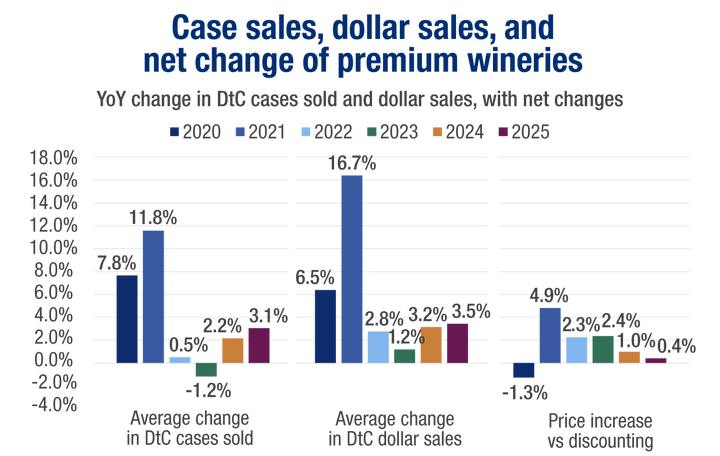
The chart details year-over-year change in DTC cases sold and dollar sales, with net changes.
2020
- Average change in DTC cases sold: 7.8%
- Average change in DTC dollar sales: 6.5%
- Price increase versus discounting: -1.3%
2021
- Average change in DTC cases sold: 11.8%
- Average change in DTC dollar sales: 16.7%
- Price increase versus discounting: 4.9%
2022
- Average change in DTC cases sold: 0.5%
- Average change in DTC dollar sales: 2.8%
- Price increase versus discounting: 2.3%
2023
- Average change in DTC cases sold: -1.2%
- Average change in DTC dollar sales: 1.2%%
- Price increase versus discounting: 2.4%
2024
- Average change in DTC cases sold: 2.2%
- Average change in DTC dollar sales: 3.2%
- Price increase versus discounting: 1.0%
2025
- Average change in DTC cases sold: 3.1%
- Average change in DTC dollar sales: 3.5%
- Price increase versus discounting: 0.4%
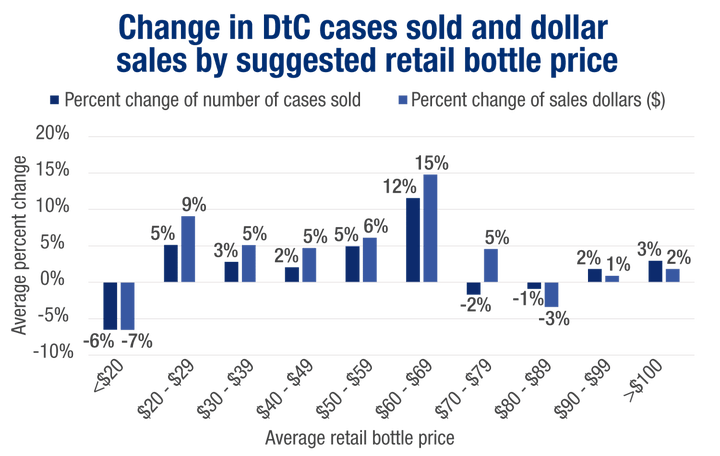
The chart details the percent change of cases sold and the percent change of sales dollars, with average percentages ranging from negative 10% to 20% and average retail bottle prices ranging from less than $20 to $100 or more.
The most significant positive change is in the $60 to $69 range, with a 12% change in the number of cases sold and a 15% change of sales dollars.
Higher-priced wines continue to perform better
Wineries competing on value are outperforming those competing on price alone. Dollar sales at higher price points are stable or growing, while lower price points are declining in both volume and revenue.
The DTC channel remains the dominant revenue source
Tasting room and wine club channels account for 72% of all winery DTC channel performance, concentrating both risk and opportunity.
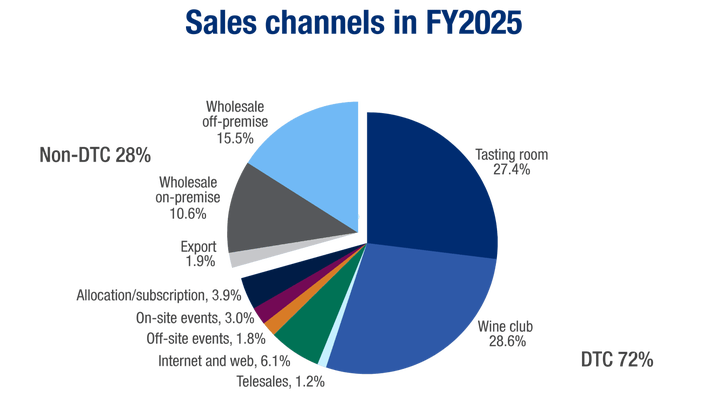
The chart illustrates the mix of sales channels used in the direct-to-consumer market in 2025, with DTC representing 72% and non-DTC representing 28%.
- Wine club: 28.6%
- Tasting room: 27.4%
- Wholesale, off-premise: 15.5%
- Wholesale, on-premise: 10.6%
- Internet and web: 6.1%
- Allocation or subscription: 3.9%
- On-site events: 3.0%
- Export: 1.9%
- Off-site events: 1.8%
- Telesales: 1.2%
Contributing author
Rob McMillan
EVP & Founder, Wine Division
As one of the US wine industry's top business analysts, Rob assesses current market conditions and provides a unique trends forecast in his annual report.

Timely Resources
Insights from our wine industry experts
Read the latest news and insights on key market indicators that impact what you do every day.

2026 State of the US Wine Industry Report
Survey results for this year's State of the US Wine Industry report show widening performance gaps across wineries as demand softens and consumer behavior shifts.

2025 State of the US Wine Industry Report
The 2025 wine report highlights digital sales strategies and the evolution of wine tasting rooms and provides valuable industry benchmarks to help guide your business.

2025 Direct-to-Consumer Wine Report
Explore how things like marketing tactics, pricing and inventory levels are affecting the evolution of the direct-to-consumer business model within the industry.
