Car buying trends and tips for 2026
Rising prices, evolving technology and shifting demand are making car buying more complex. This guide explores top car buying trends for 2026 and how they may affect affordability and long-term value.

People buy cars for many reasons—from practical transportation to personal preference or status—but it's always a significant financial commitment. Understanding today's car trends can help you make a more informed and financially sound choice.
Key takeaways
- Car prices remain elevated and are unlikely to decline significantly in 2026, making total cost of ownership more important than ever.
- Demand for used vehicles is rising, with lightly used cars often offering a balance between affordability and reliability.
- Financing decisions—from loan terms to down payments—can have a major impact on long-term costs, especially in a high-rate environment.
What to look for when buying a car today
Recognizing current market trends can help you evaluate your options more effectively. Here are top questions to consider as you begin your search.
Will car prices go down in 2026?
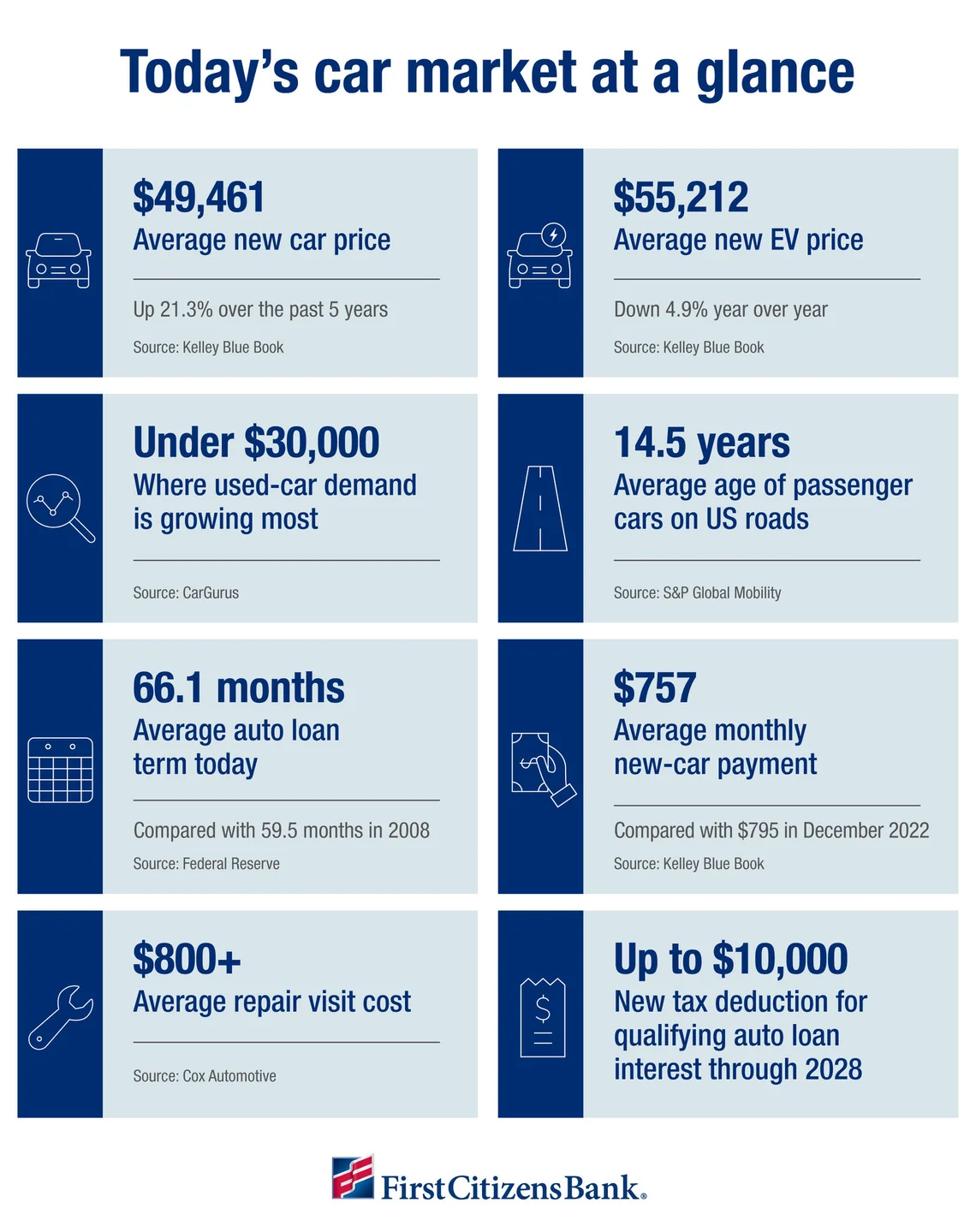
In the 2026 car market, prices are high by historical standards. According to Kelley Blue Book, the average price of a new car in April was $49,461—up 21.3% over the past 5 years.
Most industry watchers expect new-car pricing to remain elevated through the remainder of this year, with less negotiating power for buyers. This reflects a mix of structural and demand-driven factors.
- Higher production costs: Inflation, tariffs and global supply chain pressures will continue to raise manufacturing costs.
- Shift toward premium vehicles: Strong demand for SUVs, trucks and luxury models will keep average prices elevated.
- Fewer entry-level options: Some automakers are phasing out lower-cost models.
- Technology as a baseline: Advanced safety systems and infotainment features are now standard in many cases, contributing to higher prices.
What's driving demand for used cars?
The auto market is increasingly divided between premium and value-focused segments, and this dynamic is affecting demand for used cars.
On one end, the demand for new luxury vehicles among higher-income buyers remains strong and is expected to continue. One analyst predicts that luxury vehicle sales will grow 5.4% annually from 2026 to 2033.
At the same time, budget-conscious consumers are turning to older, higher-mileage vehicles to manage costs. According to a CarGurus report, most growth in used-car sales has been concentrated in vehicles priced less than $30,000—particularly those 7 years old or older.
Improved vehicle durability is supporting this shift. S&P Global Mobility reports that the average age of passenger cars on US roads is now about 14.5 years, expanding the pool of viable lower-cost options. This creates opportunity but also requires careful evaluation of maintenance and repair risks.
What's happening with EVs in 2026?
Electric vehicle, or EV, adoption is slowing in the US, due in part to the repeal of a federal tax credit—up to $7,500 for qualifying new EVs and $4,000 for qualifying used EVs—purchased after September 30, 2025. This credit was eliminated as part of the One Big Beautiful Bill Act, or OBBBA.
Some manufacturers are responding with incentives—averaging 13.8% of the transaction price—to support new EV sales. In fact, according to Kelley Blue Book, the average price of an EV declined 4.9% year over year as of April 2026—suggesting that incentives and increased competition may be improving affordability for some buyers.
Another bright spot is a growing supply of used EVs, driven by a wave of leases from 2023 to 2025 that are now maturing. By 2027, the cumulative total from just the 2023 to 2024 lease cohort is expected to exceed 650,000 vehicles. This trend may also improve affordability for EV buyers.
How is auto financing affecting affordability?
As vehicle prices rise, the cost of financing a car is becoming just as important as the purchase price.
Interest rates remain elevated, and lenders are still applying tight credit standards. As a result, more buyers are managing monthly payments by turning to longer loan terms. According to the Federal Reserve, average loan maturity was 66.1 months in December 2025. This compares to only 59.5 months in December 2008.
While longer terms can reduce monthly payments, they also increase total interest costs and delay equity buildup.
The good news is a new tax deduction introduced under the OBBBA may help offset some of these costs. Available through 2028, it allows certain individuals and businesses to deduct up to $10,000 in interest on loans for new vehicles assembled in the US.
The takeaway is that buying a car is as much a financial decision as a product choice in most instances. The steps below can help you navigate the process.
Car buying tips for 2026
A disciplined approach to car buying can help you avoid overextending your budget while still finding a vehicle that meets your needs. These steps provide a practical framework for navigating the process.
1Identify how much car you can afford
Start with a clear understanding of what you can realistically afford. Base this on your overall financial picture instead of only monthly payments. Stress test your budget by factoring in:
- Monthly loan payments
- Insurance premiums
- Fuel or charging costs
- Maintenance and repairs
- Taxes and registration fees
Rising repair costs are also an important consideration. Auto repair expenses have increased significantly, with the average visit now costing around $800 or more, according to data from Cox Automotive. For many households, an unexpected repair can create financial strain—especially when combined with a loan payment.
2Decide whether to buy a new or used car
New vehicles offer the latest technology, full warranty coverage and fewer immediate maintenance concerns. However, they come at a higher upfront cost and depreciate quickly—often losing a significant portion of their value within the first 5 years.
Used vehicles are generally more affordable and have already experienced the steepest depreciation. With today's vehicles lasting longer than in the past, well-maintained used cars can provide strong value. However, they may come with higher maintenance risks and fewer warranty protections.
As you evaluate options between new versus used cars, consider:
- The total cost of ownership instead of only the purchase price
- Expected maintenance and reliability
- Insurance costs, which are typically higher for new vehicles
- How long you plan to keep the car
In many cases, a lightly used vehicle that's 2 to 5 years old can offer a balance between cost savings and reliability.
3Review dealer add-ons carefully
Many dealerships offer optional products like interior coverage, prepaid maintenance plans, key replacement programs and electronics protection. While some buyers may find value in these offerings, they can add a significant amount to the total purchase price or amount financed.
Before agreeing to extras, consider your existing coverage, expected ownership period and financial risk tolerance. Examples of common dealer add-ons include:
- Extended warranties: Most new cars already have factory-backed coverage that lasts several years and covers many major components. A Consumer Reports survey found that many buyers paid more for extended coverage than they received in repair-related benefits.
- Protective coatings: Modern paint finishes, corrosion protection and interior materials are designed for long-term durability. Extra coatings or fabric treatments may provide limited value for many buyers.
- Wheel and tire protection: These plans may be more useful for vehicles with larger or low-profile tires that are more vulnerable to damage. Protection included in your auto insurance policy or manufacturer coverage may be enough.
4Make strategic financing choices
Financing plays a central role in overall affordability, so pay close attention to these decisions.
- Longer loan terms can reduce monthly payments but increase total interest paid over time. Choose the shortest term that fits comfortably within your budget rather than extending the loan to afford a higher-priced vehicle.
- Interest rates vary based on your credit score, and even a small difference in rate can significantly affect total cost. Check your credit score and take steps to improve it if needed before applying to help secure a more favorable rate.
- A larger down payment reduces the amount you need to finance and may improve your loan terms. It can also help protect against depreciation. Aim for at least 10% to 20% down or enough to avoid being underwater early in the loan.
In today's market, the structure of the loan matters as much as the price of the vehicle. Evaluate total loan cost—not just the monthly payment—and use a loan calculator to compare scenarios across terms and rates.
Timing matters
Timing won't outweigh factors like price, financing and total cost of ownership, but it may improve your negotiating position. While market conditions can vary, certain times of year often offer more favorable buying opportunities.
When is a good time to buy a new car?
New vehicles often see deeper discounts toward the end of the year as dealerships work to meet annual sales targets. The final days of any month may also provide added negotiating flexibility as dealers aim to hit monthly quotas.
When is a good time to buy a used car?
Used-car selection often increases early in the year as trade-ins rise after the holiday season. This can create more options for buyers.
The bottom line
The 2026 car market requires a more deliberate approach than in the past. Prices remain elevated, loan terms are an important factor and the selection of value-focused options is declining. By focusing on total cost of ownership and making disciplined financing decisions, you can choose a vehicle that supports your financial goals.
Find your rate
Save more when you finance your vehicle with a new auto loan.